Modeling Quantum State Evolution with Schrodinger's Equation

  • Thread starter Thread starter LCSphysicist
  • Start date Start date
  • Tags Tags
    Evolution
Click For Summary

Homework Help Overview

The discussion revolves around modeling quantum state evolution using Schrödinger's equation. Participants are exploring the formulation of the wave function and the resulting differential equations that describe the system's dynamics.

Discussion Character

  • Exploratory, Conceptual clarification, Mathematical reasoning

Approaches and Questions Raised

  • Participants are considering different forms of the wave function, such as ##\psi = \alpha |a_{0}\rangle + \beta |a_{1}\rangle##, and discussing the implications of using time-dependent Schrödinger equations. Questions about the validity of initial assumptions and the treatment of constants are raised.

Discussion Status

There are various approaches being discussed, with some participants suggesting different methods for solving the equations. Corrections to initial assumptions have been noted, and there is an ongoing exploration of the implications of these corrections on the problem setup.

Contextual Notes

Some participants question the treatment of constants and initial conditions, and there is mention of potential typos in the problem statement. The discussion reflects uncertainty about the correct application of the Schrödinger equation and the assumptions involved.

LCSphysicist
Messages
644
Reaction score
163
Homework Statement
.
Relevant Equations
.
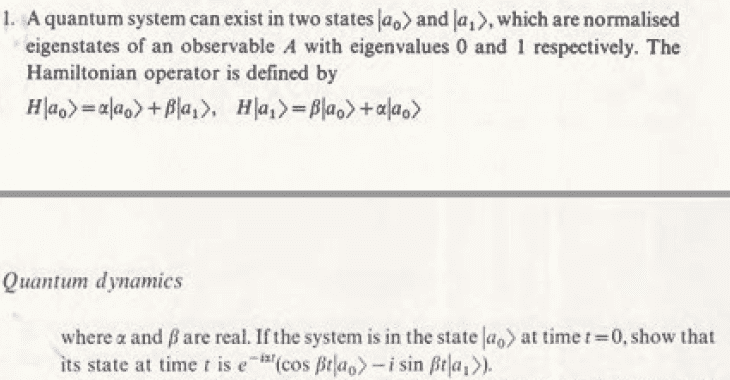
I am a little confused about how to solve it, probably it is easy but i didn't get it.
1610876763933.png


I thought that would be a good idea to work with ##\psi = \alpha |a_{0}\rangle + \beta |a_{1}\rangle## in the Schrödinger equation with time involved, so that we get a system of differential equations. $$d\alpha/dt = \alpha*a + \beta*b$$$$d\beta/dt = \alpha*r$$$$ \beta(0) = 0$$
(simplifying the notation, throwing the i and h to the other side, a b r constants)

But i am not sure if this is the best way, and if this is right. And the wolframalpha's solution of the system was not an easy one to manipulate, so i think i am wrong.
 

Attachments

  • 1610876407121.png
    1610876407121.png
    65.4 KB · Views: 147
Physics news on Phys.org
I would try ##| \psi(t)> = e^{-i\frac H h t}|a_0>## then play around with some Taylor expansion for the exponential and the trigonometric functions. Not sure it's the easiest way. It looks promising to me because you gat all this nested terms like ##H|a_0>##, ##HH|a_0> = H(\alpha|a_0> + \beta |a_1)## ecc...
 
Last edited:
LCSphysicist said:
Homework Statement:: .
Relevant Equations:: .

I am a little confused about how to solve it, probably it is easy but i didn't get it.

View attachment 276389

I thought that would be a good idea to work with ##\psi = \alpha |a_{0}\rangle + \beta |a_{1}\rangle## in the Schrödinger equation with time involved, so that we get a system of differential equations. $$d\alpha/dt = \alpha*a + \beta*b$$$$d\beta/dt = \alpha*r$$$$ \beta(0) = 0$$
(simplifying the notation, throwing the i and h to the other side, a b r constants)

But i am not sure if this is the best way, and if this is right. And the wolframalpha's solution of the system was not an easy one to manipulate, so i think i am wrong.
First, ##\alpha, \beta## are already given as constants, so you can't use them as ##\psi(t)##.

Second, are you using ##\hbar = 1## in this text?

Third, let's see the SDE for this system.

PS There's a typo in the question. It should be ##H|a_1 \rangle = \beta |a_0 \rangle + \alpha | a_1 \rangle##
 
Last edited:
With the above corrections, it all works out: using the SDE gives coupled first-order differential equations, solve (e.g. using second-order equations), apply initial conditions, gives the quoted solution.
 

Similar threads

Replies
46
Views
7K
  • · Replies 5 ·
Replies
5
Views
1K
  • · Replies 15 ·
Replies
15
Views
1K
Replies
5
Views
1K
  • · Replies 29 ·
Replies
29
Views
4K
  • · Replies 6 ·
Replies
6
Views
1K
Replies
2
Views
2K
  • · Replies 6 ·
Replies
6
Views
3K
  • · Replies 1 ·
Replies
1
Views
1K
  • · Replies 7 ·
Replies
7
Views
3K