Motion in Electric and Magnetic Fields -- (Uni Level Dynamics)

Click For Summary
SUMMARY

This discussion focuses on solving equations of motion in electric and magnetic fields, specifically addressing the dynamics of velocity components ##V_x## and ##V_y##. Participants identify a sign error in the expression for ##F_y## and emphasize the importance of differentiating the equations correctly. The final solutions derived include ##V_y(t) = A \sin(\omega t)## and ##V_x(t) = \frac{E_y}{B_z} - [\frac{E_y}{B_z} - u] \cos(\omega t)##, with the latter requiring careful simplification to avoid errors.

PREREQUISITES
  • Understanding of classical mechanics, specifically dynamics in electric and magnetic fields.
  • Familiarity with differential equations and their applications in physics.
  • Knowledge of vector calculus, particularly in the context of forces and motion.
  • Experience with harmonic motion and oscillatory systems.
NEXT STEPS
  • Study the derivation and application of Lorentz force equations in electromagnetic fields.
  • Learn about solving second-order differential equations, particularly in the context of simple harmonic motion.
  • Explore the relationship between electric fields, magnetic fields, and particle motion in physics.
  • Investigate the use of complex exponentials in solving oscillatory motion problems.
USEFUL FOR

Students and educators in physics, particularly those studying electromagnetism and dynamics, as well as anyone involved in solving motion equations in electric and magnetic fields.

SianRR
Messages
8
Reaction score
3
Homework Statement
When a charged particle of mass m and positive charge q moves with velocity ~v
in uniform electric and magnetic fields E~ and B~ it experiences a net force
F~ = q(E~ + ~v × B~ ) .

(a) A particle has an initial velocity u in the x direction. There is a magnetic field
Bz in the z direction and an electric field Ey in the y direction. Write down
the equations of motion and obtain expressions for the velocity components
vx(t) and vy(t)

hint: there are many ways to solve this, for instance differentiate one of the equations and then sub it into the other equation
Relevant Equations
F= q(E + v × B)
w=qBz/m
I've attached my attempt at a solution below, I thought integrating it would be the best way to go but I'm just getting so confused and could use some help. This isn't my first attempt at a solution either I've been working on this for just under two hours now.
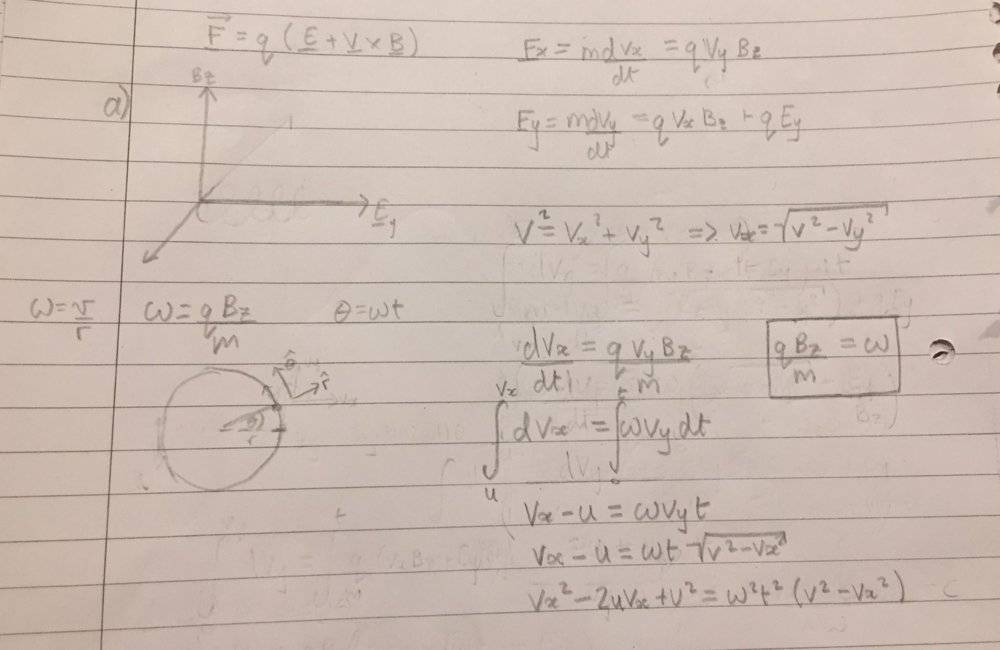
Dynamics Working.jpg
 
Physics news on Phys.org
Welcome to PF!

We ask that you type your work if possible rather than post pictures. It makes it easier for homework helpers to quote specific parts of your work.

I believe you have a sign error in your expression for ##F_y##. Check it.

When you integrated, you treated ##v_y## as a constant. But ##v_y## will change with time.

Try going with the hint. Your equation for ##F_x## may be written as ##\large \frac{d v_x}{dt} = \omega v_y##. Take the time derivative of this equation and combine with the equation for ##F_y##.
 
  • Like
Likes   Reactions: SianRR
TSny said:
Welcome to PF!

We ask that you type your work if possible rather than post pictures. It makes it easier for homework helpers to quote specific parts of your work.

I believe you have a sign error in your expression for ##F_y##. Check it.

When you integrated, you treated ##v_y## as a constant. But ##v_y## will change with time.

Try going with the hint. Your equation for ##F_x## may be written as ##\large \frac{d v_x}{dt} = \omega v_y##. Take the time derivative of this equation and combine with the equation for ##F_y##.
Ah thank you for replying, I’ll know next time to type my work thank you. I have a question though, I’m not sure about taking the time derivative of
##\large \frac{d v_x}{dt} = \omega v_y##.

Because I’d end up with accelerations, unless you mean I’d be able to sub in
##\large \frac{d v_y}{dt} ## and then rearrange and have just ##V_x## in the equation. Could I then integrate this or is it a case of homogeneous differential equations?

Thanks
 
SianRR said:
Ah thank you for replying, I’ll know next time to type my work thank you. I have a question though, I’m not sure about taking the time derivative of
##\large \frac{d v_x}{dt} = \omega v_y##.

Because I’d end up with accelerations, unless you mean I’d be able to sub in
##\large \frac{d v_y}{dt} ## and then rearrange and have just ##V_x## in the equation. Could I then integrate this or is it a case of homogeneous differential equations?

Thanks
Try differentiating both equations and see what you get. Maybe one component is easier to solve for than the other.
 
  • Like
Likes   Reactions: SianRR, TSny and etotheipi
PeroK said:
Try differentiating both equations and see what you get. Maybe one component is easier to solve for than the other.
I have done ##\frac {d^2V_x}{dt^2} = w\frac{V_y}{dt} ##
Then rearranging for ## \frac{V_y}{dt} ## I subbed that into the equation I have for ##F_y## and that leaves me with ##\frac{m}{w} \frac{d^2V_x}{dt^2} -qB_zV_x =qE_y ##

Can this then be solved by setting ##V_x=## to some exponential or a combination of sine or cosine?
 
SianRR said:
I have done ##\frac {d^2V_x}{dt^2} = w\frac{V_y}{dt} ##
Then rearranging for ## \frac{V_y}{dt} ## I subbed that into the equation I have for ##F_y## and that leaves me with ##\frac{m}{w} \frac{d^2V_x}{dt^2} -qB_zV_x =qE_y ##

Can this then be solved by setting ##V_x=## to some exponential or a combination of sine or cosine?

You shouldn't be prejudiced in favour of ##x##! What does the ##V_y## equation look like?
 
  • Like
Likes   Reactions: etotheipi
PeroK said:
You shouldn't be prejudiced in favour of ##x##! What does the ##V_y## equation look like?

Okay using the same method as above and assuming that ##E_y## is constant (because it is a uniform field?) so that differentiating means that term goes to zero. Subbing into the ##F_x## equation I get ##\frac{d^2V_y}{dt^2} = w^2V_y ##
 
SianRR said:
Okay using the same method as above and assuming that ##E_y## is constant (because it is a uniform field?) so that differentiating means that term goes to zero. Subbing into the ##F_x## equation I get ##\frac{d^2V_y}{dt^2} = w^2V_y ##

It looks like you still have the sign error from the cross product. You ought to check that.

TSny said:
I believe you have a sign error in your expression for ##F_y##. Check it.

Once you sort that out, you might already know the solution to that equation.
 
  • Like
Likes   Reactions: SianRR
PeroK said:
It looks like you still have the sign error from the cross product. You ought to check that.

Once you sort that out, you might already know the solution to that equation.

Ah okay so fixing that I have a negative in front of the ##w^2 V_y##
Which looks a lot like a form of simple harmonic motion.

I don't want to come across as silly for asking this, but I'm still not too sure what my actual final equations of ##V_y(t) ## and ##V_x(t)## should look like.
But thanks really for all your help so far its much appreciated
 
  • #10
SianRR said:
Ah okay so fixing that I have a negative in front of the ##w^2 V_y##
Which looks a lot like a form of simple harmonic motion.

I don't want to come across as silly for asking this, but I'm still not too sure what my actual final equations of ##V_y(t) ## and ##V_x(t)## should look like.
But thanks really for all your help so far its much appreciated

Now you have ##\frac{d^2V_y}{dt^2} = -w^2V_y ##

You can probably just write down the solution, especially using the initial condition that ##V_y(0) = 0##.

Then you can get ##V_x## from this. Hint: don't solve the equation for ##\frac{d^2V_x}{dt^2}##. Look for a quicker way.

Finally, you'll have to determine the amplitude of the oscillations, using ##V_x(0)## and the constants ##E_y## and ##B_z##.
 
  • Like
  • Informative
Likes   Reactions: SianRR and sysprog
  • #11
PeroK said:
Now you have ##\frac{d^2V_y}{dt^2} = -w^2V_y ##

You can probably just write down the solution, especially using the initial condition that ##V_y(0) = 0##.

Then you can get ##V_x## from this. Hint: don't solve the equation for ##\frac{d^2V_x}{dt^2}##. Look for a quicker way.

Finally, you'll have to determine the amplitude of the oscillations, using ##V_x(0)## and the constants ##E_y## and ##B_z##.

Okay I'm getting that ##V_y = e^{\pm iwt} ##
So I want to write this as ##V_y(t)=Ce^{+iwt} + De^{-iwt}## where C and D are some constants. That from the initial conditon that ##V_y(0)=0## that C=-D

##V_y(t)=Ce^{+iwt} -Ce^{-iwt}## , using Euler's expansion
##V_y(t)=C[cos(wt)+isin(wt)-cos(wt)+isin(wt)] ## therefore
##V_y(t)=2Cisin(wt)## and we can just say A=2Ci
##V_y(t)=Asin(wt)##

Is this the correct method?

For ##V_x## I subbed the first derivative of ##V_y## into my ##F_y## equation
##V_x(t)=\frac{E_y}{B_z} - Acos(wt)## , and in the question we are told it has an intial velocity u in the x direction so ##V_x(0)=u##
Then that leaves me with ##A=\frac{E_y}{B_z}-u## which I'm not too confident about
 
  • Like
Likes   Reactions: PeroK
  • #12
SianRR said:
Okay I'm getting that ##V_y = e^{\pm iwt} ##
So I want to write this as ##V_y(t)=Ce^{+iwt} + De^{-iwt}## where C and D are some constants. That from the initial conditon that ##V_y(0)=0## that C=-D

##V_y(t)=Ce^{+iwt} -Ce^{-iwt}## , using Euler's expansion
##V_y(t)=C[cos(wt)+isin(wt)-cos(wt)+isin(wt)] ## therefore
##V_y(t)=2Cisin(wt)## and we can just say A=2Ci
##V_y(t)=Asin(wt)##

Is this the correct method?

For ##V_x## I subbed the first derivative of ##V_y## into my ##F_y## equation
##V_x(t)=\frac{E_y}{B_z} - Acos(wt)## , and in the question we are told it has an intial velocity u in the x direction so ##V_x(0)=u##
Then that leaves me with ##A=\frac{E_y}{B_z}-u## which I'm not too confident about

You should be more confident.

To get ##V_y##, you could have chosen the sinuisodal solution (rather than the complex exponential):

##V_y(t) = A\sin(\omega t) + B\cos(\omega t)##

Where ##V_y(0) = 0 \ \Rightarrow \ B = 0##.
 
  • #13
PeroK said:
You should be more confident.

To get ##V_y##, you could have chosen the sinuisodal solution (rather than the complex exponential):

##V_y(t) = A\sin(\omega t) + B\cos(\omega t)##

Where ##V_y(0) = 0 \ \Rightarrow \ B = 0##.

Ah okay but are my solutions;
##V_x(t)=\frac{E_y}{B_z}[1-ucos(wt)]##
##V_y(t)=[\frac{E-y}{B_z}-u]sin(wt)##
correct? or what we'd expect?
 
  • #14
SianRR said:
Ah okay but are my solutions;
##V_x(t)=\frac{E_y}{B_z}[1-ucos(wt)]##
##V_y(t)=[\frac{E-y}{B_z}-u]sin(wt)##
correct? or what we'd expect?

##V_y## is correct, but you messed up ##V_x## trying to simplify it too much. As you can see by trying ##t = 0## in your equation. Everything in post #11 was right.
 
  • Like
Likes   Reactions: SianRR
  • #15
PeroK said:
##V_y## is correct, but you messed up ##V_x## trying to simplify it too much. As you can see by trying ##t = 0## in your equation. Everything in post #11 was right.
Ah yeah, ##V_x=\frac{E_y}{B_z}-[\frac{E_y}{B_z}-u]cos(wt)##

Thanks again for all your help!
 
  • Like
Likes   Reactions: berkeman and PeroK

Similar threads

Replies
11
Views
3K
Replies
16
Views
2K
  • · Replies 3 ·
Replies
3
Views
2K
  • · Replies 11 ·
Replies
11
Views
2K
  • · Replies 5 ·
Replies
5
Views
1K
  • · Replies 3 ·
Replies
3
Views
2K
Replies
8
Views
2K
  • · Replies 5 ·
Replies
5
Views
1K
  • · Replies 5 ·
Replies
5
Views
2K
Replies
1
Views
2K