ivanyo
- 5
- 0
Hi guys/gals,
First post here - in need of some desperate last minute help. Today is my last day to study and I will have my final exam tommorow. I've been doing past papers all day, and there a few questions I have no idea/never seen before in my course material.
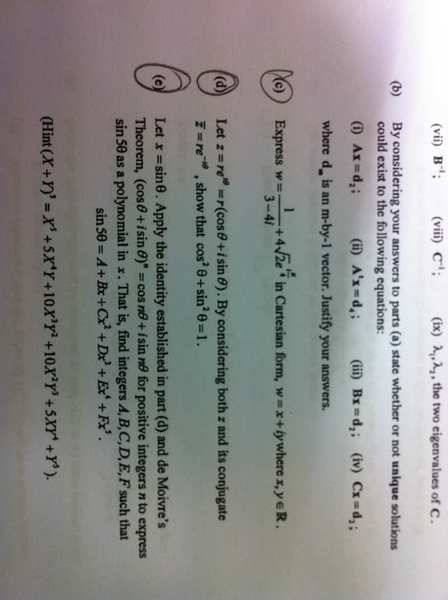
Part (c) I have no idea what to do. I know I need to convert the 4sqrt2 into Cartesian, but I have no idea how...
Part (d) I'm very close to getting, but I end up getting -cos^2(theta) + (-1) sin^2(theta) = 0
Part (e) is related to part (d), so I'm not too sure at the moment.
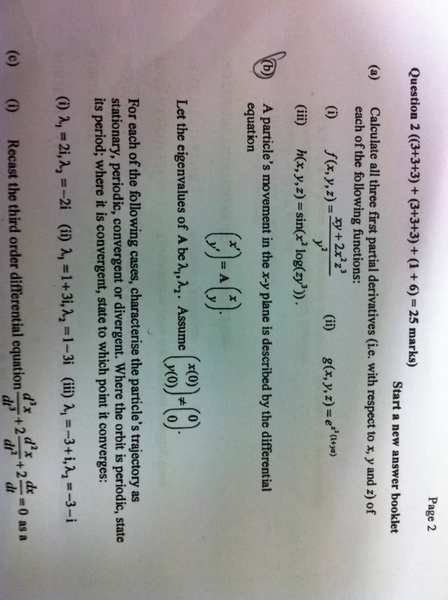
I know that there is the rule that when there is a matrix A, A1v1=A2v2. However, these eigenvalues are imaginary, so how do I calculate the eigenvectors?
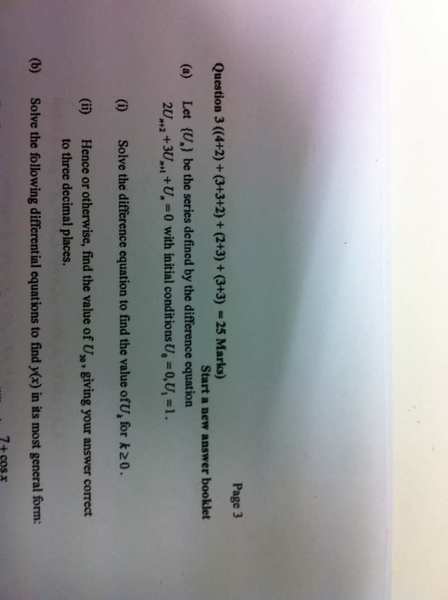
In a)i) of this question, I calculated -1/2 and -1 as the values of M (i.e. when you let Un=kM^n). I just want to double check these are correct, and also would like somebody to guide me in part ii). I have no idea how to calculate this using the results of part i)MANY MANY MANY thanks to whoever is able to help me out here. I think I may have already failed 1 subject this semster, and do not want to make it 2.
Cheers,
EDIT- extremely sorry for the image size, I don't know how to re-frame it. it's a photo from my phone haha
First post here - in need of some desperate last minute help. Today is my last day to study and I will have my final exam tommorow. I've been doing past papers all day, and there a few questions I have no idea/never seen before in my course material.
Part (c) I have no idea what to do. I know I need to convert the 4sqrt2 into Cartesian, but I have no idea how...
Part (d) I'm very close to getting, but I end up getting -cos^2(theta) + (-1) sin^2(theta) = 0
Part (e) is related to part (d), so I'm not too sure at the moment.
I know that there is the rule that when there is a matrix A, A1v1=A2v2. However, these eigenvalues are imaginary, so how do I calculate the eigenvectors?
In a)i) of this question, I calculated -1/2 and -1 as the values of M (i.e. when you let Un=kM^n). I just want to double check these are correct, and also would like somebody to guide me in part ii). I have no idea how to calculate this using the results of part i)MANY MANY MANY thanks to whoever is able to help me out here. I think I may have already failed 1 subject this semster, and do not want to make it 2.
Cheers,
EDIT- extremely sorry for the image size, I don't know how to re-frame it. it's a photo from my phone haha