New High Performance Ultra-wide Angle Lenses - Comments

Click For Summary
SUMMARY

The forum discussion centers on advancements in ultra-wide angle lens technology, particularly focusing on the Samyang 14mm f/2.8 lens, which is praised for its quality in astrophotography at an affordable price of approximately AU$360. Key trends in lens development include larger apertures, reduced size and weight, decreased chromatic aberrations, and improved image stabilization. The conversation also touches on innovative concepts such as 3-D Point Spread Function (PSF) engineering, exemplified by the Nikkor 58/1.4 lens. Additionally, the discussion clarifies that ultra-wide lenses are available for various sensor sizes, not just 35mm.

PREREQUISITES
  • Understanding of lens specifications, including focal length and aperture.
  • Familiarity with optical concepts such as chromatic aberration and image stabilization.
  • Knowledge of different lens types, including rectilinear and fisheye lenses.
  • Basic awareness of astrophotography techniques and requirements.
NEXT STEPS
  • Research advancements in optical materials and their impact on lens performance.
  • Explore the concept of 3-D PSF engineering and its applications in photography.
  • Learn about the differences between rectilinear and fisheye lenses, including their uses in various photography styles.
  • Investigate the latest ultra-wide angle lenses available for medium and large format cameras.
USEFUL FOR

Photographers, optical engineers, and anyone interested in the latest developments in lens technology, particularly those focusing on astrophotography and ultra-wide angle photography.
Andy Resnick
Science Advisor
Education Advisor
Insights Author
Messages
7,719
Reaction score
3,872
Andy Resnick submitted a new PF Insights post

New High Performance Ultra-wide Angle Lenses
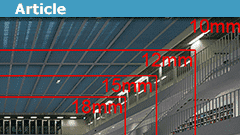
cameralense.png


Continue reading the Original PF Insights Post.
 
  • Like
Likes   Reactions: davenn and Greg Bernhardt
Computer science news on Phys.org
Andy, curious if you have ideas on where lens technology goes from here?
 
Andy Resnick said:
Andy Resnick submitted a new PF Insights post

nice write-up, Andy, thanks :)

my goto UW angle lens is my Samyang 14mm, f2.8

upload_2017-3-24_12-27-35.png
I have been quite pleased with it's quality considering its affordable ~ AU$360 price tag
particularly on wide angle astrophotography where pinpoint light sources from stars gives a good test
 
  • Like
Likes   Reactions: Andy Resnick
Greg Bernhardt said:
Andy, curious if you have ideas on where lens technology goes from here?

Good question- although predicting the future is a fool's errand :) In general the trend is to larger apertures, reduced size/weight, decreased chromatic aberrations, and improved accutance. All of this is contingent on developments in optical materials- mainly glass- and the ability to grind aspheres. Incorporation of image stabilization is increasing as well. These developments all fall under "improved performance of existing lens designs".

Something more 'exotic' I'm interested in is 3-D PSF engineering. That is, rather than simply design improved performance in the focal plane, the entire PSF can be designed- at least that's what is claimed for the new Nikkor 58/1.4. It's an interesting idea.
 
  • Like
Likes   Reactions: Greg Bernhardt
Algr said:
I take it this article is only about cameras with 35 mm size sensors? Lenses with 180° already exist on devices that pair two of them to image 360° video.

http://www.bestbuy.com/site/ricoh-t...ffcode=pg174715&ksdevice=c&lsft=ref:212,loc:2

I didn't mean to implicitly discuss only 35mm-sized sensors; there are ultra-wide lenses for medium and large format sizes as well (the Super Angulon and Grandagon series of lenses, for example).

The Theta S and similar cameras (KeyMission 360, for example) use multiple sensors, and I also distinguished between fisheye lenses that have large distortion from rectilinear lenses, which do not. I focused on the development of new rectilinear ultrawide lenses.
 
Given that lens distortion can now be removed digitally, I wonder if it is better to do that then to use extra glass to make likes straight optically?
 
Funny thing. I was very chuffed with how well my Pentax 14mm lens performed but, on the other hand, I was disappointed that the pictures don't 'look' wide angle. It's almost as if I need to give them a digital nudge to get that wide angle effect. It's just the same as people who claim to like vinyl records. I guess.

BTW, good article, @Andy Resnick.
 

Similar threads

  • · Replies 1 ·
Replies
1
Views
2K
  • · Replies 5 ·
Replies
5
Views
2K
  • · Replies 14 ·
Replies
14
Views
3K
  • · Replies 2 ·
Replies
2
Views
2K
  • · Replies 2 ·
Replies
2
Views
3K
  • · Replies 70 ·
3
Replies
70
Views
32K
  • · Replies 14 ·
Replies
14
Views
2K
  • · Replies 11 ·
Replies
11
Views
3K
  • · Replies 16 ·
Replies
16
Views
4K
  • · Replies 11 ·
Replies
11
Views
2K