Thomass
Hi,
While solving homework problems, I start by defining a positive-y direction and a positive-x direction. Let's say up and to the right. Until now, I've applied this same rule to all objects in each problem, no matter the direction the object moves. But it seems I have not understood this fully.
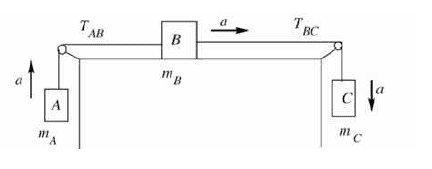
While solving the problem for the attached picture, I had to define a positive direction up for box A, and a positive direction down for box C to get the right answer. Is the positive direction decided by which direction the object moves in constant acceleration problems like this?
While solving homework problems, I start by defining a positive-y direction and a positive-x direction. Let's say up and to the right. Until now, I've applied this same rule to all objects in each problem, no matter the direction the object moves. But it seems I have not understood this fully.
While solving the problem for the attached picture, I had to define a positive direction up for box A, and a positive direction down for box C to get the right answer. Is the positive direction decided by which direction the object moves in constant acceleration problems like this?