Nodal Analysis Clarification - What are some conventions?

Click For Summary

Discussion Overview

The discussion revolves around the conventions and methodologies for solving nodal analysis problems in Electrical Engineering, particularly focusing on the application of Kirchhoff's Current Law (KCL). Participants share their experiences with a specific homework problem, express confusion over current directions, and seek clarification on best practices for setting up equations.

Discussion Character

  • Homework-related
  • Technical explanation
  • Conceptual clarification
  • Debate/contested

Main Points Raised

  • One participant reports consistent discrepancies between their calculated voltages and currents and those provided by simulation software, despite multiple attempts to solve the problem.
  • Another participant suggests that mixing current directions in KCL equations can lead to errors and recommends choosing a consistent direction for all terms in the equations.
  • Some participants propose that it is acceptable to treat each node independently regarding the direction of current flow, as long as consistency is maintained within individual node equations.
  • There is a discussion about the implications of current direction on Ohm's Law formulas, with participants questioning how to reflect chosen current directions in their calculations.
  • One participant mentions a personal habit of always choosing "out" as the direction for their equations, which they find simplifies their approach.

Areas of Agreement / Disagreement

Participants express differing opinions on the best practices for setting up nodal equations, particularly regarding the treatment of current directions. There is no consensus on a single method, as various approaches are discussed and debated.

Contextual Notes

Some participants note potential sign issues and the importance of maintaining consistent current directions, but specific mathematical errors are not resolved due to the lack of posted work. The discussion highlights the complexity of applying KCL in practice and the need for careful attention to detail.

jpruim
Messages
6
Reaction score
0
I've been assigned the following problem for homework in my Electrical Engineering class:
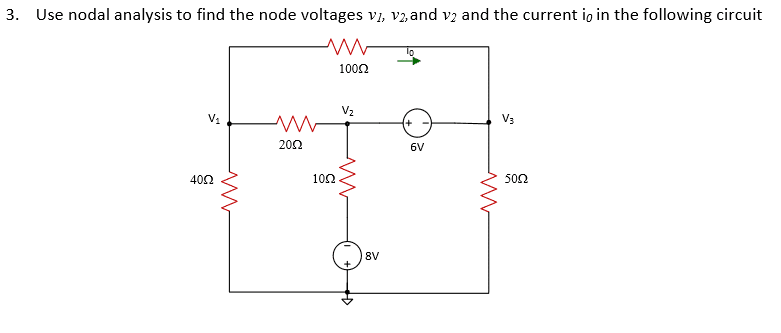
xhx0tf3.png

*Note, the duplicate v2 is supposed to be v3.

But I keep getting
v1 = 4.10V
v2 = 4.81V
v3 = -1.19V
and
i0 = 52.9mA

Every simulator I've put this into says it's wrong, yet I've attempted solving it about 12 times (consuming almost all my remaining notebook pages) and still get the same answers.

I can't post a copy of my written work since I currently don't have access to a scanner. However, I drew in arbitrary current directions and made sure to respect them for all calculations using KCL.

I have no idea what I'm doing wrong at this point. My professor just seems to get agitated when I ask what the convention is and his general response is "just do the current thing" or something vague like that. I don't think anyone in my class actually understands how to do this (except the class-repeaters).

I've been told by my friend to "always assume currents flow into a node. Ignore what's drawn. they always flow into nodes", but I've tried that at least 4 times. I've never gotten the answers my simulator provides me, regardless of how I solve it.

Is there any "convention" to solving these? Can anyone tell me what error I'm making so I don't make the same error on my exam?
 
Physics news on Phys.org
jpruim said:
I've been assigned the following problem for homework in my Electrical Engineering class:
xhx0tf3.png

*Note, the duplicate v2 is supposed to be v3.

But I keep getting
v1 = 4.10V
v2 = 4.81V
v3 = -1.19V
and
i0 = 52.9mA

Every simulator I've put this into says it's wrong, yet I've attempted solving it about 12 times (consuming almost all my remaining notebook pages) and still get the same answers.

I can't post a copy of my written work since I currently don't have access to a scanner. However, I drew in arbitrary current directions and made sure to respect them for all calculations using KCL.

I have no idea what I'm doing wrong at this point. My professor just seems to get agitated when I ask what the convention is and his general response is "just do the current thing" or something vague like that. I don't think anyone in my class actually understands how to do this (except the class-repeaters).

I've been told by my friend to "always assume currents flow into a node. Ignore what's drawn. they always flow into nodes", but I've tried that at least 4 times. I've never gotten the answers my simulator provides me, regardless of how I solve it.

Is there any "convention" to solving these? Can anyone tell me what error I'm making so I don't make the same error on my exam?
We can't tell you what you are doing wrong, since you didn't post your work.

It would help if you included your nodal equations or KCL equations. You shouldn't need a scanner for that.
 
IqZxOZu.jpg


There we go. the lighting in my room is terrible and I wasn't sure if a picture would turn out correctly. This one used directions I arbitrarily assigned and calculated from.
 
At node 2 you are considering a current in from the left, a current in from the right, and a current exiting downwards.

The current into node 2 from the right can be seen to be the sum of the two other currents entering node 3, viz., (V1-V3)/100 + (0-V3)/50[/color]
 
I can see at least a couple of sign issues in your work. But the main thing is that you're making your life difficult and prone to errors by mixing currents flowing in and flowing out of a node in the same KCL equation. This can be done, but it takes a lot of concentration to keep all the signs straight.

A better approach is to pick one direction, either flowing in or flowing out of the node, and write each term accordingly. That way every term is added, never subtracted. The single exception is for current sources where they dictate the current direction; Then you need to be careful of the sign of the term so that it matches the "in" or "out" paradigm that you've chosen.

In the sixth line of your work you transported the "-12" to the RHS but didn't change the sign. In the next line where you write the v2 node equation you've mixed up the current directions so the sum is unlikely to be zero. And in fact I can confirm that the result is not a correct node equation.
 
gneill said:
I can see at least a couple of sign issues in your work. But the main thing is that you're making your life difficult and prone to errors by mixing currents flowing in and flowing out of a node in the same KCL equation. This can be done, but it takes a lot of concentration to keep all the signs straight.

A better approach is to pick one direction, either flowing in or flowing out of the node, and write each term accordingly. That way every term is added, never subtracted. The single exception is for current sources where they dictate the current direction; Then you need to be careful of the sign of the term so that it matches the "in" or "out" paradigm that you've chosen.

In the sixth line of your work you transported the "-12" to the RHS but didn't change the sign. In the next line where you write the v2 node equation you've mixed up the current directions so the sum is unlikely to be zero. And in fact I can confirm that the result is not a correct node equation.
When you say to pick one direction, I should respect those defined directions at other nodes they affect (ex. if I say current flows into v1 from v2, I have to say it flows out of v2 in my KCL equation for v2 [subtracting it instead of adding it]), or can I sum all the currents at each node?
 
jpruim said:
When you say to pick one direction, I should respect those defined directions at other nodes they affect (ex. if I say current flows into v1 from v2, I have to say it flows out of v2 in my KCL equation for v2 [subtracting it instead of adding it]), or can I sum all the currents at each node?
You can treat every node independently with regards to choosing a direction paradigm. Multiplying an equation through by a constant doesn't change the equation, and -1 is a perfectly good constant :smile:

So you can write "in" equations for every node, or "out" equations for every node, or even a mixture. But be consistent for individual nodes.
 
gneill said:
You can treat every node independently with regards to choosing a direction paradigm. Multiplying an equation through by a constant doesn't change the equation, and -1 is a perfectly good constant :smile:

So you can write "in" equations for every node, or "out" equations for every node, or even a mixture. But be consistent for individual nodes.

When respecting that direction, I assume I also have to reflect it in my ohm's law formulas? (ex. if I say all currents are flowing into v2, I would have to consider v2 as the "lower potential" and v1, v3 as "higher potential" [v1 - v2/20] and so on?)
 
jpruim said:
When respecting that direction, I assume I also have to reflect it in my ohm's law formulas? (ex. if I say all currents are flowing into v2, I would have to consider v2 as the "lower potential" and v1, v3 as "higher potential" [v1 - v2/20] and so on?)
Right.

Personally (my own habit) is to always choose "out" as my direction of choice. So if I'm writing an equation for node "v1", every term that's not a fixed current will have the form ##\frac{v1 - <stuff>}{<stuff>}##.
 
  • #10
gneill said:
Right.

Personally (my own habit) is to always choose "out" as my direction of choice. So if I'm writing an equation for node "v1", every term that's not a fixed current will have the form ##\frac{v1 - <stuff>}{<stuff>}##.

Ah. That helps. When it was explained to me, I was told I had to keep the current directions constant, so that's why I have the mix of ins and outs, but knowing I can use just addition or just subtraction is very helpful.
 

Similar threads

  • · Replies 7 ·
Replies
7
Views
2K
  • · Replies 2 ·
Replies
2
Views
2K
  • · Replies 1 ·
Replies
1
Views
2K
  • · Replies 15 ·
Replies
15
Views
4K
  • · Replies 5 ·
Replies
5
Views
3K
  • · Replies 4 ·
Replies
4
Views
4K
Replies
15
Views
3K
  • · Replies 4 ·
Replies
4
Views
2K
  • · Replies 4 ·
Replies
4
Views
2K
  • · Replies 6 ·
Replies
6
Views
2K