Non-conservative work energy theorem and potential energy

Click For Summary

Discussion Overview

The discussion revolves around the application of the non-conservative work-energy theorem in a scenario involving a block being pushed up a ramp. Participants explore the calculations of work done by friction and the resulting potential energy, examining the discrepancies between calculated values and theoretical expectations.

Discussion Character

  • Exploratory, Technical explanation, Debate/contested

Main Points Raised

  • One participant presents a problem involving a block on a ramp, calculating work done by friction and potential energy, leading to a discrepancy between their calculations and the expected potential energy using mgh.
  • Another participant suggests that there is an additional source of energy not accounted for in the initial calculations.
  • A third participant emphasizes that friction is not the only force acting on the block, implying that other forces must be considered to understand the situation fully.
  • A later reply acknowledges a mistake in the initial reasoning, indicating a realization of the oversight regarding energy sources.

Areas of Agreement / Disagreement

Participants do not reach a consensus, as there are multiple competing views regarding the forces acting on the block and the energy considerations involved in the scenario.

Contextual Notes

The discussion highlights potential limitations in the initial problem setup, including the omission of the energy input from the force pushing the block and the need to consider all forces acting on the block.

Who May Find This Useful

Readers interested in the applications of the work-energy theorem, energy conservation principles, and the role of non-conservative forces in mechanical systems may find this discussion relevant.

blueblast
Here is problem I quickly made up:

Suppose there is a ramp with a height of 6 meters and length of 12 meters. A block of 5 kg is pushed up to the top of the ramp with a constant velocity. The force of friction is 15 N.

Here's the confusion:

By using the non-conservative force work energy theorem, Work done by friction(Wf) = (KEf-KEi) + (PEf-PEi).

Since the block is pushed up at a constant velocity, the change in KE is zero. And since the block start from the ground, PEi is zero. So, Wf = PEf. Wf = friction * distance = 15 N * 12 meters = 180. So PEf = 180.

However, mgh says that potential energy is 5 kg * 6 meters * 9.8 m/s^2 =294.

Could someone please tell me where I am wrong? A diagram of the problem is attached just in case my words weren't clear.
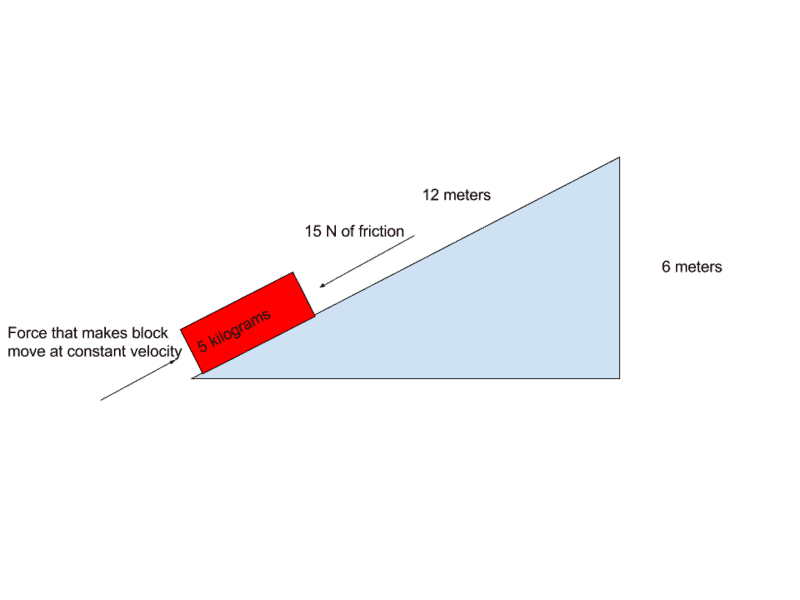
Untitled drawing (3).png
 

Attachments

  • Untitled drawing (3).png
    Untitled drawing (3).png
    4.9 KB · Views: 1,852
Physics news on Phys.org
blueblast said:
Since the block is pushed up
That sounds like a source of energy that you have not accounted for.
 
Friction is not the only force acting on the block. What makes the block to go up the ramp?
 
jbriggs444 said:
That sounds like a source of energy that you have not accounted for.
Ah, I see my mistake now. Thanks!
 

Similar threads

  • · Replies 4 ·
Replies
4
Views
3K
  • · Replies 54 ·
2
Replies
54
Views
7K
  • · Replies 77 ·
3
Replies
77
Views
6K
  • · Replies 31 ·
2
Replies
31
Views
4K
  • · Replies 65 ·
3
Replies
65
Views
6K
  • · Replies 2 ·
Replies
2
Views
2K
  • · Replies 6 ·
Replies
6
Views
3K
  • · Replies 6 ·
Replies
6
Views
2K
  • · Replies 24 ·
Replies
24
Views
5K
  • · Replies 7 ·
Replies
7
Views
2K