Nuclear Macroscopic cross-section

Join the discussion
Ask a follow-up here, or get your own question answered by working scientists, mathematicians and engineers — people, not an autocomplete.
Real named experts · corrections over time · the nuance an AI answer skips
5 replies · 2K views
badvot
Messages
5
Reaction score
1
Homework Statement
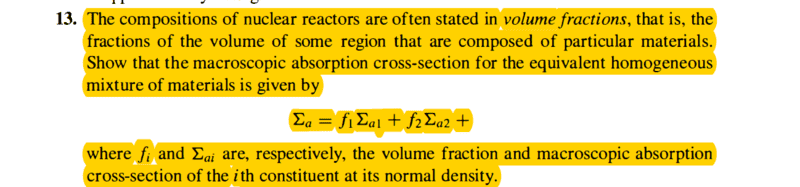
Calculate the macroscopic cross section using volume fractions
Relevant Equations
Macroscopic nuclear cross section
This question is in the book " Introduction to nuclear engineering by Lamarsh" Chapter3:
Screenshot 2024-05-03 210913.png

I think it's pretty basic but I couldn't find the proper way to prove it, and now I even suspect that it's not a correct question.
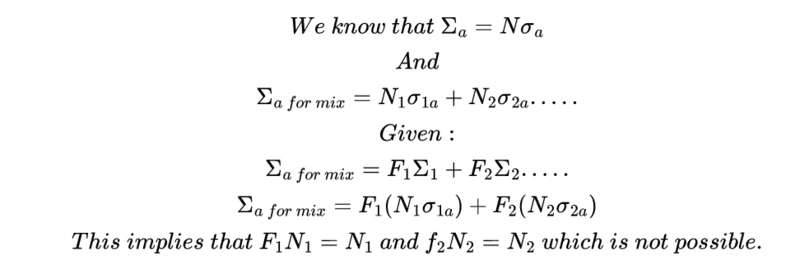
My attempt solution:

Screenshot 2024-05-03 211748.png


I would very much appreciate your help. Thanks in advance.
 
Reply
  • Like
Likes   Reactions: berkeman
Physics news on Phys.org
You need to distinguish between the number density ##N_i^{(mix)}## of constituent ##i## in the mixture and the number density ##N_i^{(norm)}## of constituent ##i## at its normal density.

How is ##N_i^{(mix)}## related to ##N_i^{(norm)}## and ##f_i##?

You are asked to show, $$\Sigma_a^{(mix)} = f_1 \Sigma_{a1}^{(norm)} + f_2 \Sigma_{a2}^{(norm)} + ...$$
 
Reply
  • Informative
Likes   Reactions: badvot
Thank you so much. I think I get it now, and here is my understanding:
If we assume two species (x,y)
$$\Sigma_{mix}= \frac{No\ of\ X\ atoms}{Volume\ of\ X} \times \frac{Volume\ of\ X}{Volume\ of\ X+Y} + \frac{No\ of\ Y\ atoms}{Volume\ of\ Y} \times \frac{Volume\ of\ Y}{Volume\ of\ X+Y}$$
 
badvot said:
Thank you so much. I think I get it now, and here is my understanding:
If we assume two species (x,y)
$$\Sigma_{mix}= \frac{No\ of\ X\ atoms}{Volume\ of\ X} \times \frac{Volume\ of\ X}{Volume\ of\ X+Y} + \frac{No\ of\ Y\ atoms}{Volume\ of\ Y} \times \frac{Volume\ of\ Y}{Volume\ of\ X+Y}$$
The left side of your equation, ##\Sigma_{mix}##, is the macroscopic absorption cross-section of the mixture. This has the dimension of inverse length. However, the right side of your equation has the dimension of inverse volume.

Also, you would expect ##\Sigma_{mix}## to depend on the microscopic absorption cross-sections ##\sigma_{a1}## and ##\sigma_{a2}## of the two species. However, these do not appear on the right side.
 
Reply
  • Like
Likes   Reactions: badvot
Oh, I guess I was so enthusiastic to write the answer that I forgot to include the microscopic cross-section for each species :oldbiggrin:
$$\Sigma_{mix}= \frac{No\ of\ X\ atoms}{Volume\ of\ X} \times
\frac{Volume\ of\ X}{Volume\ of\ X+Y} \times \sigma_{X} + \frac{No\ of\ Y\ atoms}{Volume\ of\ Y} \times \frac{Volume\ of\ Y}{Volume\ of\ X+Y} \times \sigma_{Y}$$
The volume fractions are those below, while the rest of the terms ##\sigma \times \frac{No\ of\ atoms}{Volume}## equal the ##\Sigma_{a}^{(norm)}## for each species
$$\frac{Volume\ of\ X}{Volume\ of\ X+Y} =F_{X}$$
$$\frac{Volume\ of\ Y}{Volume\ of\ X+Y} =F_{Y}$$
The units check out
$$cm^{-1}= \frac{\#}{cm^{3}} \times \frac{cm^{3}}{cm^{3}} \times cm^{2} + \frac{\#}{cm^{3}} \times \frac{cm^{3}}{cm^{3}} \times cm^{2} $$