Observing objects moving close to light speed

Click For Summary

Discussion Overview

The discussion revolves around the observations made by an observer at Point A regarding a spherical light source moving at near light speed in various scenarios. The scenarios include the light source moving in circular and linear paths, and the effects of time dilation and light travel time on the observer's perception of the light's motion. The scope includes conceptual reasoning and technical explanations related to relativistic effects.

Discussion Character

  • Exploratory
  • Technical explanation
  • Debate/contested

Main Points Raised

  • In Problem A, the original poster (OP) suggests that the observer at Point A sees nothing for 1 year, followed by light moving in a straight line for about a year before disappearing. Some participants challenge this interpretation, arguing that the light should appear to move in a circular arc instead.
  • In Problem B, the OP claims the observer sees light moving in a straight line appearing to decelerate for about 1.41 years. Some participants find this answer acceptable.
  • In Problem C, the OP states that the observer sees light moving away in a straight line appearing to decelerate for 2 years. This point is also generally accepted by other participants.
  • In Problem D, the OP provides a series of observations regarding the clocks of the observer and the light source. Some participants note that the OP fails to consider time dilation in their calculations, while others point out inconsistencies in the OP's reasoning.
  • Participants discuss the implications of the light source moving in a circular arc versus a straight line, highlighting the differences in apparent motion and acceleration due to the varying distances from the observer.

Areas of Agreement / Disagreement

There is no consensus on the interpretations of the observations in Problem A, with some participants agreeing with the OP while others dispute the conclusions. Problems B and C seem to have more agreement, but the discussion remains unresolved regarding the implications of time dilation and the correct interpretation of the light's motion in Problem D.

Contextual Notes

Participants express uncertainty regarding the effects of time dilation and the finite speed of light on the observer's perception. The discussion highlights the complexity of relativistic effects and the need for careful consideration of the geometry involved in the scenarios presented.

daveyb
Messages
7
Reaction score
0
Would someone be kind enough to tell me if I'm getting this correct.
Prob_4.gif


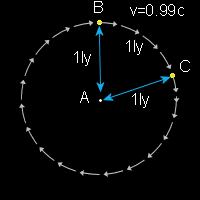
Problem A
A spherical light source is 1 light year away from Point A at point B.
It moves at near light speed in a circumference around Point A to Point C for a distance of 1 light year.
When the light reaches it's destination it turns off.
What does a person at Point A observe?

Answer: Nothing for 1 year and then a light moving in a straight line at a constant speed for about a year before disappearing.
Problem_4.gif


Problem B
A spherical light source is at Point B, 1 light year away from Point A.
It moves to Point C at constant near light speed.
When the light reaches it's destination it turns off.
What does a person at Point A observe?

Answer: Nothing for 1 year and then a light moving in a straight line appearing to decelerate for about a 1.41 years before disappearing.

Problem C
A spherical light source is at Point A.
It moves to point B at constant near light speed.
When the light reaches it's destination it turns off.
What does a person at Point A observe?

Answer: A light moving away from them in a straight line appearing to decelerate for 2 years before switching off.

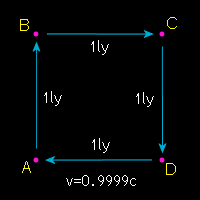
Problem D
A spherical light source is at Point A along with an observer. They both have atomic stop watches.
As both stop watches start the light moves at a constant near light speed to Point B, then Point C, then Point D, then Point A without resting.
What will the person at Point A observer on each clock at 1, 2, 3 and 4 years (assuming he has a decent telescope)?

Answer:
1 year: Observer clock=1 year, light's clock observed as ~0.5 years
2 year: Observer clock=2 years, light's clock observed as ~1 year
3 year: Observer clock=3 years, light's clock observed as ~1.75 years (?)
4 year: Observer clock=4 years, light's clock observed as ~4 years

I think I'm likely wrong, and if so, please could you explain why?
 
Physics news on Phys.org
Everything seems fine except the last experiment where you fail to consider time dilation. You're only considering the lag effect caused by the finite speed of light.
 
daveyb said:
Problem A
A spherical light source is 1 light year away from Point A at point B.
It moves at near light speed in a circumference around Point A to Point C for a distance of 1 light year.
When the light reaches it's destination it turns off.
What does a person at Point A observe?

Answer: Nothing for 1 year and then a light moving in a straight line at a constant speed for about a year before disappearing.

This doesn't make sense; you said the light moves in a circular arc with a radius of 1 light-year around Point A. That means the person at A will see the light moving in a circular arc, not a straight line. The arc will have an arc length of 1 light-year, but that just means the angle through which A sees the light move is 1 radian. It doesn't mean the light is moving in a straight line relative to A.

daveyb said:
Problem B
A spherical light source is at Point B, 1 light year away from Point A.
It moves to Point C at constant near light speed.
When the light reaches it's destination it turns off.
What does a person at Point A observe?

Answer: Nothing for 1 year and then a light moving in a straight line appearing to decelerate for about a 1.41 years before disappearing

This looks OK.

daveyb said:
Problem C
A spherical light source is at Point A.
It moves to point B at constant near light speed.
When the light reaches it's destination it turns off.
What does a person at Point A observe?

Answer: A light moving away from them in a straight line appearing to decelerate for 2 years before switching off.

This looks OK too.

daveyb said:
Problem D
A spherical light source is at Point A along with an observer. They both have atomic stop watches.
As both stop watches start the light moves at a constant near light speed to Point B, then Point C, then Point D, then Point A without resting.
What will the person at Point A observer on each clock at 1, 2, 3 and 4 years (assuming he has a decent telescope)?

Answer:
1 year: Observer clock=1 year, light's clock observed as ~0.5 years
2 year: Observer clock=2 years, light's clock observed as ~1 year
3 year: Observer clock=3 years, light's clock observed as ~1.75 years (?)
4 year: Observer clock=4 years, light's clock observed as ~4 years

I think I'm likely wrong, and if so, please could you explain why?

I'm not sure how you're getting these answers, since at least the first two are just repeats of problems C and B above. Call the time of launch t = 0 by the person at A's clock. From Problem C, he will see the light moving away from him, apparently decelerating, for 2 years by his clock, until t = 2. Then, by Problem B, he will see the light moving at an angle away from him (from B to C) for about 1.41 years, until about t = 3.41. By symmetry, the geometry of the last two legs is just like the first two in reverse; but now the light source is moving towards A instead of away, so the 3rd leg (C to D) will appear to take 1 year minus about 0.41 years, as seen by the observer at A, or about 0.59 years, until about t = 4. And since the light source is traveling close to the speed of light, the final leg (from D back to A) will appear to take almost no time at all as seen by the observer at A; the light source itself will arrive back at A almost as soon as the light it emits when it is at D. So the observer at A will read t = 4 when the light source arrives back at A.

The only thing left to address is what a clock that is moving along with the light source will read; but since you've stipulated that the light source moves at nearly c, the time elapsed on a clock moving with the light source will be nearly zero. The closer the light source's speed gets to c, the closer to zero the elapsed time will be. As dauto noted, you failed to address this issue in your estimates of the time elapsed on the light's clock. There will also be some effect on the clock readings seen at A due to the time delay of light traveling from the light source to the observer at A; but if the light source is traveling at close to c, this effect will be small since the elapsed time on the clock moving with the light source is small anyway.
 
dauto said:
Everything seems fine except the last experiment

No, the answer given to the first experiment is wrong too. See my previous post.
 
PeterDonis said:
No, the answer given to the first experiment is wrong too. See my previous post.

No, it isn't. An arc seen from the center looks like a straight line.
 
dauto said:
No, it isn't. An arc seen from the center looks like a straight line.

No, it doesn't, if you properly take into account the variation in distance from the "center" for a straight line.

In the arc case (case A), the distance of the light source from the observer remains constant. That means there is no apparent deceleration/acceleration; the apparent speed of the light source remains constant.

In the straight line case (case B), the distance of the light source from the observer changes. That means there is apparent deceleration/acceleration; the apparent speed of the light source does *not* remain constant (because the light-speed travel time changes).

If by "moving in a straight line" the OP actually mean "apparently moving in a transverse straight line, with no apparent deceleration/acceleration", then it would be a correct description for case A; but since he used the same language, "moving in a straight line", for the other cases, it did not seem as though he was aware of the difference if the apparent "straight line" is actually a circular arc. That's why I stressed that difference.
 

Similar threads

  • · Replies 34 ·
2
Replies
34
Views
4K
  • · Replies 42 ·
2
Replies
42
Views
3K
  • · Replies 26 ·
Replies
26
Views
968
  • · Replies 9 ·
Replies
9
Views
1K
  • · Replies 25 ·
Replies
25
Views
5K
  • · Replies 24 ·
Replies
24
Views
2K
  • · Replies 22 ·
Replies
22
Views
2K
  • · Replies 72 ·
3
Replies
72
Views
5K
  • · Replies 6 ·
Replies
6
Views
2K
  • · Replies 33 ·
2
Replies
33
Views
4K