On the width of the kinetic energy distribution of a gas

Click For Summary
SUMMARY

The discussion centers on the width of the kinetic energy distribution of gas particles as described in statistical mechanics. The author asserts that the width can be approximated by the ratio of the standard deviation to the mean energy, expressed as ##\frac{\sigma_E}{\langle E\rangle}=\frac{\langle (E-\textrm {U})^{2} \rangle^{1/2}}{\langle E\rangle}##. Participants clarify that this approximation arises from the thermodynamic limit, where the mean energy and standard deviation both increase with the number of particles, ##N##. The conversation emphasizes the importance of understanding the relationship between standard deviation and mean in the context of large particle systems.

PREREQUISITES
  • Statistical mechanics fundamentals
  • Understanding of kinetic energy distributions
  • Familiarity with the central limit theorem
  • Concept of thermodynamic limit in physics
NEXT STEPS
  • Study the derivation of the thermodynamic limit in statistical mechanics
  • Explore the implications of the central limit theorem in physical systems
  • Investigate the relationship between standard deviation and mean in large datasets
  • Learn about the Gaussian distribution and its applications in physics
USEFUL FOR

Physicists, students of statistical mechanics, and researchers analyzing kinetic energy distributions in gases will benefit from this discussion.

Aaron121
Messages
15
Reaction score
1
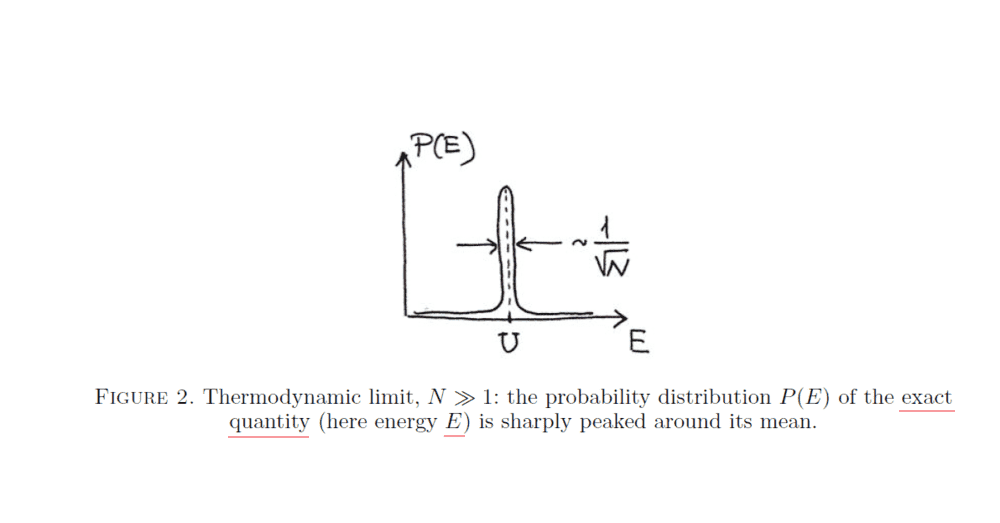
In these lecture notes about statistical mechanics, page ##10##, we can see the graph below.
1578510366663.png


It represents the distribution (probability density function) of the kinetic energy ##E## (a random variable) of all the gas particles (i.e., ##E=\sum_{i}^{N} E_{i}##, where ##E_{i}## (also a random variable) is the kinetic energy of gas molecule ##i##, and ##N## is the total number of gas molecules). ##U## above is the mean value of ##E## (##U=\langle E\rangle##).

The author claims that the width of the distribution above is approximately ##\frac{\sigma _{E}}{\langle E\rangle}=\frac{\langle (E-\textrm {U})^{2} \rangle ^{1/2}}{\langle E\rangle}##. Where does this approximation come from? Shouldn't it be just ##\sigma _{E}=\langle (E-\textrm {U})^{2} \rangle ^{1/2}##?

The exact quote reads,
the distribution of the system's total energy ##E## (which is a random variable because particle velocities are random variables) is very sharply peaked around its mean ##U=\langle E\rangle##: the width of this peak is ##\sim \Delta E_{rms}/U \sim \frac{1}{\sqrt{N}}## . This is called the thermodynamic limit— the statement that mean quantities for systems of very many particles approximate extremely well the exact properties of the system.

##\Delta E_{rms}## above is just ##\sigma _{E}##.
 

Attachments

  • 1578493496246.png
    1578493496246.png
    18.4 KB · Views: 338
Last edited:
Physics news on Phys.org
Are you aware of the central-limit theorem? It says that the sum of a large number of equally distributed random numbers to a very good approximation follows a Gaussian distribution with mean ##U=\langle E \rangle =N \langle E_1 \rangle## and standard deviation ##\Delta E=\Delta E_1 \sqrt{N}## (corrected in view of #3). The standard deviation is defined by ##\Delta E^2 = \langle (E-U)^2 \rangle=\langle E^2 \rangle - U^2 ##.
 
Last edited:
I think two things are being confused here.
If E is the total energy, i.e. E = ΣEi, then <E> = N<Ei> and ΔE = ΔEi*√N.
If E is the average energy per molecule, i.e. E = ΣEi/N, then <E> = <Ei> and ΔE = ΔEi/√N.
 
Sorry, of course you are right: ##\Delta E=\sqrt{N} \Delta E_1##, but ##\Delta E/E=\Delta E_1/(\sqrt{N} \langle E_1 \rangle)##, where ##E## is the total energy.
 
The question was not really about why ##\frac{\Delta E_{RMS}}{\langle E\rangle}## can be approximated by ##\frac{1}{\sqrt{N}}##. But, rather, about why the author says the width of the distribution is, approximately, the ratio of the standard deviation to the mean ##\frac{\Delta E_{RMS}}{\langle E\rangle}##, rather than just the standard deviation itself ##\sigma_{E}=\Delta E_{RMS}##, which we all know measures how spread (how wide) a given distribution is.
 
I'd say the argument is to consider the (order of magnitude) of the width compared to the (order of magnitude) of the mean of the quantity. In other words you consider the mean an "accurate description" the smaller the standard deviation of the quantity is relative to the magnitude of the quantity itself.
 
@vanhees71
you consider the mean an "accurate description" the smaller the standard deviation of the quantity is relative to the magnitude of the quantity itself.

Correct me if I'm wrong, but do you mean by this that the standard deviation can be approximated by the mean when we have a very small standard deviation?
 
Aaron121 said:
In these lecture notes about statistical mechanics, page ##10##, we can see the graph below.

View attachment 255318

The author claims that the width of the distribution above is approximately ##\frac{\sigma _{E}}{\langle E\rangle}=\frac{\langle (E-\textrm {U})^{2} \rangle ^{1/2}}{\langle E\rangle}##.

We have to understand what is being graphed on the x-axis. Those notes show calculation for the the relative root-mean-square fluctuation of energy, so I think the x-axis is not total energy, but rather total energy rescaled by dividing it by the mean energy.
 
@Stephen Tashi
the x-axis is not total energy, but rather total energy rescaled by dividing it by the mean energy.
No where in the notes is it indicated that the graph is the plot of ##P(E)## against##E/U##. Had it been the case, the x-axis would not have been labeled ##E##. Besides, it is clearly indicated under the graph that it is the plot of##P(E)## against the energy ##E=\sum_{i}^{N}(\frac{mv_{i}^2}{2})##.
 
  • #10
Aaron121 said:
Besides, it is clearly indicated under the graph that it is the plot of##P(E)## against the energy ##E=\sum_{i}^{N}(\frac{mv_{i}^2}{2})##.

Then the notation that the width of the peak is proportional to ##\frac{1}{\sqrt{N}}## is incorrect.

The notes focus on "the thermodynamic limit". Trusting Wikipedia:
The thermodynamic limit, or macroscopic limit,[1] of a system in statistical mechanics is the limit for a large number N of particles (e.g., atoms or molecules) where the volume is taken to grow in proportion with the number of particles.[2] The thermodynamic limit is defined as the limit of a system with a large volume, with the particle density held fixed.[3]

As we increase the number of particles, the mean of the total energy ##U## will approach infinity and the standard deviation of total energy will also approach infinity.

If we want a graph where the the width of the peak about the mean decreases with the number of particles, we must look at quantities like the mean energy per particle or the distribution of some quantity that approaches a finite limit as ##N## approaches infinity. The notes derive the proportionality of ##\sigma_E/ U## to ##\frac{1}{\sqrt {N}}##. The notes don't say that ##\sigma_E## is proportional to ##\frac{1}{\sqrt{N}}##.
 
  • Like
Likes   Reactions: Aaron121
  • #11
Of course, in the thermodynamic limit only quantities like the energy and particle density make sense. Of course in real-world systems the volume, the number of particles, the total energy etc. are all finite, the limit "##V \rightarrow \infty##" is a mathematical tool to formalize the simplifying description (and it's far from trivial, as already the treatment of an ideal gas in quantum many-body theory shows, which is only the most simple exactly treatable example).
 

Similar threads

  • · Replies 18 ·
Replies
18
Views
3K
  • · Replies 18 ·
Replies
18
Views
2K
  • · Replies 0 ·
Replies
0
Views
2K
  • · Replies 1 ·
Replies
1
Views
1K
  • · Replies 3 ·
Replies
3
Views
4K
  • · Replies 11 ·
Replies
11
Views
3K
  • · Replies 15 ·
Replies
15
Views
3K
  • · Replies 1 ·
Replies
1
Views
2K
  • · Replies 10 ·
Replies
10
Views
3K
  • · Replies 2 ·
Replies
2
Views
2K