Optimal Placement of a Resistor in a Circuit

  • Thread starter Thread starter Infamous911
  • Start date Start date
  • Tags Tags
    Placement Resistor
Click For Summary

Discussion Overview

The discussion centers around the optimal placement of a 100 ohm resistor in relation to a 220nF capacitor within a circuit. Participants explore the implications of resistor placement on circuit behavior, particularly in terms of impedance and signal paths. The conversation includes technical reasoning and considerations related to circuit design and frequency response.

Discussion Character

  • Technical explanation
  • Debate/contested
  • Mathematical reasoning

Main Points Raised

  • Some participants assert that the placement of the 100 ohm resistor does matter due to differing polarities on either side of the capacitor.
  • One participant notes that the resistor is in parallel with another resistor (R13), suggesting that the placement affects the total resistance and circuit behavior.
  • Another participant emphasizes that moving the resistor changes the DC path seen by the circuit, which could significantly impact performance.
  • Concerns are raised about the unusual combination of the 100 ohm and 15k resistors in parallel, questioning the necessity of the 15k resistor given its minimal effect on impedance.
  • Frequency response is mentioned, with a participant indicating that the corner frequency of the high-pass filter formed by the capacitor and resistor would change based on the resistor's position.

Areas of Agreement / Disagreement

Participants generally agree that the placement of the resistor is significant, but there are multiple competing views regarding the specific implications and the necessity of additional information to fully resolve the question.

Contextual Notes

Limitations include potential dependencies on manufacturing tolerances of the resistors and the input frequency, which may affect the circuit's behavior in ways not fully explored in the discussion.

Infamous911
Messages
5
Reaction score
0
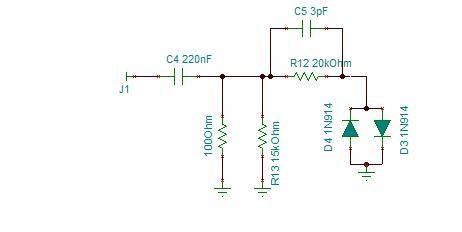
Am I correct in thinking that it would not matter if I place the 100ohm resistor after the 220nF capacitor (as shown in the picture), or before the capacitor?
lKvGlyt.jpg
 
Physics news on Phys.org
It certainly does matter where you place the resistor in this circuit, since each side of the capacitor has a different polarity. Furthermore, you have the 100 ohm resistor in parallel with R13, which tells me that you are trying to achieve a value for a resistance that you could not otherwise provide using a single resistor that you do not have in your possession as in Rtotal=1/(1/R1 +1/R2), which in this case is effectively 99.338 ohm, so by that reasoning alone, the resistor is improperly placed.
 
Infamous911 said:
Am I correct in thinking that it would not matter if I place the 100ohm resistor after the 220nF capacitor (as shown in the picture), or before the capacitor?
For a number of reasons, it probably does matter. Where it currently sits means that J "sees" an infinite DC path to ground. But move that resistor to the other side, and signal at J "sees" a DC path of 100Ω to ground. Big difference, where it's important.

You can apply similar reasoning to what the circuit on the right sees.
 
Infamous911 said:
Am I correct in thinking that it would not matter if I place the 100ohm resistor after the 220nF capacitor (as shown in the picture), or before the capacitor?

I agree with other replies.

It probably does matter but more information is required to fully answer the question.

As baudrunner points out the combination of 100R and 15K in parallel is unusual. Not least because the effect of the 15k on the combined impedance is small. What is the manufacturing tolerance of the 100R? The 15K affects the impedence by less than 1% so if the manufacturing tollerance of the 100R was say 1 or 2% then you have to wonder why the 15k is there at all.

The answer might also depend on the input frequency. Currently anything below about 7Khz is attenuated by the high pass filter (220nF & 100R).

http://en.wikipedia.org/wiki/High-pass_filter

If you swap the 100R to the left of the 220nF that won't work the same. The corner frequency will increase to something much higher (220nF and 15k//20K).
 

Similar threads

  • · Replies 8 ·
Replies
8
Views
3K
  • · Replies 3 ·
Replies
3
Views
3K
  • · Replies 9 ·
Replies
9
Views
883
  • · Replies 13 ·
Replies
13
Views
3K
  • · Replies 4 ·
Replies
4
Views
3K
  • · Replies 5 ·
Replies
5
Views
2K
  • · Replies 9 ·
Replies
9
Views
5K
  • · Replies 37 ·
2
Replies
37
Views
6K
  • · Replies 15 ·
Replies
15
Views
7K
  • · Replies 6 ·
Replies
6
Views
3K