asdfsystema
- 87
- 0
Optimization/Related Rates (URGENT) !
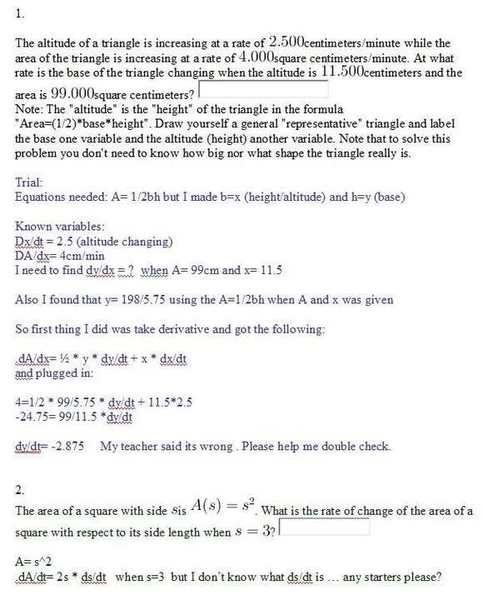

Please take a look. Thanks a lot.
Please take a look. Thanks a lot.
Hi Ken,asdfsystema said: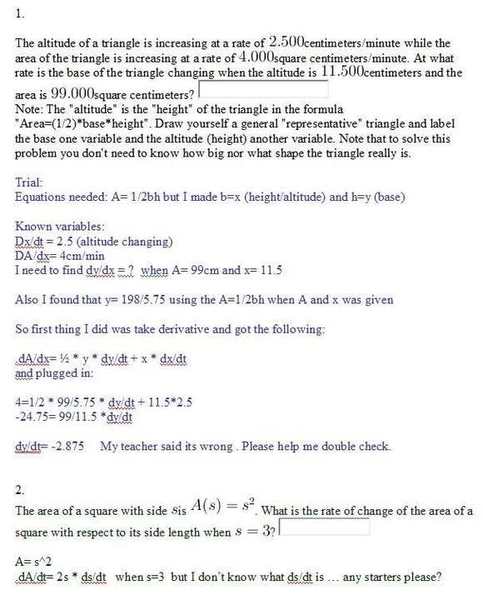

Please take a look. Thanks a lot.
So far, so good.asdfsystema said:thanks i got all the answers except for 1)
so here's what i did:
dh/dt = 2.5 cm
h=11.5
dA/dt= 4cm
A= 99
and i need to find the rate of change of db/dt when h= 11.5
first i found out what the base would be so I plugged h=11.5 into A= 1/2bh and got b=17.2173913
No, the part in parentheses is wrong. Assuming that both b and h are differentiable functions of t, what do you get for d/dt(b*h) using the product rule?asdfsystema said:Next I took dA/dt 1/2 (b*db/dt + h *dh/dt)
Is this correct? Next I plugged in all the known variables and isolated db/dt
At the moment in time of interest, I get db/dt [tex]\approx[/tex] -3.047 cm/min, meaning that the base is decreasing in length.asdfsystema said:db/dt= -1.2051767 ? but it is wrong ...
thanks again