Optimizing AC Power Supply Wiring for Desired Equipment Setup

Click For Summary

Discussion Overview

The discussion revolves around optimizing AC power supply wiring for a specific equipment setup, focusing on the implications of wiring configurations, current sharing, and safety concerns. Participants explore theoretical and practical aspects of connecting multiple power sources, including AC outlets and batteries, while addressing potential hazards and operational requirements.

Discussion Character

  • Debate/contested
  • Technical explanation
  • Conceptual clarification
  • Exploratory

Main Points Raised

  • Some participants express concerns about the safety of wiring configurations that leave live prongs exposed and the risks associated with circuit energization if one breaker is opened.
  • There is a debate on whether current can be doubled when two sources are switched on at positive zero crossing, with some arguing that it cannot if the outlets are on the same phase.
  • Participants discuss the need for synchronization and load sharing between power supplies to avoid damage and ensure proper operation.
  • One participant suggests that using isolation transformers might be a solution, though they note the high cost associated with them.
  • Questions arise about the actual power draw of the equipment and the implications of moving between different plug/socket standards, such as 16A and 13A systems.
  • There is a discussion about the configuration of batteries, with some participants clarifying that connecting batteries in series increases voltage while connecting them in parallel can increase current, depending on the type of battery.
  • Concerns are raised about the potential dangers of merging AC or DC supplies without proper knowledge and precautions.

Areas of Agreement / Disagreement

Participants express differing views on the feasibility and safety of various wiring configurations, with no consensus reached on the optimal approach or the implications of connecting power sources in specific ways. The discussion remains unresolved regarding the best practices for wiring and safety measures.

Contextual Notes

Participants highlight limitations related to assumptions about the power sources, the need for synchronization, and the potential for hazardous conditions if safety measures are not properly implemented. The discussion also reflects uncertainty about the specific equipment and its power requirements.

Who May Find This Useful

This discussion may be of interest to electrical engineers, technicians involved in power supply configurations, and individuals working with AC and DC power systems, particularly in contexts involving safety and equipment compatibility.

Denny Lai
Messages
1
Reaction score
0
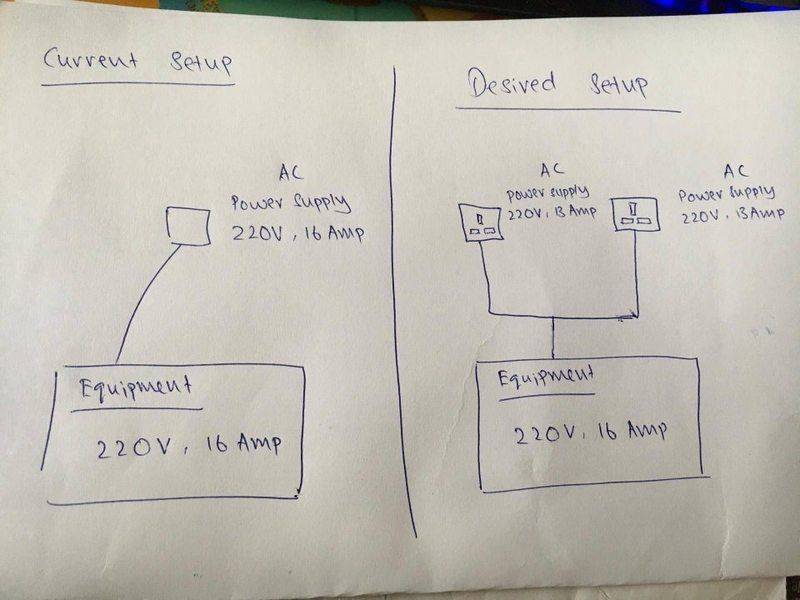
As per the diagram, how do i change the wiring of the equipment on the outside to achieve my desired setup?
ac.jpg
 
Engineering news on Phys.org
Denny Lai said:
As per the diagram, how do i change the wiring of the equipment on the outside to achieve my desired setup?

there's no point if the power outlets are on the same phase, you won't double the current
 
  • Like
Likes   Reactions: berkeman
This also causes a safety issue in two ways. First if you plug only one branch in you will have live prongs exposed on the other. Second if one breaker is opened for some reason the circuit will be energized through your death cord.

BoB
 
  • Like
Likes   Reactions: davenn
davenn said:
there's no point if the power outlets are on the same phase, you won't double the current
Why wouldn't the current be doubled if the two sources are switched on at positive zero crossing, so that there is no phase difference between the two sources?
 
jaus tail said:
Why wouldn't the current be doubled if the two sources are switched on at positive zero crossing, so that there is no phase difference between the two sources?
What would the current be in the bottom circuit?
twowires.jpg
 
The current would be 16A, but that's cause there is only 1 voltage source. But in the OP's picture there are 2 voltage sources so each can provide 8A current.
Isn't that how parallel operation of transformer or generator works? Each transformer or generator provides with half the load current?
Untitled-6-min.png

parallel_gens.gif

I'm confused. When should the voltage sources be in series and when in parallel?
Sorry OP for hijacking your thread. Not sure if I should start a new thread or the mod will allow discussion here.
 
OP is not clear - but I am reading Power Supplies to mean a piece of equipment, not just an outlet.

1) For an AC source - the Power supplies need a way to synchronize their outputs ( be in phase with one another)-otherwise they may get damaged or as one "competes" with the other - they both shut down under a current fault, or get damaged.

2) To Share the Load 8 A each to supply the 16A Load they need to have a load sharing feature, they need to communicate. Otherwise one Power supply will typically carry all of the load, or if regulated, will put out it's 13A limit, and then go into a current limit - as the other one only has 3A - this could damage the 13 A - or the system could oscillate.

Basically - if the two PS are not made, and configured to load share load current they wont.

Jaus -- in the 2 transformer case, very slight differences in the transformers can lead to circulating current, but paralleling Transformers is possible when properly matched. In the generator case - the generator controls must be equipped to be tied to the grid, or to another generator - primarily to carry out the two functions Synchronization and Load Sharing, I mention above.
 
  • Like
Likes   Reactions: jaus tail
There may be a solution using a pair of isolation transformers, but these are heavy and very expensive so expect the cost to exceed $1000. Still interested?
 
Denny Lai said:
As per the diagram, how do i change the wiring of the equipment on the outside to achieve my desired setup?

Tell us more about the 16A and the 13A power supplies and the appliance itself. How much power does it actually draw? What is the wattage stated on the rating label?

It sounds like you might be moving country from somewhere that has 16A plugs/sockets to somewhere that has 13A plugs/sockets. In which case there might be an easy solution if the power/wattage is below 3kW.

In some countries you can replace a 13A socket with a 16A socket. There is a bit more to it but that might be a valid solution.
 
  • #10
jaus tail said:
The current would be 16A, but that's cause there is only 1 voltage source. But in the OP's picture there are 2 voltage sources so each can provide 8A current.

NO, as I said, it's the same source because it's most likely two AC outlets off the same mains phase
 
  • Like
Likes   Reactions: jaus tail, dlgoff and rbelli1
  • #11
davenn said:
two AC outlets

That is the assumption I made as well due to the ends of the cables being terminated in something that looks like a British wall plug and 13A which also matches British style wall plugs. This configuration *MIGHT* work as it parallels two 13A fuses inside the plugs. But it creates an electrical death hazard. Locally if one plug comes unplugged due to exposed prongs and possibly longer distance if two circuits are bridged with this thing.

Do not do this. It is dangerous and probably illegal.

BoB
 
  • Like
Likes   Reactions: davenn
  • #12
I can see a way to prevent the danger with two plugs but I'm not going to suggest it because it would only take a single device to fail and the hazard would return. Way too dangerous.
 
  • Like
Likes   Reactions: davenn
  • #13
One question:
What if instead of power outlets they are batteries (separate power sources)? Can i connect batteries in series to increase the power output? In network problems I've seen voltage sources in series. But then only the voltage output would increase. Not the current capacity of each battery.

Say i have two power sources and one load. I guess the voltage output of both power sources much match the require load voltage. and the power sources must be connected in parallel to supply the required load current, and yes, there must be care(a lot lot lot lot of it) to make sure no circulating current flows between the sources. Am i right?
 
  • #14
If you connect two batteries in series the voltage will increase. _IF_ the current is limited by the battery that will not change.

Only certain types of battery can be connected in parallel. If you connect two batteries in parallel the voltage will stay the same. _If_ the current is limited by the battery then that will double.
 
  • Like
Likes   Reactions: jaus tail
  • #15
It might help if we knew what the equipment was so we had some idea of the variation in energy demand over time.

Two AC or DC supplies could be merged with bridge rectifiers, but that is not safe to try unless you know exactly what you are doing.
Consider for example a 6 kW variable frequency drive with three phase input. You might run that on the two outlets since the 3PH bridge on the VFD input could isolate an unplugged input.

On the other hand, could the equipment run on DC? Or does it have AC motors?
 
  • Like
Likes   Reactions: jaus tail
  • #16
The OP seems to have disappeared.
 
  • Like
Likes   Reactions: Windadct

Similar threads

  • · Replies 3 ·
Replies
3
Views
2K
Replies
30
Views
3K
  • · Replies 46 ·
2
Replies
46
Views
4K
  • · Replies 11 ·
Replies
11
Views
3K
  • · Replies 12 ·
Replies
12
Views
6K
Replies
6
Views
4K
Replies
29
Views
2K
Replies
13
Views
4K
  • · Replies 10 ·
Replies
10
Views
2K
  • · Replies 16 ·
Replies
16
Views
2K