Optimizing Phase Current Measurements with Shunt Resistors

Click For Summary

Discussion Overview

The discussion focuses on the measurement of phase currents using shunt resistors, particularly addressing the differences in wiring configurations for measuring phase Ia compared to Ib and Ic. Participants explore the implications of these configurations, potential advantages, and conditions that may lead to incorrect phase current readings.

Discussion Character

  • Technical explanation
  • Debate/contested
  • Experimental/applied

Main Points Raised

  • One participant questions the rationale behind the different wiring for measuring phase Ia compared to Ib and Ic, suggesting it may have advantages in fault detection.
  • Another participant notes the deliberate nature of the asymmetric wiring and requests a reference to the application note being discussed.
  • A participant provides a link to the application note and specifies the relevant page number for reference.
  • Discussion includes the concept of a current sum as part of a hardware over-current detector, which can also be read by software.
  • There is a proposal that the channel notations for current measurements may differ from the expected, with assumptions made about which channel corresponds to which phase current.
  • One participant mentions a specific voltage calculation related to the system and how it pertains to detecting over-current conditions based on phase current values.
  • A later reply corrects a previous typo regarding the reference voltage for differential current sense amplifiers, providing clarification on its value.

Areas of Agreement / Disagreement

Participants express varying views on the wiring configurations and their implications, with no consensus reached on the advantages or specific conditions affecting phase current measurements.

Contextual Notes

Some assumptions about channel notations and the relationship between phase currents and the current sum remain unresolved. The discussion also reflects uncertainty regarding the implications of the wiring configurations on fault detection.

PhysicsTest
Messages
260
Reaction score
27
TL;DR
To understand the logic of phase current measurement in 3 phase AC motors using shunt resistors from a reference application note.
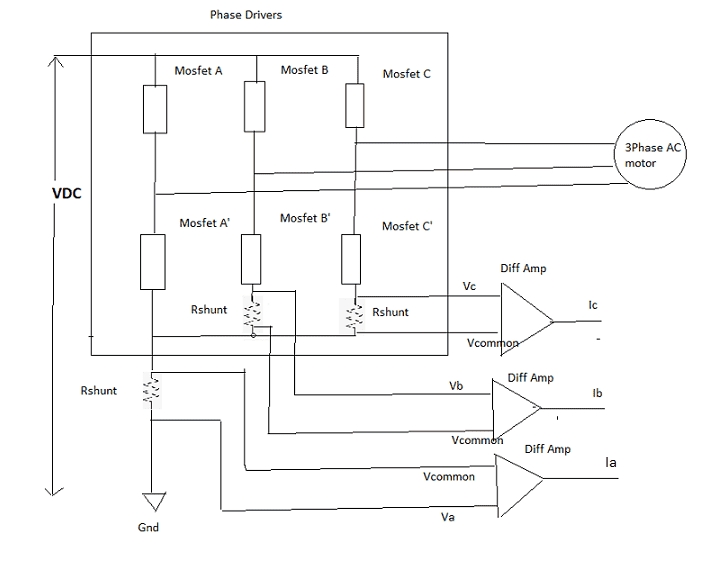
I have seen an application note of how to measure the phase currents using shunt resistors as shown below
1611371469220.png

I am only confused with the connection when measuring the phase Ia current, it differs from the way the shunt resistor is connected for Ic and Ib, he could have done the same way like Ib and Ic. Is there any advantage doing like this? By using Ia he was also able to detect the fault in the phase currents? My question is what are the conditions under which the phase currents can be wrong like one condition i can think of is
a. Ia+Ib+Ic ##\neq ## 0.
 
Engineering news on Phys.org
The asymmetric wiring does seem very deliberate.
PhysicsTest said:
I have seen an application note of how to measure the phase currents using shunt resistors as shown below
Can you please give a reference to the application note.
Do you have a link ?
 
Baluncore said:
The asymmetric wiring does seem very deliberate.

Can you please give a reference to the application note.
Do you have a link ?
Yes, Thank you, please find the attachment of the application note, i am referring to the page no 34. The link for the same is
https://www.microchip.com/developmenttools/ProductDetails/dm330021-2
 

Attachments

Any advise?
 
The current sum is part of a hardware over-current detector.
The current sum can also be read by software.
Channels 2 or 3 current can be read with software.
Channel 1 current can be computed from Isum - I1 - I2.
 
  • Like
Likes   Reactions: PhysicsTest
Baluncore said:
The current sum can also be read by software.
Channels 2 or 3 current can be read with software.
Channel 1 current can be computed from Isum - I1 - I2.
Thank you. I am confused about the channel notations, but i assume that Channel 1 -> I3, Channel 2 -> I1,
Channel3 -> I2. The hardware notation followed for measurement of current is different, since they want to incorporate all the three phase currents to detect the over current fault is my understanding.
Baluncore said:
The current sum is part of a hardware over-current detector.
This is based on the system, in this it corresponds to the voltage of ##3.3*30/31.5= 3.14V ##. Hence the ##I_{sum} - I_1 - I_2 =I_3## one of the phase currents exceeds this value then it detects the over-current?
 
Sorry for the earlier typo;
Notice that the outputs from the differential current sense amplifiers are referenced to Vref, which is half of the AVDD voltage = 3.3V / 2 = 1.65 volt.
 

Similar threads

Replies
4
Views
4K
Replies
68
Views
7K
Replies
12
Views
3K
  • · Replies 10 ·
Replies
10
Views
6K
Replies
4
Views
2K
  • · Replies 12 ·
Replies
12
Views
5K
  • · Replies 1 ·
Replies
1
Views
2K
  • · Replies 2 ·
Replies
2
Views
2K
Replies
3
Views
2K
  • · Replies 7 ·
Replies
7
Views
4K