Graduate Origin of the polarization in BaTiO3 unit cell

Click For Summary
SUMMARY

The polarization in the BaTiO3 unit cell arises from the off-center position of the Ti ion, which exists in a 4+ oxidation state. This state contributes to the overall dipole moment of the unit cell, rather than the Ti atom acting as an electric dipole itself. To understand this phenomenon, one must calculate the dipole moment for both symmetric and distorted unit cells, treating the atoms as charged points. The polarization is a direct result of the structural distortion rather than the electron cloud separation.

PREREQUISITES
  • Understanding of perovskite crystal structures
  • Knowledge of dipole moments in physics
  • Familiarity with oxidation states, specifically Ti in 4+ state
  • Ability to perform calculations on crystal symmetry and distortion
NEXT STEPS
  • Research the properties of perovskite materials and their applications
  • Learn how to calculate dipole moments in crystal structures
  • Study the effects of crystal distortion on electrical properties
  • Explore the role of oxidation states in material properties
USEFUL FOR

Materials scientists, physicists, and engineers interested in piezoelectric materials and the electrical properties of perovskite crystals.

athosanian
Messages
66
Reaction score
8
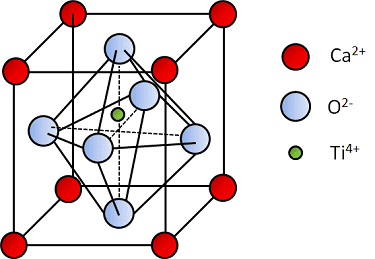
hi, in perovskite crystal, such as BaTiO3, due to the off-centre of Ti ion, there exists a polarization moment in the unit cell (as shown in below link). my question is: does the disposition of Ti atom lead to separation of electron cloud from the nuclei of the Ti atom and so the Ti atom plays as a electric dipole ?

https://www.comsol.com/blogs/piezoelectric-materials-crystal-orientation-poling-direction/
Perovskite-unit-cell.png
 
Physics news on Phys.org
Not really. The Ti atom itself is in the 4+ state so that the whole unit cell acquires a dipole moment. You should probably look up the definition of the dipolar moment and calculate it for a perfectly symmetric and a distorted unit cell. Just think of the atoms as charged points. It is really that simple.
 
so if the dipole moment of the unit cell is because the Ti atom is in 4+ state. So when is the Ti atom in the 4+ state ? for a perfectly symmmetric cell or distorted cell ?
 
Thread 'Unexpected irregular reflection signal from a high-finesse cavity'
I am observing an irregular, aperiodic noise pattern in the reflection signal of a high-finesse optical cavity (finesse ≈ 20,000). The cavity is normally operated using a standard Pound–Drever–Hall (PDH) locking configuration, where an EOM provides phase modulation. The signals shown in the attached figures were recorded with the modulation turned off. Under these conditions, when scanning the laser frequency across a cavity resonance, I expected to observe a simple reflection dip. Instead...

Similar threads

  • · Replies 2 ·
Replies
2
Views
5K
  • · Replies 1 ·
Replies
1
Views
11K
  • · Replies 1 ·
Replies
1
Views
7K
Replies
3
Views
3K
  • · Replies 8 ·
Replies
8
Views
815
Replies
4
Views
10K
  • · Replies 7 ·
Replies
7
Views
7K
  • · Replies 19 ·
Replies
19
Views
18K
  • · Replies 8 ·
Replies
8
Views
5K