Overhead power lines wires and strings deviation

Click For Summary
The discussion centers on calculating the deviation angle of a suspension insulator string between two tension insulator strings on overhead power line towers. The second tower's misalignment creates a need to determine the transverse load and swing angle, with initial calculations suggesting a line angle of less than 2 degrees. The correct formula for transverse load is confirmed as F=2*T*sin(θ/2), where T is the tension and θ is the total angle from both sides. The participants clarify that the swing angle is influenced by the weight of the spans and the resultant transverse load, leading to a swing angle of approximately 3 degrees. The conversation emphasizes the importance of accurately applying vector analysis to understand the tension forces involved.
Stefan Vasilev
Messages
3
Reaction score
0
Hello to all of you.

I have the following case to solve.

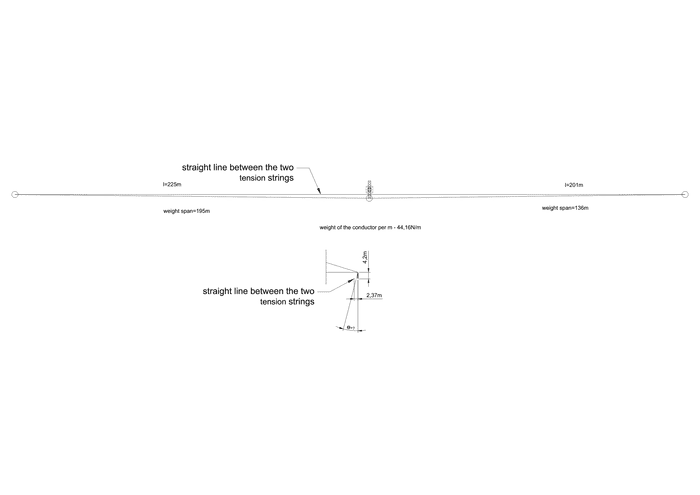
I have three overhead power line towers. The first and the third are with tension insulator strings, and the second is with suspension insulator string.
During the design process i noticed that the second tower is located incorrectly and the suspension insulator string is not in the straight line between the two tension insulator strings (located at tower one and three).

I have created a drawing in order to illustrate the problem.
pYeROJX.png

My question is how can I calculate the exact angle at which the suspension insulator string will deviate? No wind or other forces are applied to the constructor.

Many thanks in advance.
 
Physics news on Phys.org
You need to specify the wire tension, T. The line angle (not the swing angle) you can get from geometry and trig, based on the 2.7 meter offset in the approximate 200 m spans, and assuming initially the insulator is restrained from swing. It's less than a 2 degree line angle. Say 2 degrees for talking purposes.

Now to calculate the swing angle, you have the sum of the weight spans acting vertically down on the insulators, that's about 15 kN, but transversely, you have the load from the wire tensions on either side of the insulators, and using vector resultant approach, the transverse load is 2T sin ( line angle/2). Assuming T is 20 kN (is it?) , I get a transverse load of about 700 N. Thus, swing angle is inv tan 700/15000 or about less than 3 degrees. That will kick out the bottom of the 4.2 m insulator length about 0.2 m. Roughly. Of course, if wire tension is higher, swing is greater... plus wind...
 
Hello PhanthomJay,
thank you for your reply.

You are pretty close for the tension - it's about 40MPa, which for this conductors makes about 17,6kN.
What I was not sure was how to calculate the transverse load from the conductors tension.
At first I got confused that I have to use the angle between the straight line and the insulator string suspension point (as shown on the second part of the picture below), but then i got confused about not using the tension in the formula.

I just would like you to confirm that I got this right - the transverse load is calculated by F=2*T*sin(α/2), where
F - transverse load in kN
T - tension in kN
α - angle as shown on the picture bellow

TXiob9x.png


Many thanks again in advance.
 
Stefan Vasilev said:
Hello PhanthomJay,
thank you for your reply.

You are pretty close for the tension - it's about 40MPa, which for this conductors makes about 17,6kN.
What I was not sure was how to calculate the transverse load from the conductors tension.
At first I got confused that I have to use the angle between the straight line and the insulator string suspension point (as shown on the second part of the picture below), but then i got confused about not using the tension in the formula.

I just would like you to confirm that I got this right - the transverse load is calculated by F=2*T*sin(α/2), where
F - transverse load in kN
T - tension in kN
α - angle as shown on the picture bellow

TXiob9x.png


Many thanks again in advance.
that angle alpha is shown on one side of the tower in question...the total line angle at that middle tower must include the angle from the other side also, more or less total angle is twice that. That's the angle to use in your F=2Tsin(theta/2) equation, where theta is the sum of the two 'alphas' from each side if you know what I mean. But your swing angle is shown as 29 degrees which is way off...you've got a lot of weight acting down (sum of weight spans x 44N/m is about 14 kN), and the transverse load F is about in the order of only 700 N or so, so swing angle is more like inv tan 700/14,000 or about 3 degrees in rough numbers.
 
What I was saying was that when I tried to solve this problem, I tried to find the transverse load from the sine of this 29 deg angle, which was obviously a mistake. The angle between the suspension insulator string and the straight line has nothing to do with the calculations for transverse load.

Now I get it (correct me if I am wrong) - the angle theta in this formula <<F=2Tsin(theta/2)>> is the sum of my alpha (on the side where I had it placed) + the other sides angle. In this case they are almost the same as the first span is pretty much as long as the second one.
 
Stefan Vasilev said:
What I was saying was that when I tried to solve this problem, I tried to find the transverse load from the sine of this 29 deg angle, which was obviously a mistake. The angle between the suspension insulator string and the straight line has nothing to do with the calculations for transverse load.

Now I get it (correct me if I am wrong) - the angle theta in this formula <<F=2Tsin(theta/2)>> is the sum of my alpha (on the side where I had it placed) + the other sides angle. In this case they are almost the same as the first span is pretty much as long as the second one.
yes, that's right. But you should convince yourself why this formula f = 2T sin (theta/2) is correct, using a vector analysis for the resultant of the tension forces.
 
For simple comparison, I think the same thought process can be followed as a block slides down a hill, - for block down hill, simple starting PE of mgh to final max KE 0.5mv^2 - comparing PE1 to max KE2 would result in finding the work friction did through the process. efficiency is just 100*KE2/PE1. If a mousetrap car travels along a flat surface, a starting PE of 0.5 k th^2 can be measured and maximum velocity of the car can also be measured. If energy efficiency is defined by...

Similar threads

  • · Replies 2 ·
Replies
2
Views
2K
  • · Replies 5 ·
Replies
5
Views
2K
  • · Replies 3 ·
Replies
3
Views
997
  • · Replies 56 ·
2
Replies
56
Views
6K
Replies
50
Views
13K
  • · Replies 3 ·
Replies
3
Views
3K
  • · Replies 1 ·
Replies
1
Views
2K
  • · Replies 17 ·
Replies
17
Views
6K
  • · Replies 75 ·
3
Replies
75
Views
7K
  • · Replies 49 ·
2
Replies
49
Views
4K