Parallel Plate Capacitor Design

Click For Summary
SUMMARY

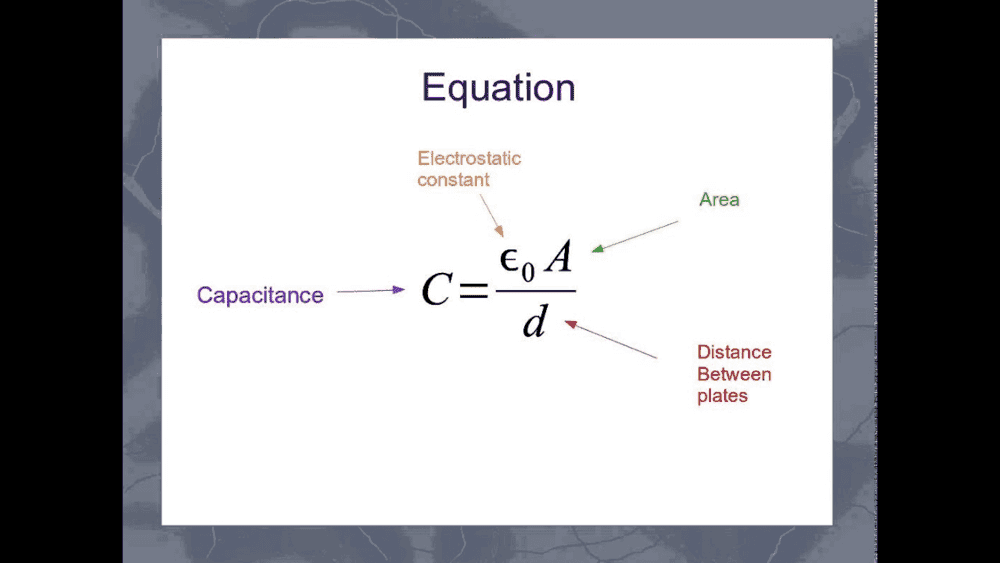
The discussion focuses on the design of a parallel plate capacitor, specifically addressing the relationship between capacitance, charge, and dielectric strength. The capacitance equation, C = ε(A/d), is highlighted, where ε is the permittivity, A is the plate area, and d is the distance between plates. The participants emphasize the importance of dielectric strength in determining the maximum voltage specifications and the physical volume of the capacitor, particularly when using silicon dioxide as a dielectric material with a dielectric constant of approximately 4.

PREREQUISITES
  • Understanding of capacitance equations, specifically C = ε(A/d)
  • Knowledge of dielectric materials and their properties, particularly silicon dioxide
  • Familiarity with electrical concepts such as charge (Q), voltage (V), and their relationship (Q = CV)
  • Awareness of dielectric strength and its impact on capacitor design
NEXT STEPS
  • Research the dielectric strength of various materials for capacitor applications
  • Explore the impact of plate area on capacitance in parallel plate capacitors
  • Learn about the breakdown voltage and its significance in capacitor specifications
  • Investigate advanced capacitor design techniques for optimizing performance
USEFUL FOR

Electrical engineers, capacitor designers, and students studying electronics who are interested in understanding the principles of capacitor design and the role of dielectric materials in performance optimization.

decaf14
Messages
23
Reaction score
7
TL;DR
How to design a parallel plate capacitor.
Hello,

A question came up in my head that I couldn't think of a way to math out.

Say I want to design a parallel plate capacitor. The equation for capacitance is quite simple:
1568928279871.png


Everything in this equation makes sense, besides for the distance. This is saying that an infinitely small length of material would have infinite capacitance. This doesn't seem right, as a material can only hold so much charge/electric field. How would I go about factoring in the amount of charge a material can hold when designing a parallel plate capacitor?

I'm going through an exercise of designing a silicon dioxide capacitor (dielectric constant = ~4).
 
Engineering news on Phys.org
The solution to the problem lies in the relation between charge, voltage and capacitance. Q = CV and the dielectric strength of the insulator.
 
  • Like
Likes   Reactions: decaf14
gleem said:
The solution to the problem lies in the relation between charge, voltage and capacitance. Q = CV and the dielectric strength of the insulator.

Thanks, that makes sense. This probably gives rise to those "maximum voltage" specifications we see in capacitor datasheets?
 
  • Like
Likes   Reactions: gleem
The critical thing that determines capacitor physical volume is the thickness of the dielectric needed to separate and reliably insulate the plates. That thickness will be determined by the breakdown voltage, a function of dielectric strength in volts / metre.
 
  • Like
Likes   Reactions: decaf14

Similar threads

Replies
34
Views
6K
  • · Replies 7 ·
Replies
7
Views
4K
Replies
22
Views
3K
Replies
3
Views
2K
  • · Replies 17 ·
Replies
17
Views
3K
  • · Replies 15 ·
Replies
15
Views
4K
  • · Replies 6 ·
Replies
6
Views
2K
  • · Replies 12 ·
Replies
12
Views
5K
Replies
5
Views
2K
Replies
5
Views
681