Particle in a box question in classical mechaincs

Click For Summary
The discussion revolves around confusion regarding the particle-in-a-box model in classical mechanics, particularly the implications of energy levels and momentum. The user struggles with understanding why a particle can have momentum at E=0, despite equations suggesting imaginary momentum when E<Δ. Clarification is sought on how the particle behaves within the potential barriers and the conditions under which it can exist in different energy states. The conversation also touches on the physical interpretation of the particle's movement and the significance of the energy barrier. Ultimately, the user expresses gratitude after gaining insight into the topic.
Taylor_1989
Messages
400
Reaction score
14
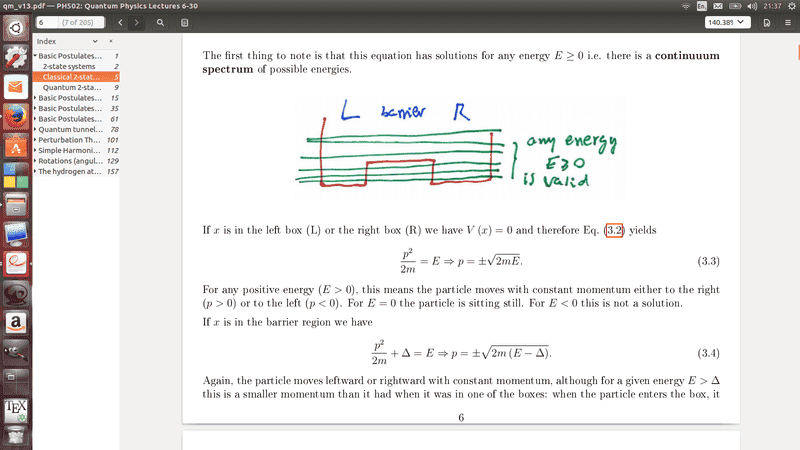
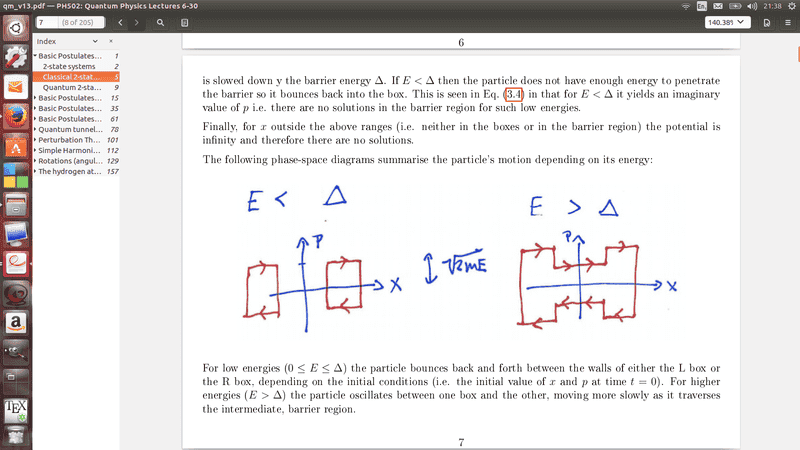
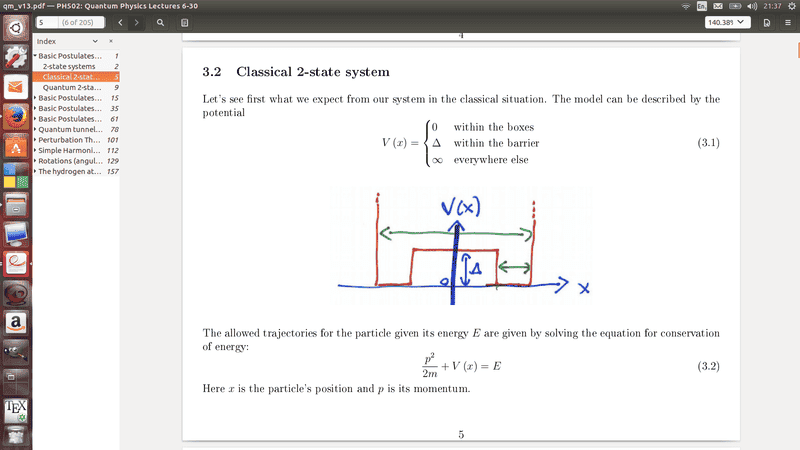
Hi guys, I am having an issue with what my lecture is saying in these slides, I have attched my slides below.
upload_2017-12-15_21-37-16.png

upload_2017-12-15_21-37-38.png


upload_2017-12-15_21-38-12.png


Here is my issue. I am very confused by the ##E<\Delta ## Beacuse I can't see how this has any momentum as it would produce an imagery number. And ye say that ##E<\Delta ## cannot be a solution yet on these diagrams he show the particle has momentum, at E=0 which can't be correct. I know I have this back to front, because he also mentions that at ##E>\Delta ## that is has less momentum than but I just can't see how, could someone please explain to me what my lecture is conveying here.
 

Attachments

  • upload_2017-12-15_21-37-16.png
    upload_2017-12-15_21-37-16.png
    37.5 KB · Views: 1,115
  • upload_2017-12-15_21-37-38.png
    upload_2017-12-15_21-37-38.png
    44.6 KB · Views: 953
  • upload_2017-12-15_21-38-12.png
    upload_2017-12-15_21-38-12.png
    48.8 KB · Views: 939
Physics news on Phys.org
Taylor_1989 said:
Here is my issue. I am very confused by the ##E<\Delta ## Beacuse I can't see how this has any momentum as it would produce an imagery number. And ye say that ##E<\Delta ## cannot be a solution yet on these diagrams he show the particle has momentum, at E=0 which can't be correct. I know I have this back to front, because he also mentions that at ##E>\Delta ## that is has less momentum than but I just can't see how, could someone please explain to me what my lecture is conveying here.
If E<Δ the particle is confined in one of the boxes, where the potential is zero.
 
This is confusing, if I look at the equation it tell me that momentum dose not exist it imaginary. I can't seem to think how this particle is moving inside the box.

I mean if I look over this again he states that at 0 poteinal the particle is in the right of left box, so the particle as I see it is moving to the left and right at the bottom of one of the boxes. But how if E=0 the ##P=\sqrt(2m(E-\Delta))## then the solution give an imaginary value so tho I can see it physically I can see how it is relating to the equation.

Is there a link to either a website or video that will help me understand this concept?

Also where is this energy barrier I can't see how this particle is moving from box to to box
 
Last edited:
Okay so I have been thinking about this a bit more. I have attched photos of my workings, and tryed to explain best to what I think is going on, I know normally it not great to post photo but I couldn’t draw a decent enough diagram to convey what I was thinking.

25465818_10159697059840635_136173687_n.jpg


25463815_10159697060110635_409303650_n.jpg


25463749_10159697060125635_320944506_n.jpg
 

Attachments

  • 25465818_10159697059840635_136173687_n.jpg
    25465818_10159697059840635_136173687_n.jpg
    12.6 KB · Views: 850
  • 25463815_10159697060110635_409303650_n.jpg
    25463815_10159697060110635_409303650_n.jpg
    14.1 KB · Views: 882
  • 25463749_10159697060125635_320944506_n.jpg
    25463749_10159697060125635_320944506_n.jpg
    13.5 KB · Views: 863
Taylor_1989 said:
This is confusing, if I look at the equation it tell me that momentum dose not exist it imaginary. I can't seem to think how this particle is moving inside the box.

I mean if I look over this again he states that at 0 poteinal the particle is in the right of left box, so the particle as I see it is moving to the left and right at the bottom of one of the boxes. But how if E=0 the ##P=\sqrt(2m(E-\Delta))## then the solution give an imaginary value so tho I can see it physically I can see how it is relating to the equation.

Remember, the equation is p2/2m +V(x) =E
There are walls of infinite high at x1 and x4. There is a barrier between x2 and x3. The function is defined between x1 and x2, outside it is infinite.

x1<x ≤ x2 V(x) = 0
x2 <x ≤ x3 V(x) = Δ
x3 < x ≤ x4 V(x) = 0

If E < Δ the particle can not exist in the interval x2 <x ≤ x3. It is confined "inside" one of the boxes, either between x1 and x2 or between x3 and x4.

Taylor_1989 said:
Also where is this energy barrier I can't see how this particle is moving from box to to box
If E ≥ Δ the particle can exist in the whole interval x1 <x ≤ x4, only its kinetic energy changes above the barrier. It is not "inside" any boxes
 
Taylor_1989 said:
Okay so I have been thinking about this a bit more. I have attched photos of my workings, and tryed to explain best to what I think is going on, I know normally it not great to post photo but I couldn’t draw a decent enough diagram to convey what I was thinking.

View attachment 216869

View attachment 216870

View attachment 216871
The drawing is right, but I can not read your handwriting.
 
ehild said:
The drawing is right, but I can not read your handwriting.
Sorry, from your pervious comment, and a couple more hours, I realized what was going on. Thank you for the advice.
 

Similar threads

  • · Replies 30 ·
2
Replies
30
Views
8K
Replies
8
Views
1K
  • · Replies 4 ·
Replies
4
Views
2K
  • · Replies 5 ·
Replies
5
Views
2K
Replies
6
Views
879
  • · Replies 8 ·
Replies
8
Views
1K
  • · Replies 4 ·
Replies
4
Views
2K
  • · Replies 7 ·
Replies
7
Views
2K
  • · Replies 1 ·
Replies
1
Views
1K
  • · Replies 7 ·
Replies
7
Views
910