Path orientation for calculating electric potential

Click For Summary
The discussion focuses on the orientation of the differential path element, dl, in line integrals related to electric potential. While commonly oriented from point a to b, the textbook suggests a path from O to r, leading to confusion about the direction of dl, which appears to be radially outward. It is clarified that the orientation of dl does not affect the integral's value, as reversing the path changes the sign but not the modulus. The standard choice is to start from infinity, where the potential is zero, simplifying calculations. Ultimately, understanding the relationship between the electric field and potential is key, as the field is derived from the gradient of the potential.
OmegaKV
Messages
22
Reaction score
1
For line integrals in vector calculus,

\int^a_b F \cdot dl

I almost always see the path oriented from a to b.

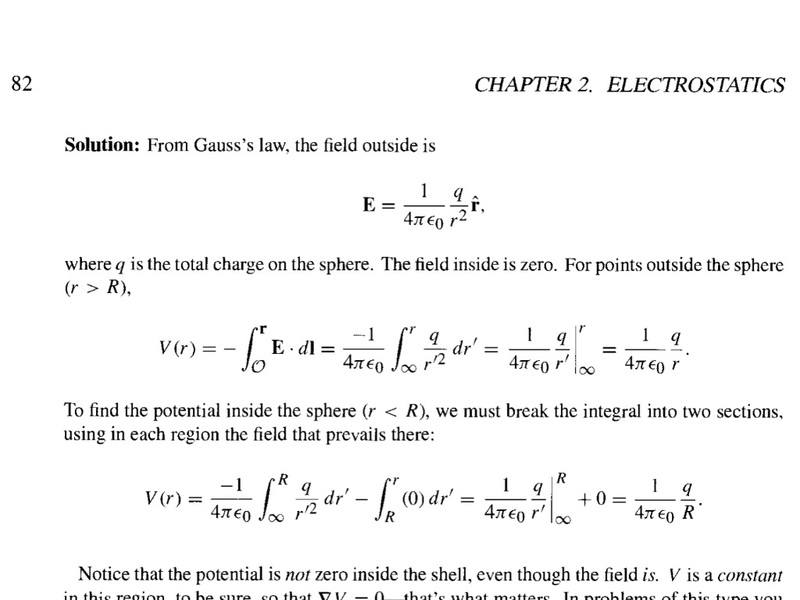
But my textbook has the following (look at the first equation for V(r):
lapJZ5b.jpg


Since the integral's limits are from O to r, I would have expected dl to also be pointing in the direction from O to r (i.e. pointing in the radially inward (minus r hat) direction), but the math in the textbook seems to imply that dl points radially outward (positive r hat direction, from r to O). I say this because the result of E dot dl has no minus sign in front of it.

How do you know which direction to orient dl?
 
Physics news on Phys.org
It doesn't matter at which point you start your integration path as long as it is not at the singularity at ##\vec{r}=0## of the Coulomb potential (I don't know what's discussed in your book, because you didn't tell us; maybe it's a spherical surface carrying some charge?). Changing the starting point of your path just adds a constant to the potential, but the only thing interesting is the field ##\vec{E}=-\vec{\nabla} V##.

Here they used a path starting from ##r=|\vec{r}| \rightarrow \infty##, making the potential ##0## at infinity, which is a convenient standard choice. Since the field is radial always, the only contribution is from the part going from infinity radially in, and you get the integral solved in your book.
 
OmegaKV said:
For line integrals in vector calculus,

\int^a_b F \cdot dl

I almost always see the path oriented from a to b.

But my textbook has the following (look at the first equation for V(r):

lapJZ5b.jpg


Since the integral's limits are from O to r, I would have expected dl to also be pointing in the direction from O to r (i.e. pointing in the radially inward (minus r hat) direction), but the math in the textbook seems to imply that dl points radially outward (positive r hat direction, from r to O). I say this because the result of E dot dl has no minus sign in front of it.

How do you know which direction to orient dl?

The path goes from b to a. If you reverse the order the modulus stay the same but the sign changes.
 
Thread 'Colors in a plasma globe'
I have a common plasma globe with blue streamers and orange pads at both ends. The orange light is emitted by neon and the blue light is presumably emitted by argon and xenon. Why are the streamers blue while the pads at both ends are orange? A plasma globe's electric field is strong near the central electrode, decreasing with distance, so I would not expect the orange color at both ends.

Similar threads

  • · Replies 18 ·
Replies
18
Views
2K
  • · Replies 1 ·
Replies
1
Views
2K
  • · Replies 7 ·
Replies
7
Views
1K
  • · Replies 4 ·
Replies
4
Views
1K
  • · Replies 3 ·
Replies
3
Views
3K
  • · Replies 1 ·
Replies
1
Views
2K
Replies
4
Views
2K
  • · Replies 8 ·
Replies
8
Views
2K
  • · Replies 11 ·
Replies
11
Views
4K
  • · Replies 3 ·
Replies
3
Views
1K