Pendulum Potential energy equation

Click For Summary

Discussion Overview

The discussion revolves around the potential energy equations for a pendulum, particularly in the context of stabilizing it in an inverted position. Participants explore different equations for potential energy and the implications of choosing a reference level for potential energy calculations.

Discussion Character

  • Technical explanation
  • Conceptual clarification
  • Debate/contested

Main Points Raised

  • One participant presents multiple potential energy equations for a pendulum: V=mgl_{p}cosα, V=-mgl_{p}cosα, V=mgl_{p}(1-cosα), and V=mgl_{p}(cosα-1), expressing confusion over which is correct.
  • Another participant asks about the reference level for potential energy, suggesting that the gravitational potential energy is calculated based on the height change from this reference level.
  • Participants discuss setting the potential energy to zero at the vertical position of the pendulum, leading to questions about which of the two equations (P.E=mgl_{p}(1-cosα) or P.E=mgl_{p}(cosα-1)) should be used.
  • Clarifications are made regarding the measurement of Δy, with emphasis on measuring from the chosen reference level where potential energy is zero.
  • One participant confirms their understanding of the reference level and the implications for potential energy values being negative for non-zero angles.

Areas of Agreement / Disagreement

Participants express uncertainty about which potential energy equation is correct based on the chosen reference level, indicating that multiple competing views remain on this topic.

Contextual Notes

The discussion highlights the dependence on the choice of reference level for potential energy calculations, which affects the sign and value of Δy and consequently the potential energy equations used.

cres222
Messages
4
Reaction score
0
hello every one
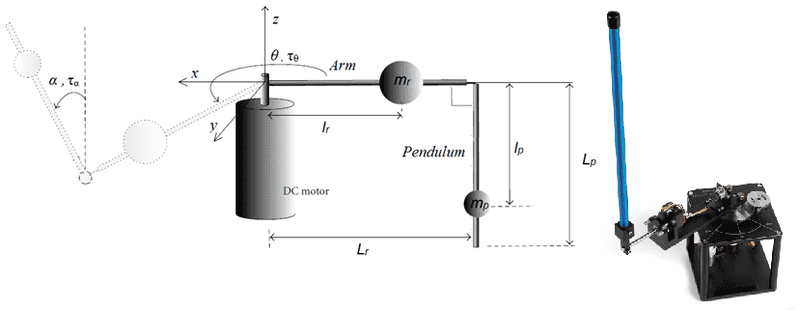
i have this pendulum:
pend222.png

i need to stabilize the pendulum in the inverted position , i need to know the potential energy for the pendulum , i read several articles in each one i have a different equation :
[itex]V=mgl_{p}cos\alpha[/itex]
[itex]V=-mgl_{p}cos\alpha[/itex]
[itex]V=mgl_{p}(1-cos\alpha)[/itex]
[itex]V=mgl_{p}(cos\alpha-1)[/itex]
Now i'am really confused which equation is the correct one?
Please help me
 
Physics news on Phys.org
What are you taking as your reference level? (Where PE = 0.) The pivot? The gravitational PE is given by mgΔy, where Δy is measured from your chosen reference level. Using that you should be able to pick the correct formula.
 
[itex]P.E=0[/itex] at the vertical position ([itex]\alpha=0[/itex] from the vertical line in the picture above), now which formula should i use :
[itex]P.E=mgl_{p}(1-cos\alpha)[/itex]
or
[itex]P.E=mgl_{p}(cos\alpha-1)[/itex]
 
cres222 said:
[itex]P.E=0[/itex] at the vertical position ([itex]\alpha=0[/itex] from the vertical line in the picture above), now which formula should i use :
[itex]P.E=mgl_{p}(1-cos\alpha)[/itex]
or
[itex]P.E=mgl_{p}(cos\alpha-1)[/itex]
Using the vertical position as your reference, Δy will be negative for any nonzero angle. The second of those is the one you want.
 
so:
[itex]\Delta y=[/itex](center of mass level-reference level)
not the other way around , am i correct?
 
cres222 said:
so:
[itex]\Delta y=[/itex](center of mass level-reference level)
not the other way around , am i correct?
Δy is measured from the PE = 0 reference point. Another way to write the PE is mgy, where y is the vertical position of the center of mass and y = 0 is the PE = 0 point.

Since you are choosing the reference level to be where the pendulum is vertical (the angle is zero) and thus the mass is at its highest point, all values for y and thus PE for non-zero angles will be negative since they are below that point.
 
Now i understand , thank you very much for you kindly help,I'm very appreciative
 

Similar threads

  • · Replies 11 ·
Replies
11
Views
2K
  • · Replies 1 ·
Replies
1
Views
2K
  • · Replies 2 ·
Replies
2
Views
2K
  • · Replies 1 ·
Replies
1
Views
2K
  • · Replies 30 ·
2
Replies
30
Views
2K
  • · Replies 4 ·
Replies
4
Views
2K
  • · Replies 3 ·
Replies
3
Views
4K
  • · Replies 2 ·
Replies
2
Views
2K
  • · Replies 2 ·
Replies
2
Views
3K
  • · Replies 46 ·
2
Replies
46
Views
5K