Periodic Boundary Conditions proof

Click For Summary
The discussion centers on the application of periodic boundary conditions (PBC) in modeling Bloch waves within solids. It clarifies that the length L, representing the size of the crystal, is typically much larger than the atomic scale unit cell, allowing for the assumption that L approaches infinity. This assumption leads to the conclusion that boundary conditions have a diminishing effect on the wave functions as the number of particles increases, according to Wigner's theorem. The conversation addresses the misconception that PBC implies physical connections between the edges of a finite crystal, emphasizing that for bulk states, the choice of boundary conditions can be flexible. Ultimately, the importance of L is contextualized, affirming that it should be significantly larger than the unit cell for accurate modeling.
Wminus
Messages
173
Reaction score
29
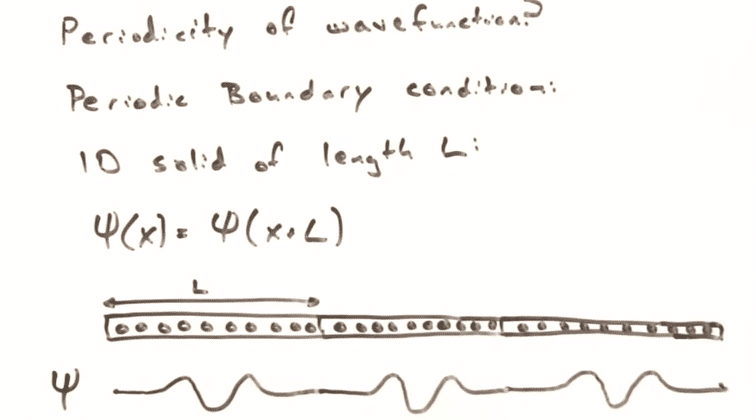
Hi! When we model bloch-waves in a solid we assume that there exist some kind of periodic boundary conditions such that the wave function is periodic. In 1D, ##\psi(x)## repeats itself for every ##L##, ##\psi(x) = \psi(x+L)##, such as here:
?temp_hash=0dc795db7139072038dac60b394bf8b6.png


OK, fine, we get pretty wave solutions if we assume the existence of the PBC. But what ##L##? As far as I know the only repeating unit in a crystal is the Wieger Seitz cell, which is sized on the atomic scale.

Is ##L## just the wavelength?
 

Attachments

  • Skjermbilde 2015-05-28 kl. 12.07.58.png
    Skjermbilde 2015-05-28 kl. 12.07.58.png
    50.1 KB · Views: 943
Physics news on Phys.org
No, L is the size of your crystal, so e.g. 1cm. In the end, this size doesn't matter to much and you often take ##L \to \infty##.
 
DrDu said:
No, L is the size of your crystal, so e.g. 1cm. In the end, this size doesn't matter to much and you often take ##L \to \infty##.

How can that be? if that is true, it means ##\psi## is a standing wave... But bloch waves are traveling!
 
That's why you use periodic boundary conditions, the waves then move on a circle and you can have left and right moving waves.
 
this makes no sense physically. if you have a crystal cube of 1cm, you are assuming that its left side is connected to its right?
 
No, it doesn't, but there is a theorem by Wigner that the influence of the boundary conditions on the states vanishes like 1/N, where N is the number of particles (or elementary cells). So if you are interested in the bulk states only, you can pick the boundary conditions as seem convenient.
 
  • Like
Likes Wminus
DrDu said:
No, it doesn't, but there is a theorem by Wigner that the influence of the boundary conditions on the states vanishes like 1/N, where N is the number of particles (or elementary cells). So if you are interested in the bulk states only, you can pick the boundary conditions as seem convenient.
Ah, OK, I see. So you can pick whatever PBC you like? What about if L = length of unit cell?
 
No, I said that the boundary conditions become unimportant when L is much larger than the elementary cell.
 
DrDu said:
No, I said that the boundary conditions become unimportant when L is much larger than the elementary cell.

Yes you did, my apologies. And thanks for the help!
 

Similar threads

Replies
11
Views
7K
  • · Replies 1 ·
Replies
1
Views
1K
  • · Replies 5 ·
Replies
5
Views
1K
  • · Replies 1 ·
Replies
1
Views
2K
  • · Replies 0 ·
Replies
0
Views
3K
  • · Replies 20 ·
Replies
20
Views
7K
  • · Replies 15 ·
Replies
15
Views
4K
Replies
4
Views
8K
Replies
1
Views
1K
Replies
5
Views
2K