Periodic electron motion in a perfect conductor using a semiclassical model

Click For Summary
SUMMARY

The discussion centers on the phenomenon of Bloch oscillations in a perfect conductor as described by the semiclassical model. Participants confirm that electrons exhibit periodic motion in response to a constant electric field, characterized by sinusoidal velocity functions. The conversation also addresses the question of energy loss due to radiation emission, concluding that in a perfect crystal at absolute zero (0 K), radiation is negligible despite the presence of alternating current (AC). The independent electrons assumption is highlighted as a key factor in the derivation of Bloch oscillations.

PREREQUISITES
  • Understanding of semiclassical approximation in solid-state physics
  • Familiarity with Bloch oscillations and their implications
  • Knowledge of perfect conductors and their properties at absolute zero
  • Basic concepts of radiation emission in the context of electron motion
NEXT STEPS
  • Research the mathematical derivation of Bloch oscillations in solid-state physics
  • Explore the implications of the independent electrons assumption in quantum mechanics
  • Study the effects of temperature on electron behavior in perfect crystals
  • Investigate the experimental detection methods of Bloch oscillations
USEFUL FOR

Physicists, solid-state researchers, and students studying quantum mechanics or semiconductor physics will benefit from this discussion.

dRic2
Gold Member
Messages
887
Reaction score
225
TL;DR
Imagine to have a perfect conductor, i.e. no impurities and no thermal motion (0K)
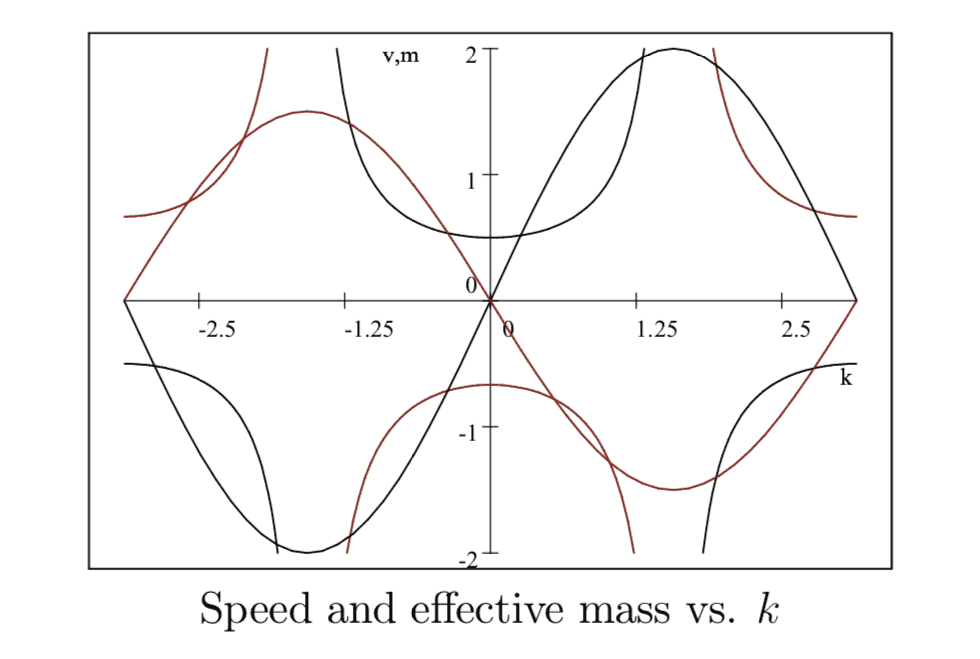
According to the semiclassical approximation, in response to a constant electric field I would get a periodic motion of the electron, like this:
Schermata 2019-09-02 alle 17.28.01.png

The sinusoidal type function is the velocity, while the function that goes to infinity is the effective mass. Thus I was wondering, since ##v## also gets negative values, does it means that an electron oscillates back and forth ?

Thanks,
Ric
 
Last edited:
Physics news on Phys.org
  • Like
Likes   Reactions: dRic2
fluidistic said:
Yes, this is called Bloch oscillations.

Thanks! Does the electron lose energy due to radiation emission ?
 
  • Like
Likes   Reactions: jim mcnamara and fluidistic
dRic2 said:
Thanks! Does the electron lose energy due to radiation emission ?
Good question. I think not, because radiation is a surface phenomenon while we are considering a perfect crystal (and at 0 K), i.e. a bulk. But then it's very strange, because we have a time varying current (AC), but no radiation. I'm not sure what's going on.
 
  • Like
Likes   Reactions: dRic2
fluidistic said:
Good question. I think not, because radiation is a surface phenomenon while we are considering a perfect crystal (and at 0 K), i.e. a bulk. But then it's very strange, because we have a time varying current (AC), but no radiation. I'm not sure what's going on.
That's reasonable. At least it is the only think I can think of... I am dumber than usual when it comes to radiation, but assuming that there is a continuous exchange of radiation between electrons in the bulk, wouldn't you expect a more complicated motion instead of simple oscillations ?
 
dRic2 said:
That's reasonable. At least it is the only think I can think of... I am dumber than usual when it comes to radiation, but assuming that there is a continuous exchange of radiation between electrons in the bulk, wouldn't you expect a more complicated motion instead of simple oscillations ?
Yeah for sure. For one, Bloch oscillations are derived from the idependant electrons assumption.
 
  • Like
Likes   Reactions: dRic2
fluidistic said:
Yeah for sure. For one, Bloch oscillations are derived from the idependant electrons assumption.
Then I find very surprising that they have been detected experimentally 😯😯
 

Similar threads

  • · Replies 7 ·
Replies
7
Views
2K
  • · Replies 0 ·
Replies
0
Views
3K
  • · Replies 3 ·
Replies
3
Views
3K
  • · Replies 5 ·
Replies
5
Views
4K
Replies
25
Views
1K
  • · Replies 20 ·
Replies
20
Views
7K
  • · Replies 1 ·
Replies
1
Views
3K
  • · Replies 1 ·
Replies
1
Views
7K
Replies
1
Views
4K
  • · Replies 15 ·
Replies
15
Views
4K