Periodic electron motion in a perfect conductor using a semiclassical model

Click For Summary

Discussion Overview

The discussion revolves around the periodic motion of electrons in a perfect conductor as described by a semiclassical model, specifically focusing on Bloch oscillations and the implications of radiation emission in this context.

Discussion Character

  • Exploratory
  • Technical explanation
  • Debate/contested

Main Points Raised

  • Ric introduces the concept of periodic electron motion in response to a constant electric field, questioning whether this implies oscillation back and forth due to negative velocity values.
  • Some participants confirm that this phenomenon is known as Bloch oscillations.
  • There is a question regarding whether electrons lose energy due to radiation emission during these oscillations.
  • One participant suggests that radiation is a surface phenomenon and, in the context of a perfect crystal at 0 K, it may not occur, leading to confusion about the presence of a time-varying current without radiation.
  • Another participant expresses uncertainty about the implications of continuous radiation exchange among electrons, suggesting that it might lead to more complex motion rather than simple oscillations.
  • It is noted that Bloch oscillations are derived from the assumption of independent electrons.
  • A participant expresses surprise that Bloch oscillations have been detected experimentally, given the assumptions involved.

Areas of Agreement / Disagreement

Participants generally agree on the identification of the phenomenon as Bloch oscillations, but there is uncertainty and debate regarding the implications of radiation emission and the assumptions of independent electrons.

Contextual Notes

There are limitations regarding the assumptions made about radiation and the independence of electrons, which are not fully resolved in the discussion.

dRic2
Gold Member
Messages
887
Reaction score
225
TL;DR
Imagine to have a perfect conductor, i.e. no impurities and no thermal motion (0K)
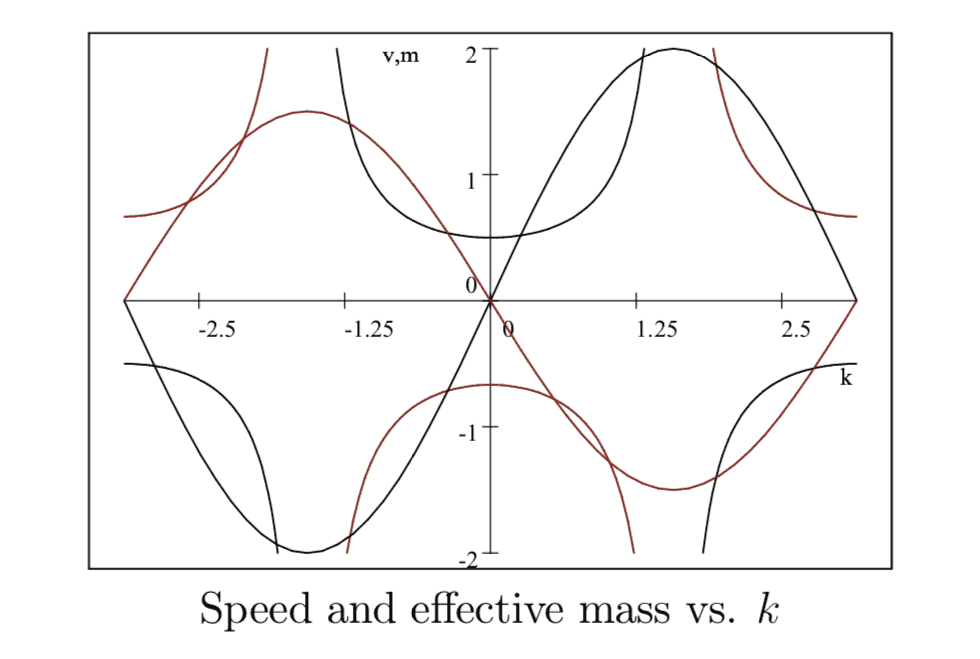
According to the semiclassical approximation, in response to a constant electric field I would get a periodic motion of the electron, like this:
Schermata 2019-09-02 alle 17.28.01.png

The sinusoidal type function is the velocity, while the function that goes to infinity is the effective mass. Thus I was wondering, since ##v## also gets negative values, does it means that an electron oscillates back and forth ?

Thanks,
Ric
 
Last edited:
Physics news on Phys.org
  • Like
Likes   Reactions: dRic2
fluidistic said:
Yes, this is called Bloch oscillations.

Thanks! Does the electron lose energy due to radiation emission ?
 
  • Like
Likes   Reactions: jim mcnamara and fluidistic
dRic2 said:
Thanks! Does the electron lose energy due to radiation emission ?
Good question. I think not, because radiation is a surface phenomenon while we are considering a perfect crystal (and at 0 K), i.e. a bulk. But then it's very strange, because we have a time varying current (AC), but no radiation. I'm not sure what's going on.
 
  • Like
Likes   Reactions: dRic2
fluidistic said:
Good question. I think not, because radiation is a surface phenomenon while we are considering a perfect crystal (and at 0 K), i.e. a bulk. But then it's very strange, because we have a time varying current (AC), but no radiation. I'm not sure what's going on.
That's reasonable. At least it is the only think I can think of... I am dumber than usual when it comes to radiation, but assuming that there is a continuous exchange of radiation between electrons in the bulk, wouldn't you expect a more complicated motion instead of simple oscillations ?
 
dRic2 said:
That's reasonable. At least it is the only think I can think of... I am dumber than usual when it comes to radiation, but assuming that there is a continuous exchange of radiation between electrons in the bulk, wouldn't you expect a more complicated motion instead of simple oscillations ?
Yeah for sure. For one, Bloch oscillations are derived from the idependant electrons assumption.
 
  • Like
Likes   Reactions: dRic2
fluidistic said:
Yeah for sure. For one, Bloch oscillations are derived from the idependant electrons assumption.
Then I find very surprising that they have been detected experimentally 😯😯
 

Similar threads

  • · Replies 7 ·
Replies
7
Views
3K
  • · Replies 0 ·
Replies
0
Views
3K
  • · Replies 3 ·
Replies
3
Views
3K
  • · Replies 5 ·
Replies
5
Views
4K
Replies
25
Views
1K
  • · Replies 20 ·
Replies
20
Views
7K
  • · Replies 1 ·
Replies
1
Views
3K
  • · Replies 1 ·
Replies
1
Views
7K
Replies
1
Views
4K
  • · Replies 15 ·
Replies
15
Views
4K