Permutation symbol - indicial notation

Click For Summary

Homework Help Overview

The discussion revolves around the use of indicial notation and permutation symbols, particularly in the context of vector operations and their mathematical representations. Participants are exploring the implications of squaring expressions involving indices and the relationships between different vector components.

Discussion Character

  • Exploratory, Conceptual clarification, Mathematical reasoning, Assumption checking

Approaches and Questions Raised

  • Participants are attempting to clarify the notation and operations involving the Levi-Civita symbol and its properties. Questions are raised about the proper treatment of indices when squaring expressions and the implications of summation conventions. There is also discussion about the meaning of the angle \theta in the context of vector cross products.

Discussion Status

There is ongoing exploration of the mathematical relationships and properties involved in the problem. Some participants have provided insights into the correct handling of indices and the implications of the Einstein summation convention. However, there is no explicit consensus on the resolution of the problem, and some participants express uncertainty about their understanding.

Contextual Notes

Participants note the importance of defining variables clearly, such as the angle \theta, and the constraints imposed by the notation used. There is mention of the need for additional information to fully address the problem at hand.

Dafe
Messages
144
Reaction score
0
1. The problem statement and attempt at solution

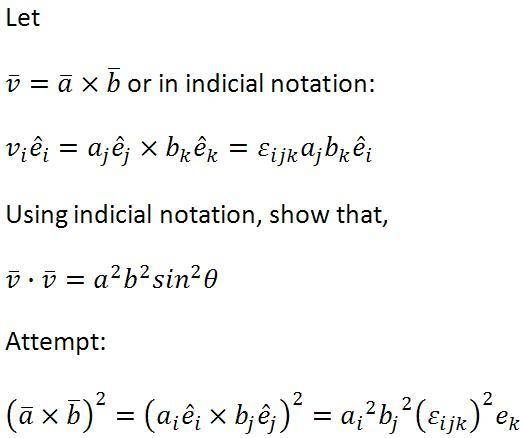
Hey, I'm still trying to get my head around indicial notation. I'm finding it quite hard..
21.jpg


I think this is somewhat right, but I don't know if the answer is clear enough..

Any hints/comments are greatly appretiated!

Thank you
 
Last edited:
Physics news on Phys.org
It would help if we knew what \theta was! The angle between \vec{a} and \vec{b}?

I think you need to add two things:
1) How you got from (a_i\hat{e}_i\times b_j\hat{e}_j)^2 to a_i^2b_j^2(\epsilon_{ijk})^2\hat{e}_k

2) Why \epsilon_{ijk} is equal to sin(\theta)
 
Something important to note is that when you square an expression with indices, you can't re-use any of the "dummy" indices (i.e. the ones you sum over). You have to write out the second factor using different symbols for the dummy indices. You can't just raise everything to the power 2.
e.g. If you take the square of
v_i = \epsilon_{ijk}a_j b_k
you get
v_i^2 = (\epsilon_{ijk}a_j b_k)(\epsilon_{imn}a_m b_n)
You CANNOT write
v_i^2 = (\epsilon_{ijk})^2(a_j)^2( b_k)^2
Write the summations out in full for a small example and you'll see that this is true.
 
Last edited:
Pacopag:
you write that:
<br /> v_i = \epsilon_{ijk}a_j b_k<br />

Does:

(\epsilon_{ijk}a_j b_k) = (\epsilon_{ijk}a_i b_j) ?

As for me not changing the indices when I took the square, that's exactly what I did :redface:

Thank you!
 
(\epsilon_{ijk}a_j b_k) = (\epsilon_{ijk}a_i b_j) ?
No. On the left hand side you are implying a summation over the repeated indices j and k. On the right hand side you are implying summation over i and j. This is not the same thing. Furthermore, in
v_i = \epsilon_{ijk}a_j b_k,
since i is not repeated in the left hand side, you are implying that i is fixed.
Do a google on the Einstein summation convention for more information.
 
<br /> v_i^2 = (\epsilon_{ijk}a_j b_k)(\epsilon_{imn}a_m b_n)<br />

\epsilon_{ijk}\epsilon_{imn}=\delta_{jm}\delta_{kn}-\delta_{jn}\delta_{km}

(\delta_{jm}\delta_{kn}-\delta_{jn}\delta_{km})(a_ja_mb_kb_n)

a_ja_jb_kb_k - a_ja_kb_kb_j = a_j^2b_k^2 - a_ja_kb_kb_j

I'm so incredibly stuck :rolleyes:
 
Dafe said:
<br /> v_i^2 = (\epsilon_{ijk}a_j b_k)(\epsilon_{imn}a_m b_n)<br />

\epsilon_{ijk}\epsilon_{imn}=\delta_{jm}\delta_{kn}-\delta_{jn}\delta_{km}

(\delta_{jm}\delta_{kn}-\delta_{jn}\delta_{km})(a_ja_mb_kb_n)
= (\delta_{jm}a_j)(\delta_{kn}b_n)a_mb_n- (\delta_{jn}a_j)(\delta_{km}a_m)b_kb_n
a_ma_m b_nb_n- a_na_kb_kb_n= a^2b^2- (a\cdot b)^2

a_ja_jb_kb_k - a_ja_kb_kb_j = a_j^2b_k^2 - a_ja_kb_kb_j

I'm so incredibly stuck :rolleyes:

a_na_n is a sum. It is equal to |a|^2 not a_n^2.
 
Alright, I get that but am still not able to solve the problem
Think I'll call it quits for now and do a bit more reading.
Looks like my head isn't ready for this yet :p

Thanks a lot though!
 
I notice that you still haven't told us what \theta is. If it is, in fact, the angle between \vec{a} and \vec{b}, and you are using a and b to denote the lengths of those two vectors, then you probably want to use the very fundamental property that \vec{a}\times\vec{b}= ab sin(\theta).
 
  • #10
Oh sorry, I totally forgot. Yes, theta is the angle between a and b.

v = (a x b) = (a_je_j x b_ke_k) = absin(\theta)

v_i = (\epsilon_{ijk}a_jb_k)=absin(\theta)

v_i^2 = (\epsilon_{ijk})^2a_j^2b_k^2=a^2b^2sin^2(\theta)

:redface:
 

Similar threads

  • · Replies 20 ·
Replies
20
Views
5K
Replies
3
Views
4K
  • · Replies 15 ·
Replies
15
Views
10K
  • · Replies 3 ·
Replies
3
Views
2K
  • · Replies 5 ·
Replies
5
Views
3K
Replies
12
Views
2K
  • · Replies 2 ·
Replies
2
Views
2K
  • · Replies 2 ·
Replies
2
Views
6K
  • · Replies 1 ·
Replies
1
Views
3K
  • · Replies 1 ·
Replies
1
Views
2K