Phase currents of Trapezoidal switching

Join the discussion
Ask a follow-up here, or get your own question answered by working scientists, mathematicians and engineers — people, not an autocomplete.
Real named experts · corrections over time · the nuance an AI answer skips
4 replies · 2K views
PhysicsTest
Messages
260
Reaction score
27
TL;DR
Calculate the phase currents for trapezoidal switching
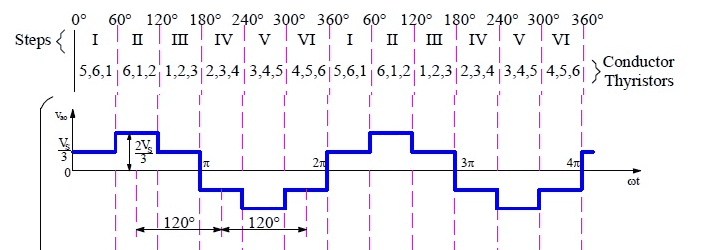
For trapezoidal switching or 180 degree switching these are the waveforms when i referred to the website
180 switching
1684308510462.png


when i calculated the RMS value of the phase voltage it is Vp = 0.4714Vs
so assuming the
Vs = supply voltage = 20V
and each phase - phase resistance as per the data sheet is 0.57 Ohms. So, the current is 16.52 amps in each phase? Are my calculations correct? Please advise.
 
Engineering news on Phys.org
Now i understand that the currents also depend on the inductance and the back emf of the motor connected. But one doubt is if the applied voltage and the back emf are equal then 0 correct flow. How does it happen?
TonyStewart said:
Show your assumptions
Sorry I don't understand this. Assumptions with regard to motor?
 
Yes all assumptions include RdsOn of source and complex load impedance for RMS current, backEMF @ RPM but a quick simulation on my part proves you are close to my answer for a pure 570m load of 16.46 Arms ... in theory, in practise is always different.

for +/- 13.33V with steps normalized to 1,2,1,-1,-2,-1.

There are harmonic differences with 8 phases and others, which do you think is best for cancellation? Considering magnetics are strong odd harmonics. Ask your prof.
 
Reply
  • Like
Likes   Reactions: PhysicsTest
If T is the shortest cycle at max RPM, and ##\tau=L/DCR## what would you expect for a good practical efficient motor for max Tau/T? and why? 1% , 10%, 100% ?
Also why would one ever want to use only 2/3 of Vs? Or just hypothetical Academic?