Zibi04
Member advised to use the homework template for posts in the homework sections of PF.
In a physics investigation we were required to use a Photo-Electric Effect Instrument (Shown in the attached pdf file), which was able to measure the current produced via the photoelectric effect.
One of the objectives of the investigation was to alter the aperture size, and hence intensity of the lamp and record the current created. As expected, the current increased as the intensity increased since more electrons were produced.
The next part of the investigation was to change the aperture size and observe the voltage required to stop electron flow towards the anode, i.e. the stopping voltage.
Theoretically, the light intensity should have no effect on the stopping voltage, where the stoppage voltage should be equal for all apertures. However, our results and every other groups results did not support this. The following are our results:

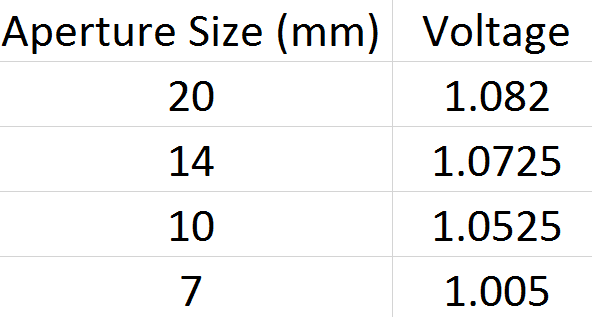
Clearly, each stopping voltage differs by a certain amount, hence resulting in a curved graph.
Does anybody happen to know what might have caused this, some sort of error etc.?
One of the objectives of the investigation was to alter the aperture size, and hence intensity of the lamp and record the current created. As expected, the current increased as the intensity increased since more electrons were produced.
The next part of the investigation was to change the aperture size and observe the voltage required to stop electron flow towards the anode, i.e. the stopping voltage.
Theoretically, the light intensity should have no effect on the stopping voltage, where the stoppage voltage should be equal for all apertures. However, our results and every other groups results did not support this. The following are our results:
Clearly, each stopping voltage differs by a certain amount, hence resulting in a curved graph.
Does anybody happen to know what might have caused this, some sort of error etc.?