Physics of the mountain car problem

  • Context: Undergrad 
  • Thread starter Thread starter Rupert Young
  • Start date Start date
  • Tags Tags
    Car Physics
Click For Summary

Discussion Overview

The discussion revolves around the physics of the mountain car problem, focusing on the dynamics of an underpowered car navigating a hilly landscape. Participants explore the underlying mechanics, equations governing motion, and the implications of inertia and forces acting on the car.

Discussion Character

  • Exploratory
  • Technical explanation
  • Debate/contested

Main Points Raised

  • One participant expresses confusion about the car's behavior, expecting it to stop when the forward force equals the gravitational force, but noting that it oscillates instead.
  • Another participant clarifies that the car's inertia allows it to move beyond the balance point of forces, leading to a negative velocity and a return down the slope.
  • A different participant critiques the equations provided, questioning the definition of "action" and asserting that acceleration results from net force rather than being a separate entity.
  • One participant points out that if the car starts with initial velocity and the engine is off, gravity will eventually stop the car and then accelerate it back down, leading to repeated oscillation.
  • A participant links to a Wikipedia article for clarification on the term "action" in the context of the mountain car problem.
  • Another participant comments on the quality of the equations in the linked article, suggesting that the focus is more on control strategies than on accurate physics.

Areas of Agreement / Disagreement

Participants express differing views on the interpretation of the equations and the physics involved. There is no consensus on the correctness of the equations or the understanding of the forces at play.

Contextual Notes

Some participants note that the equations may lack clarity and proper documentation, and there are unresolved questions about the definitions and implications of terms used in the discussion.

Rupert Young
Messages
28
Reaction score
2
I'm a bit confused by the physics of the mountain car problem.
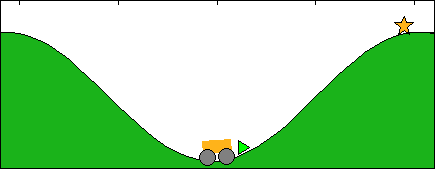
Mcar.png


The problem concerns driving an underpowered car up a mountain.

I had expected that the car would be able drive up to a point where the forward force due to acceleration is equal to the opposing force due to gravity and that the car would then just stop.

However, I am finding that the car falls back down and goes up the other slope, and continues to oscillates in that way.

What am I misunderstanding?

Here are the equations.

The landscape curve is given by, cos(3*(x+(pi/2))), where x is the position.

And,
Velocity = Velocity + (Action) * 0.001 + cos(3 * Position) * (-0.0025)
Position = Position + Velocity

where Action = 1
and starting position = -0.5, which is the bottom of the valley.
 
Physics news on Phys.org
Your expectation is wrong. The car's inertia will carry it beyond the point where forces balance, so velocity will go negative and the car will slip back.

I think you are intended to learn that the driver must use both forward and reverse to get enough head start to make it to the top of the hill. It is like rocking a car back and forth to get out of a slippery spot in a snow bank during winter.
 
Your equations do not make much sense, especially the second one which is dimensionally inconsistent.
What do you call "action" in this context? In physics action has a well defined meaning but it doe snot seem this is what you mean here.
There is no force "due to acceleration". The acceleration is due to the net force.
If the car starts with some initial velocity and the engine is shutdown, the only force is gravity and this force will produce the acceleration (opposite to the car's velocity) which will result in the car eventually stopping. Once it stops, the same force will accelerate it down the hill, where is come from. And the process repeats.
 
Oh, so the car is powered. Thank you for the link.
 
The equations in the Wiki article linked are poorly written and poorly documented. But I think the focus is not on accurate physics, but rather on control strategies to achieve a goal, given a set (any set) of equations.
 

Similar threads

  • · Replies 8 ·
Replies
8
Views
2K
  • · Replies 8 ·
Replies
8
Views
3K
  • · Replies 14 ·
Replies
14
Views
3K
  • · Replies 66 ·
3
Replies
66
Views
6K
  • · Replies 15 ·
Replies
15
Views
4K
  • · Replies 11 ·
Replies
11
Views
2K
  • · Replies 17 ·
Replies
17
Views
3K
  • · Replies 4 ·
Replies
4
Views
2K
Replies
1
Views
2K
  • · Replies 4 ·
Replies
4
Views
2K