orange7crush
- 2
- 0
In my physics problem I want to see how the energy transferred to a projectile differs if I (Setup A) set the weight on the lever arm and (Setup B) have a hanging weight on the lever arm.
Here are some images that better describe my project:


My experiment consisted of a base made of a 4x4 piece of wood and took identical pieces of wood straight up along the sides and another piece of wood for the lever arm. I used a metal cylinder as the pivot for the lever. I used three bricks as my 3 main masses and a golf ball for my projectile. I used a screw to stop the lever when it reached 90 degrees so the projectile would only have a horizontal component to its velocity. Here is a real life picture:
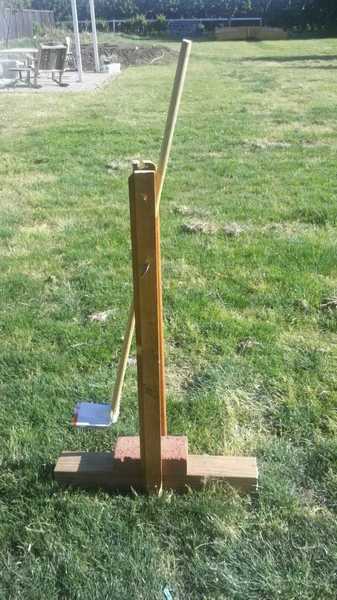
So my actual data I gathered from the experiment was the time of flight of the projectile and the distance it traveled when I let go of the mass and let the lever rotate. I have the height at which the lever arm released the golf ball, the height the ball started at and the height the counterweight(brick) started at.
Since my experiment was going for the energy efficiency difference: I used Energy Final / Energy Initial. Energy final = (KE of the ball + PE of the Ball at release) Energy initial = (PE of counterweight + PE of ball at initial height)
Is this good enough to see the difference in energy efficiencies of a weight on top of a lever arm and a weight hanging from a lever arm if the weight has the same height as to have the PE?
Is there more calculations needed? (moment of inertia, rotational momentum, etc...)
Here are some images that better describe my project:
My experiment consisted of a base made of a 4x4 piece of wood and took identical pieces of wood straight up along the sides and another piece of wood for the lever arm. I used a metal cylinder as the pivot for the lever. I used three bricks as my 3 main masses and a golf ball for my projectile. I used a screw to stop the lever when it reached 90 degrees so the projectile would only have a horizontal component to its velocity. Here is a real life picture:
So my actual data I gathered from the experiment was the time of flight of the projectile and the distance it traveled when I let go of the mass and let the lever rotate. I have the height at which the lever arm released the golf ball, the height the ball started at and the height the counterweight(brick) started at.
Since my experiment was going for the energy efficiency difference: I used Energy Final / Energy Initial. Energy final = (KE of the ball + PE of the Ball at release) Energy initial = (PE of counterweight + PE of ball at initial height)
Is this good enough to see the difference in energy efficiencies of a weight on top of a lever arm and a weight hanging from a lever arm if the weight has the same height as to have the PE?
Is there more calculations needed? (moment of inertia, rotational momentum, etc...)