Physics Work & Kinetic Energy Question

Click For Summary
SUMMARY

The forum discussion centers on the application of the Kinetic Work Energy theorem to solve a physics problem involving work done by friction. The user, Expo, attempts to calculate the work done by friction but encounters discrepancies in the expected kinetic energy values. Key insights reveal that the applied force P does positive work while friction does negative work, leading to a conclusion that the exercise may contain a typo regarding energy values. The correct formula to use is Worknet = ΔKE, where the net work is the sum of the work done by all forces acting on the object.

PREREQUISITES
  • Understanding of the Kinetic Work Energy theorem
  • Familiarity with vector forces and their components
  • Knowledge of work calculation using the formula W = F · d
  • Basic principles of friction and its effects on motion
NEXT STEPS
  • Study the Kinetic Work Energy theorem in detail
  • Learn about vector decomposition and force components
  • Explore examples of work done by friction in various scenarios
  • Review common errors in physics problem statements and how to identify them
USEFUL FOR

Students preparing for physics exams, educators teaching mechanics, and anyone interested in understanding the principles of work and energy in physical systems.

Exspozed
Messages
2
Reaction score
0
moved fro classical physics forum
Hello, I have a question regarding one of the questions on a sample exam I have for an upcoming test tomorrow.
For question 2, I attempt to use the Kinetic Work Energy theorem to solve for the Work done by friction, but I don't get a correct answer.
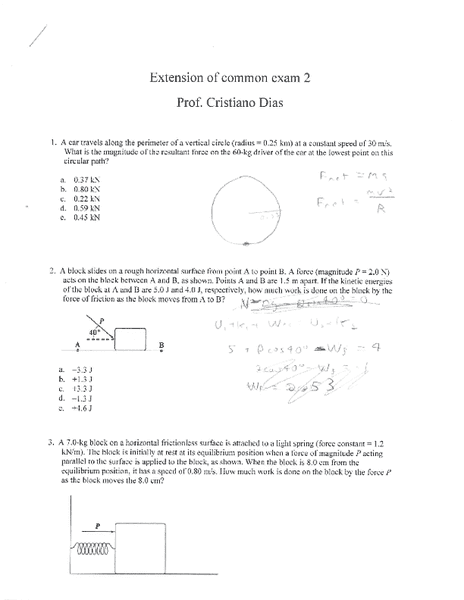
LrntAJt.png


As you can see, I attempted certain things, but I feel as if I am missing a key concept. Could anybody solve this for me? Again, this is not a graded assignment, just a practice exam they gave us to help us review the material.
Thanks!
Note: sorry if I posted this in the wrong section, first time on this website!
 
Physics news on Phys.org
Hello Expo; welcome to PF :)

I understand the time pressure, but you have to give potential helpers a chance: keep it understandable (and legible -- the exercise tekst is badly legible and your work is as good as illegible).

I see a block that moves over 1.5 m from A to B. Let the positive x-direction be to the right. That means the applied force P does work to the tune of ##1.5\; m \times P \times \cos(140^{\circ}) = - 2.3 \; J## .

In other words, if there were no fricion the kinetic energy would be reduced from 5 J at point A to 2.7 J at point B.

The exercise states that the kinetic energy drops from 5 J to 4 J. In order for that to be the case, the friction would have to add 1.3 J to the kinetic energy. There is no way friction can do that, so I am inclined to see this as a typo or some other error in the exercise statement. For example: If the movement would have been from B to A, then P would add 2.3 J and the friction could take away 3.3 J to get from 5 J to 4 J, and to me the -3.3 J would then be the right answer.

If I were you, I wouldn't spend more time on this. Unless one of my colleagues has a useful comment to add.
 
The formula you'd like is: Worknet = ΔKE

We can let the work done by force P be positive, and we can let the work done by friction be negative. Substitute in the sum of the work done by those two agents for work net in the above equation to solve for work done by friction.

@BvU: Force P acts at an angle of 40° (making cosine of the angle positive) as opposed to at 140°.
 
.

(I accidentally replied when I meant to edit my original post.)
 
Impulse said:
The formula you'd like is: Worknet = ΔKE

We can let the work done by force P be positive, and we can let the work done by friction be negative. Substitute in the sum of the work done by those two agents for work net in the above equation to solve for work done by friction.

@BvU: Force P acts at an angle of 40° (making cosine of the angle positive) as opposed to at 140°.

Hogwash. Work ##\ dW \equiv \vec F \cdot d\vec s \ ## ; the inner product of ##\vec F## and ##\vec s## is negative.

To eliminate any confusion I clearly let x point to the right. Doesn't even matter: a redefinition of the coordinates leaves the sign of ##W## unchanged.

And friction force is always in a direction opposite to the motion. So friction work is always < 0 .

Wouldn't be good for car brakes if it weren't ...
 
BvU said:
Hogwash. Work ##\ dW \equiv \vec F \cdot d\vec s \ ## ; the inner product of ##\vec F## and ##\vec s## is negative.

To eliminate any confusion I clearly let x point to the right. Doesn't even matter: a redefinition of the coordinates leaves the sign of ##W## unchanged.

And friction force is always in a direction opposite to the motion. So friction work is always < 0 .

Wouldn't be good for car brakes if it weren't ...

The way I interpret the question, force P is not friction but an external force such as a push that points to the right (in the direction of point B) and acts on the object in addition to friction (which points to the left in the direction of A opposite the object's motion.) Force P causes the motion to the right, and force friction opposes it.

(However, there is no arrow on vector P and the wording is unclear, so at this point we're speculating as to the author's intent.)
 
o:) Humble pie !

Increased the enlargement on my screen and discovered a puny little arrow in the figure !
And sure enough P is pointing at an angle 400 wrt the motion.

So sure enough P adds 2.3 J .

My apologies to Expo he gets such an impulsive response on his first post...but next time add a slightly clearer picture, please
And my apologies to Impulse that he is exposed to my unwarranted "hogwash"
 
Thank you both for your help! ByU, your solution was a bit unorthodox if I may add, but it still helped nevertheless :)
 

Similar threads

Replies
1
Views
1K
  • · Replies 58 ·
2
Replies
58
Views
3K
  • · Replies 8 ·
Replies
8
Views
1K
  • · Replies 9 ·
Replies
9
Views
2K
  • · Replies 33 ·
2
Replies
33
Views
3K
Replies
1
Views
2K
  • · Replies 7 ·
Replies
7
Views
1K
  • · Replies 16 ·
Replies
16
Views
1K
  • · Replies 4 ·
Replies
4
Views
2K
  • · Replies 6 ·
Replies
6
Views
2K