Picture of Bragg's diffraction sounds confusing

Click For Summary
SUMMARY

The discussion centers on the confusion surrounding Bragg's Law of Diffraction, specifically regarding the interference of wave beams C and C' on a detector screen. It is clarified that while these beams hit different points on the screen, they can still undergo constructive interference due to their phase alignment, provided the path difference equals an integer multiple of the wavelength. The explanation emphasizes that the incoming and outgoing rays are nearly parallel, and although they may intersect at the detector, calculations can assume parallelism within the crystal structure for simplicity.

PREREQUISITES
  • Understanding of Bragg's Law of Diffraction
  • Familiarity with wave interference principles
  • Basic knowledge of x-ray diffraction techniques
  • Concept of path difference in wave mechanics
NEXT STEPS
  • Study the derivation of Bragg's Law in detail
  • Explore the concept of constructive and destructive interference in wave physics
  • Learn about x-ray diffraction methods and their applications in material science
  • Investigate the geometry of wave propagation in crystalline structures
USEFUL FOR

Students and researchers in physics, particularly those focused on crystallography, material science, and wave mechanics, will benefit from this discussion.

kasha
Messages
7
Reaction score
0
This may be a little of a stupid question.

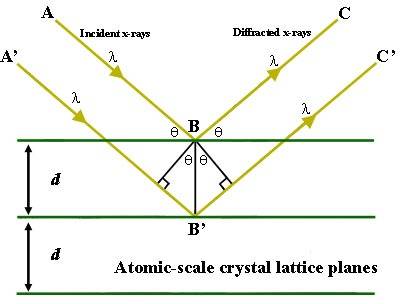
But I was looking at a diagram describing Bragg's Law of Diffraction.
2Ltz4.jpg


and I was like...how can an interference happen if wave beam C and wave beam C' are hitting different points on the detector screen?! they are not hitting the same point on the detector.

Per Wikipedia: The two separate waves will arrive at a point with the same phase, and hence undergo constructive interference, if and only if this path difference is equal to any integer value of the wavelength...but how would they arrive at the same point? I think the graph is very confusing.

Any help to clear things up would be very appreciated...
 
Science news on Phys.org
The beams are much wider than the plane spacing. You actually have many many parallel incoming rays and many many parallel outgoing rays. Try shifting one of the rays in the diagram horizontally so that the outgoing rays coincide. With this new diagram, deriving the path difference to be 2d sin θ is more complicated, but it can be done.
 
I actually found the answer for that...
First: the lines are not perfectly parallel, they are almost parallel. over the very short distance (d in Angstrom) the paths of the reflected x-rays C and C' are pretty much parallel, but over the distance of the screen of the detector let's say it is L...the lines are not parallel. it is safe to assume the lines are parallel in our calculations inside the Crystal Latex...but they do intersect at some point on the screen.
 

Similar threads

  • · Replies 54 ·
2
Replies
54
Views
10K
  • · Replies 7 ·
Replies
7
Views
2K
Replies
12
Views
1K
  • · Replies 4 ·
Replies
4
Views
2K
  • · Replies 2 ·
Replies
2
Views
2K
  • · Replies 19 ·
Replies
19
Views
3K
  • · Replies 13 ·
Replies
13
Views
3K
  • · Replies 10 ·
Replies
10
Views
3K
  • · Replies 1 ·
Replies
1
Views
5K
  • · Replies 12 ·
Replies
12
Views
3K