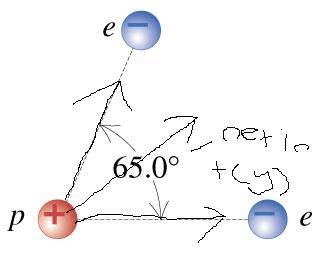
Picture to make sure my concepts are correct.

  • Thread starter Thread starter Mdhiggenz
  • Start date Start date
  • Tags Tags
    Concepts Picture
Click For Summary

Homework Help Overview

The discussion revolves around understanding the forces exerted by two electrons on a proton, particularly focusing on the correct representation of these forces in a diagram. Participants are examining the components of these forces and their magnitudes, with a specific angle of 65 degrees being referenced.

Discussion Character

  • Conceptual clarification, Mathematical reasoning, Assumption checking

Approaches and Questions Raised

  • Participants are attempting to clarify the correct order and components of forces in a diagram. Questions arise regarding the calculation of force components, particularly the use of sine and cosine for different angles. There is also discussion about the assumptions made regarding the distances and angles involved.

Discussion Status

Some participants have provided guidance on the correct approach to calculating the resultant force, noting errors in previous calculations. There is an ongoing exploration of different interpretations of the problem, particularly regarding the components of the forces and their resultant magnitudes.

Contextual Notes

There is an assumption that the electrons are equidistant from the proton, which influences the calculations being discussed. The angle of 65 degrees is central to the problem, and participants are questioning how this angle affects the force components.

Mdhiggenz
Messages
324
Reaction score
1

Homework Statement


2rh2v83.jpg


can you judge the diagram I want to make sure i have the forces being exerted in the correct order.


Homework Equations


The Attempt at a Solution

 
Physics news on Phys.org
Mdhiggenz said:

Homework Statement


2rh2v83.jpg


can you judge the diagram I want to make sure i have the forces being exerted in the correct order.

Homework Equations


The Attempt at a Solution

That's the correct direction. If you add the vectors correctly, you will also get the correct magnitude !
 
One more question sam. I have want to make sure I clearly understand, Let's call the top top electron E1, and bottom E2.

I only have to get the Cosine of the bottom election because it is on the horizontal and not on an angle, but for E1 I have to get both the sin and cos.

And to get the magnitude I can simply add squareroot fsin(theta)+2fcos(theta) ?
 
Mdhiggenz said:
One more question sam. I have want to make sure I clearly understand, Let's call the top top electron E1, and bottom E2.

I only have to get the Cosine of the bottom election because it is on the horizontal and not on an angle, but for E1 I have to get both the sin and cos.

And to get the magnitude I can simply add squareroot fsin(theta)+2fcos(theta) ?
No. That won't give the correct answer.

There seems to be the assumption that the electrons are equidistant from the proton, so that the magnitude of the force that each electron exerts on the proton is f. Right?

What are you calling θ, (theta)?

If θ = 65°/2, then (f)cos(θ) the component of the force along the resultant that's exerted by either of the electrons.
 
Pretty much my theta is 65 degrees and what I am doing is this

√(F)^2+(Fsin(65))^2+(Fcos(65))^2

and I don't understand how it isn't giving me the answer
 
Mdhiggenz said:
Pretty much my theta is 65 degrees and what I am doing is this

√(F)^2+(Fsin(65))^2+(Fcos(65))^2

and I don't understand how it isn't giving me the answer
Earlier you said "squareroot fsin(theta)+2fcos(theta)".

But what you have here is also not correct.

The horizontal component is F + F cos(65°) which is equal to F(1 + cos(65°)) .

The vertical component is F sin(65°) .

Square each component, sum those & take the square root of the result. That's close to what you have, but (a + b)2 ≠ a2 + b2.
 
Mdhiggenz said:
Pretty much my theta is 65 degrees and what I am doing is this

√(F)^2+(Fsin(65))^2+(Fcos(65))^2

and I don't understand how it isn't giving me the answer
Now that a complete answer to a similar, but more detailed problem has been given in another of your threads, I'll give the solution here, arrived at in two ways.

The link to that other thread of yours: https://www.physicsforums.com/showthread.php?t=635951 .

If F is the magnitude of the force that one of the electrons exerts on the proton, then:

E2 exerts a force of F in the horizontal direction.

E1 exerts a force which has a component of F cos(65°) in the horizontal direction and a component of F sin(65°) in the vertical direction.

The magnitude of that force is:

[itex]\displaystyle \sqrt{\left(F+F\cos(65^\circ)\,\right)^2+\left(F \sin(65^\circ)\,\right)^2}[/itex]
[itex]\displaystyle <br /> =F\sqrt{\left(1+\cos(65^\circ)\,\right)^2+\sin^2(65^\circ)}[/itex]

[itex]\displaystyle =F\sqrt{1+2\cos(65^\circ)+\cos^2(65^\circ)+\sin^2(65^\circ)}[/itex]

[itex]\displaystyle =F\sqrt{2+2\cos(65^\circ)}[/itex]

[itex]\displaystyle =2F\sqrt{\frac{1+\cos(65^\circ)}{2}}[/itex]

[itex]\displaystyle =2F\cos(32.5^\circ)[/itex]​

A simpler way:

Of course if you look at the component of the force E2 exerts parallel to the bisector of the 65° angle, that component is F cos(32.5°). Similarly the component of the force E1 exerts in that same direction is also F cos(32.5°). Making the resulting component of the force parallel to the bisector 2F cos(32.5°).

The forces perpendicular to the bisector cancel.
 
Really appreciate the clear and thorough explanation. It makes perfect sense now!
 

Similar threads

  • · Replies 9 ·
Replies
9
Views
1K
  • · Replies 9 ·
Replies
9
Views
3K
  • · Replies 27 ·
Replies
27
Views
1K
  • · Replies 4 ·
Replies
4
Views
2K
  • · Replies 20 ·
Replies
20
Views
4K
  • · Replies 6 ·
Replies
6
Views
2K
  • · Replies 2 ·
Replies
2
Views
1K
  • · Replies 8 ·
Replies
8
Views
2K
  • · Replies 16 ·
Replies
16
Views
2K
  • · Replies 6 ·
Replies
6
Views
1K