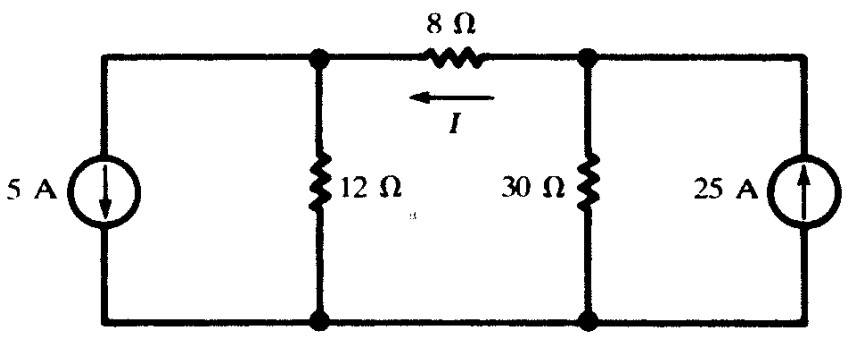
I haven't done circuit theory in years, but here goes nothing lol.
Just as a review, when you're using superposition theorem, you only "turn on" one source on at a time. In this case, you can split this circuit up into two cases:
5A Current Source = Let's call this Case #1.
25A Current Source = Let's call this Case #2Case #1: Only turn on "5A current source": Which means you turn off the 25A current source. So, the 25A current source will be an "open".
This means, you will be left with the 5A Current source in parallel with the 12 ohm resistor in parallel with the "38 ohm resistor"
So for this case, the 30 ohm resistor and the 8 ohm resistor have the same current because they are in series.
You can use the current divider equation in this case and find the current for the "38 ohm" ohm resistor, which then gives you the current for the 8 ohm resistor. This current can be called I'
I got 1.2 A for this current value.For Case #2: Only 25A current source on:
So for this case, the 5A current source is turned off. Which means the 5A current source becomes an "open".
This means that the 25A current source is now in parallel with the 30 ohm resistor and in parallel with the "20 ohm resistor" (i.e. because now the 8 ohm resistor is in series with the 12 ohm resistor).
The current through the 8 ohm resistor is the same as the current through the 12 ohm resistor, since they are in series.
You should be able to use current division to find the current through the "20 ohm resistor", which will give you the current through the 8 ohm resistor. This current value will be called I". I got 15A for this current value.
Your total "I" current value will be = I' + I"
My total I = I' + I" = 15A + 1.2A = 16.2A
Let me know what the final solution is to double check this work.