kevinp
- 4
- 0
Just found this forum and found some great help here so far just reading some posts. But I am stuck on a question in my homework. I am asking you to help check my work and make sure I am going in the right direction. I missed my lecture due to illness and have to figure this out on my own. Thank you in advance.
The question asks for the 3 different currents through R2; With E1 as the source only, E2 as the source only, and both E1 and E2.
Here are the variables:
E1= 11V
E2= 8V
R1= 430ohms
R2= 250ohms
R3= 200ohms
R4= 130ohms
Here is the diagram
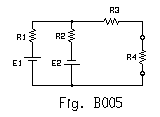
This is my work with E1 as the only source Voltage
Rt= R1 + ((R2x(R3+R4)) / R2 + R3 + R4)
Rt= 572.2414ohms
Rt (of parallel circuit only is 142.2414ohms)
It= E/Rt = 11/572...
It= 19.223mA
Based on KVL, the current of It = R1 = Ra (the parallel circuit of R2 and (R3 + R4 in series)
Using the current divider, I got
I2= Rt (of parallel) / Rt(prl) + R2 * It
I2 = 6.971mA
So far so good?
With E2 as the only source voltage, I made R1 and R2 the parallel circuit and had the branch of R3, R4 and R2 as my series circuit
Rt = R4 + R3 + (R1xR2 / (R1+R2))
Rt= 488.0882ohms
Rt of parallel = 158.0882ohms
It = E/Rt
It = 16.3905 mA
Current divider rule
I2 = 158.0882 / (158.0082 + 250) ohms * 16.3905mA
I2 = 6.3495
I do not have the answers to this question since its a online test and each section is worth 1% of my final mark. I would like you to help make sure I am doing this question right so I can move onto the other ones.
Where I get stuck is how to find the answer with both voltage sources.
I assume based on the fact there series adding that I would add them together for a total of 13.3205mA but this is where I am unsure.
On top of that, for my future questions, how would I find Rt of the entire circuit with both sources? For the current total, since its a series adding circuit, could I add both to get 3X.XX mA for the It. If that's the case I could find Rt using ohms law, but any help is much appreciated.
Thank you
The question asks for the 3 different currents through R2; With E1 as the source only, E2 as the source only, and both E1 and E2.
Here are the variables:
E1= 11V
E2= 8V
R1= 430ohms
R2= 250ohms
R3= 200ohms
R4= 130ohms
Here is the diagram
This is my work with E1 as the only source Voltage
Rt= R1 + ((R2x(R3+R4)) / R2 + R3 + R4)
Rt= 572.2414ohms
Rt (of parallel circuit only is 142.2414ohms)
It= E/Rt = 11/572...
It= 19.223mA
Based on KVL, the current of It = R1 = Ra (the parallel circuit of R2 and (R3 + R4 in series)
Using the current divider, I got
I2= Rt (of parallel) / Rt(prl) + R2 * It
I2 = 6.971mA
So far so good?
With E2 as the only source voltage, I made R1 and R2 the parallel circuit and had the branch of R3, R4 and R2 as my series circuit
Rt = R4 + R3 + (R1xR2 / (R1+R2))
Rt= 488.0882ohms
Rt of parallel = 158.0882ohms
It = E/Rt
It = 16.3905 mA
Current divider rule
I2 = 158.0882 / (158.0082 + 250) ohms * 16.3905mA
I2 = 6.3495
I do not have the answers to this question since its a online test and each section is worth 1% of my final mark. I would like you to help make sure I am doing this question right so I can move onto the other ones.
Where I get stuck is how to find the answer with both voltage sources.
I assume based on the fact there series adding that I would add them together for a total of 13.3205mA but this is where I am unsure.
On top of that, for my future questions, how would I find Rt of the entire circuit with both sources? For the current total, since its a series adding circuit, could I add both to get 3X.XX mA for the It. If that's the case I could find Rt using ohms law, but any help is much appreciated.
Thank you