Plotting the Probability Density of the Coulomb Wave Function

Click For Summary

Discussion Overview

The discussion revolves around the plotting of the probability density of the Coulomb wave function, specifically focusing on the 3D density plots of various wave functions associated with quantum states. Participants explore the characteristics of these wave functions, their representations in different coordinate systems, and the implications for understanding orbital shapes and properties.

Discussion Character

  • Exploratory
  • Technical explanation
  • Debate/contested
  • Mathematical reasoning

Main Points Raised

  • One participant notes an issue with their 3D density plots, observing that the plots for |ψ(2, 1, -1)|² and |ψ(2, 1, 1)|² are identical, contrary to expectations of rotational symmetry.
  • Another participant explains that the spherical harmonics Yℓ,±m differ by a relative phase, which results in the same complex modulus, thus leading to identical probability densities.
  • It is suggested that suitable linear combinations of ψ(2, 1, -1) and ψ(2, 1, +1) can yield the p_x and p_y orbitals, which prompts further questions about the nature of these orbitals.
  • A participant expresses confusion about whether some orbital wave functions are energy eigenfunctions, questioning the implications of linear combinations on eigenstates.
  • Responses clarify that while p_x and p_y are not eigenfunctions of the angular momentum operator L_z, they remain energy eigenfunctions.
  • Questions arise regarding the nature of donut-shaped probability densities and their validity as orbitals, with some participants asserting that these are valid but complex functions.
  • There is a request for a systematic method to combine base wave functions to generate all electron orbitals, indicating a desire for a more structured approach to understanding orbital shapes.

Areas of Agreement / Disagreement

Participants express differing views on the nature and validity of certain wave functions and their combinations. While there is some agreement on the properties of energy eigenfunctions, the discussion remains unresolved regarding the systematic generation of all orbitals and the interpretation of complex functions.

Contextual Notes

Participants reference the need for clarity in the conversion between spherical and Cartesian coordinates, as well as the implications of linear combinations on the properties of wave functions. The discussion highlights the complexity of interpreting quantum states and their representations.

tomdodd4598
Messages
137
Reaction score
13
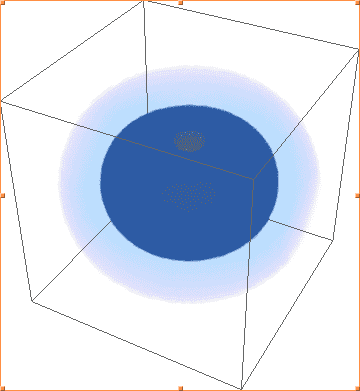
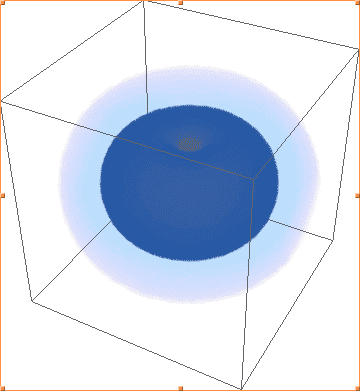
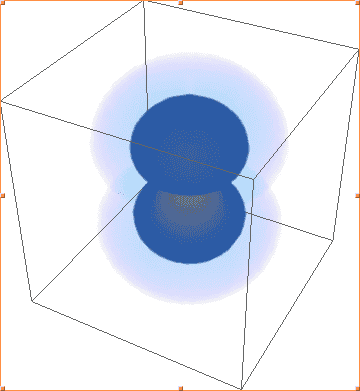
Hey there - I think I have an issue with my 3D density plots of the probability density of the Coulomb wave function. The reason I think something is going wrong is because my plots of |ψ(n=2, l=1, m=-1)|² and |ψ(2, 1, 1)|² are identical, while I would expect them to have the same shape but be rotationally symmetric along different orthogonal axes.
cph1joM.png
oF3Tp6b.png
DXDLHxW.png


The above images are Mathematica's plots of |ψ(2, 1, -1)|², |ψ(2, 1, 0)|², |ψ(2, 1, 1)|², respectively. As you can see, the first and third are identical, and not the shape of 2p orbitals, while the second plot actually looks like what I would expect - one of the three 2p orbitals.

Here is my wave function - it's possible that the conversion from spherical to Cartesian coordinates is a problem, but I'm not sure:

AfffBBP.png


If the above needs clarifying, do ask. Thanks for any help in advance ;)
 
Physics news on Phys.org
If you take suitable linear combinations of ##\psi(2,1,-1)## and ##\psi(2,1,+1)##, and then find the probability densities, you do get the ##p_x## and ##p_y## orbitals.
 
jtbell said:
If you take suitable linear combinations of ##\psi(2,1,-1)## and ##\psi(2,1,+1)##, and then find the probability densities, you do get the ##p_x## and ##p_y## orbitals.

Ah, I've managed to make linear combinations which give the x and y-direction p orbitals, but I am still confused - does that mean some orbital wave functions aren't energy energy eigenfunctions? How/why would that be true?
 
tomdodd4598 said:
Ah, I've managed to make linear combinations which give the x and y-direction p orbitals, but I am still confused - does that mean some orbital wave functions aren't energy energy eigenfunctions? How/why would that be true?
They are still energy eigenfunctions. However, ##p_x## and ##p_y## are not eigenfunctions of ##\hat{L}_z##.
 
DrClaude said:
They are still energy eigenfunctions. However, ##p_x## and ##p_y## are not eigenfunctions of ##\hat{L}_z##.

Right, I understand that, but I've now got more questions - what are those donut-shaped probability densities? Why aren't they valid orbitals? Also, is there a systematic way for me to combine these 'base' wave functions to create the correct electron orbitals? I managed to make an intuitive guess with the other two p orbitals, but is there a general set of linear combinations which give all of the orbitals?
 
Last edited:
tomdodd4598 said:
Right, I understand that, but I've now got more questions - what are those donut-shaped probability densities? Why aren't they valid orbitals?
They are completely valid orbitals. But they are complex functions, which can make them more difficult to work with in certain situations. The ##p_x## and ##p_y## orbitals are completely real functions, and their orientation along the Cartesian coordinates makes them useful to understand things like chemical bonding.

tomdodd4598 said:
Also, is there a systematic way for me to combine these 'base' wave functions to create the correct electron orbitals? I managed to make an intuitive guess with the other two p orbitals, but is there a general set of linear combinations which give all of the orbitals?
See https://en.wikipedia.org/wiki/Atomic_orbital#Real_orbitals
 

Similar threads

  • · Replies 8 ·
Replies
8
Views
2K
  • · Replies 64 ·
3
Replies
64
Views
6K
  • · Replies 16 ·
Replies
16
Views
2K
  • · Replies 7 ·
Replies
7
Views
1K
  • · Replies 2 ·
Replies
2
Views
1K
  • · Replies 2 ·
Replies
2
Views
1K
Replies
4
Views
2K
  • · Replies 11 ·
Replies
11
Views
3K
  • · Replies 7 ·
Replies
7
Views
2K
Replies
29
Views
4K