Plotting the radial wave function of Deuteron in a finite well

Click For Summary
SUMMARY

This discussion focuses on plotting the radial wave function of the Deuteron within a finite potential well using Python 3.7. The user describes the need to find solutions for the wave function in different regions and emphasizes the importance of continuity at the boundary, specifically at r=R. The equations k²=2μ(E+V0)/ħ² and κ²=2μE/ħ² are critical for determining the values of k and κ, with V0 set at 35 MeV and E calculated as -2.223 MeV. The user also highlights the necessity of evaluating u(r) and its derivative at r=R before plotting to ensure accuracy.

PREREQUISITES
  • Understanding of quantum mechanics, specifically wave functions and potential wells
  • Proficiency in Python 3.7 for numerical computations and plotting
  • Familiarity with root-finding algorithms and numerical methods
  • Knowledge of continuity conditions for wave functions in quantum mechanics
NEXT STEPS
  • Implement root-finding algorithms in Python, such as the Newton-Raphson method
  • Explore numerical libraries in Python, like NumPy and SciPy, for advanced mathematical functions
  • Learn about normalization of wave functions in quantum mechanics
  • Study the implications of continuity conditions on wave functions and their derivatives
USEFUL FOR

Students and researchers in quantum mechanics, computational physicists, and anyone involved in numerical modeling of wave functions in potential wells.

TopologyisGeometry
Messages
2
Reaction score
2
Homework Statement
Plot the wave function ##u(r)## as a function of ##r## from 0 to 10 fm. Since ##u##is not normalized, you won't need units on the y axis.
Relevant Equations
$$\frac{-\hbar^2}{2\mu}\frac{d^2u(r)}{dr^2}+V(r)u(r) = Eu(r)$$ Where $$V(r) = \begin{cases}-V_0 \quad r<R\\ 0\quad r>R\end{cases}$$ Which has the solutions previously found to be

$$u(r)=\begin{cases}A\sin(kr)\quad r<R\\ De^{-\kappa r}\qquad r>R\end{cases}$$
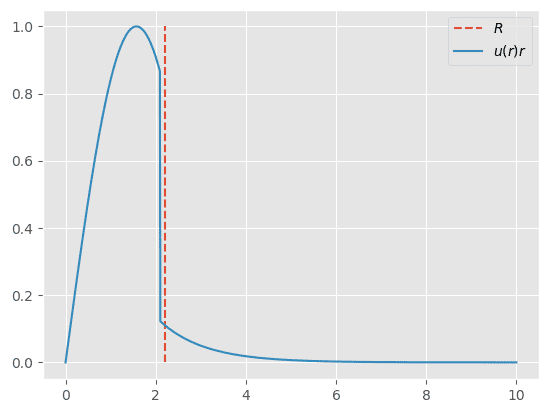
To plot ##u(r)## we need to find the solutions for each region. Which is in the relevant equations part. Now, I have to do this numerically. Using python 3.7 I made an ##u## which is filled with zeros and a for loop with if/elseif statement, basically telling it to plot values for whenever ##r<R## and ##r>R##. Here is the plot generated by my simple code
1584374866735.png


Due to continuity at $r=R$ they need to have the same value. Which makes me believe that this is a root finding problem, basically ##A\sin(kr)-De^{-\kappa r}=0## Now I don't know how to implement this onto my code, at first I thought make another elif statement for when ##r==R## to use the roots as the values, how would I go on about this problem? Have I forgotten something?
 
Physics news on Phys.org
You have some prepping to do that it is better done with pencil and paper, not code. At ##r=R##, the wavefunction and its derivative must be continuous. This will give you a relation between ##k## and ##\kappa## which you will have to solve numerically (the root finding part) to find ##k## and ##\kappa## for an assumed numerical value of ##V_0.## Then you can write the unnormalized wavefunction in terms of ##A## or ##D## and plot.
 
kuruman said:
You have some prepping to do that it is better done with pencil and paper, not code. At ##r=R##, the wavefunction and its derivative must be continuous. This will give you a relation between ##k## and ##\kappa## which you will have to solve numerically (the root finding part) to find ##k## and ##\kappa## for an assumed numerical value of ##V_0.## Then you can write the unnormalized wavefunction in terms of ##A## or ##D## and plot.
I found that ##k\cot{kr} = -\kappa## which comes from the fact that we claim ##u(r)## to be continuous everywhere and it's derivate too, then I just divided to get rid of the coefficients, where ##k^2=2\mu(E+V0)/\hbar^2## and ##\kappa^2=2\mu E/\hbar^2## if that's what you're asking ##V0=35MeV## and I found that ##E=-2.223 MeV## This should be everything to plot this right?
 
Before plotting, I would evaluate ##u(r)## and its derivative at ##r=R## to make sure that I did not make any mistakes. Also, if you are not going to normalize ##u(r)##, be sure to use one of the continuity equations in order to write ##u(r)## in terms of single constant, ##A## or ##D##.
 

Similar threads

  • · Replies 30 ·
2
Replies
30
Views
3K
  • · Replies 4 ·
Replies
4
Views
2K
Replies
10
Views
3K
Replies
7
Views
3K
  • · Replies 5 ·
Replies
5
Views
2K
  • · Replies 2 ·
Replies
2
Views
3K
  • · Replies 2 ·
Replies
2
Views
4K
Replies
4
Views
5K
Replies
1
Views
2K
  • · Replies 2 ·
Replies
2
Views
3K