Points of a finite projective line

  • Context: Undergrad 
  • Thread starter Thread starter Lapidus
  • Start date Start date
  • Tags Tags
    Finite Line Points
Click For Summary
SUMMARY

The discussion focuses on computing fractions in the finite field GF(23), specifically how 2/5 and 18/22 both yield the result of 5. The calculations demonstrate that in GF(23), 2 multiplied by its multiplicative inverse of 5 results in 5, as shown by the equation 5 × 5 = 25 ≡ 2 (mod 23). Similarly, 18/22 also simplifies to 5 through the equation 5 × 22 = 110 ≡ 18 (mod 23). This illustrates the properties of finite fields, particularly when the field order is a prime number.

PREREQUISITES
  • Understanding of finite fields, specifically GF(p) where p is prime.
  • Knowledge of modular arithmetic and equivalence classes.
  • Familiarity with multiplicative inverses in finite fields.
  • Basic concepts of error-correcting codes and their relation to finite fields.
NEXT STEPS
  • Study the properties of finite fields, focusing on GF(p) where p is prime.
  • Learn how to compute multiplicative inverses in finite fields.
  • Explore applications of finite fields in error-correcting codes.
  • Investigate the relationship between finite fields and algebraic structures like groups and rings.
USEFUL FOR

Mathematicians, computer scientists, and engineers working with error-correcting codes, cryptography, or any applications involving finite fields and modular arithmetic.

Lapidus
Messages
344
Reaction score
12
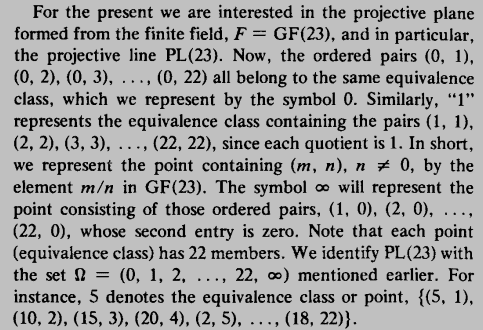
I found in Thompson "From Error-Correcting to Sphere Packing and Simple Groups" this on page 131
upload_2016-9-14_9-58-29.png


How do you compute m/n in a finite field?

Take the equivalence class 5 given above. Why does 2/5 and 18/22 give 5?

thanks
 
Physics news on Phys.org
The finite field being used is ##GF(23)## which is (isomorphic to) the set of integers modulo 23. Because 23 is prime, that is a field.

2/5=5 because ##5\times 5=25=2\mod 23##
18/22=5 because ##5\times 22=110=18\mod 23##

If you are operating in a finite field of prime order ##p##, the multiplicative inverse of ##f## is the smallest positive solution ##x## of the equation ##xf=1+kp## for ##k## any non-negative integer.
 
  • Like
Likes   Reactions: Lapidus

Similar threads

  • · Replies 40 ·
2
Replies
40
Views
4K
  • · Replies 3 ·
Replies
3
Views
2K
  • · Replies 4 ·
Replies
4
Views
2K
  • · Replies 3 ·
Replies
3
Views
1K
  • · Replies 26 ·
Replies
26
Views
1K
  • · Replies 1 ·
Replies
1
Views
2K
  • · Replies 4 ·
Replies
4
Views
2K
  • · Replies 26 ·
Replies
26
Views
3K
  • · Replies 1 ·
Replies
1
Views
1K
  • · Replies 6 ·
Replies
6
Views
4K