Possible to connect two electromagnets perfectly together?

Click For Summary

Discussion Overview

The discussion revolves around the design of a pair of electromagnets intended to connect perfectly together, focusing on the geometry of the magnets and their alignment. Participants explore various design ideas, including the use of pentagonal shapes and the challenges of achieving consistent magnetic alignment.

Discussion Character

  • Exploratory
  • Technical explanation
  • Debate/contested

Main Points Raised

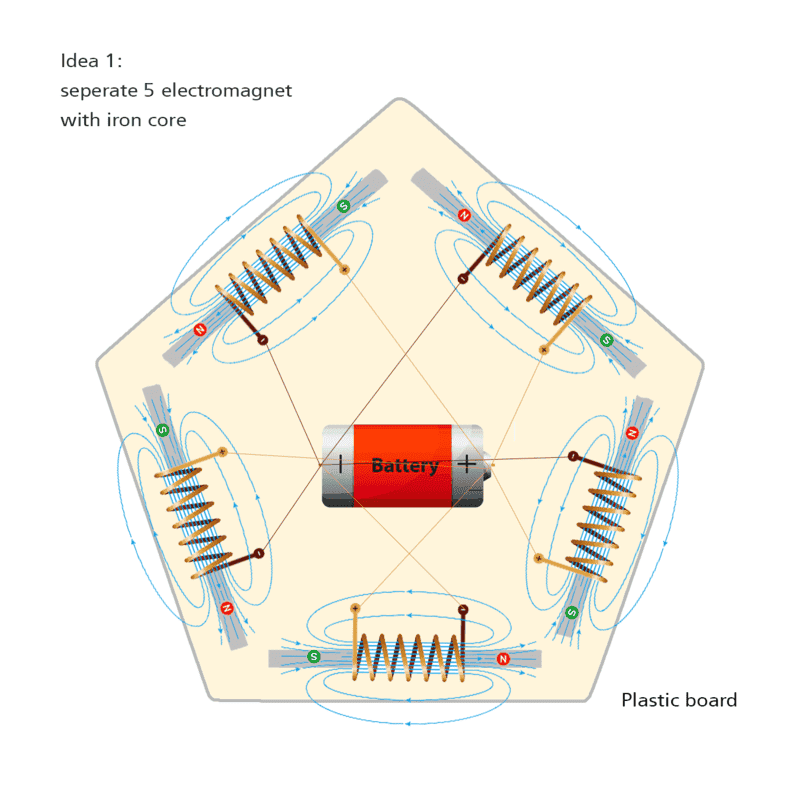
  • One participant proposes a design using five iron cores aligned at the edges, but notes that it does not achieve perfect connection.
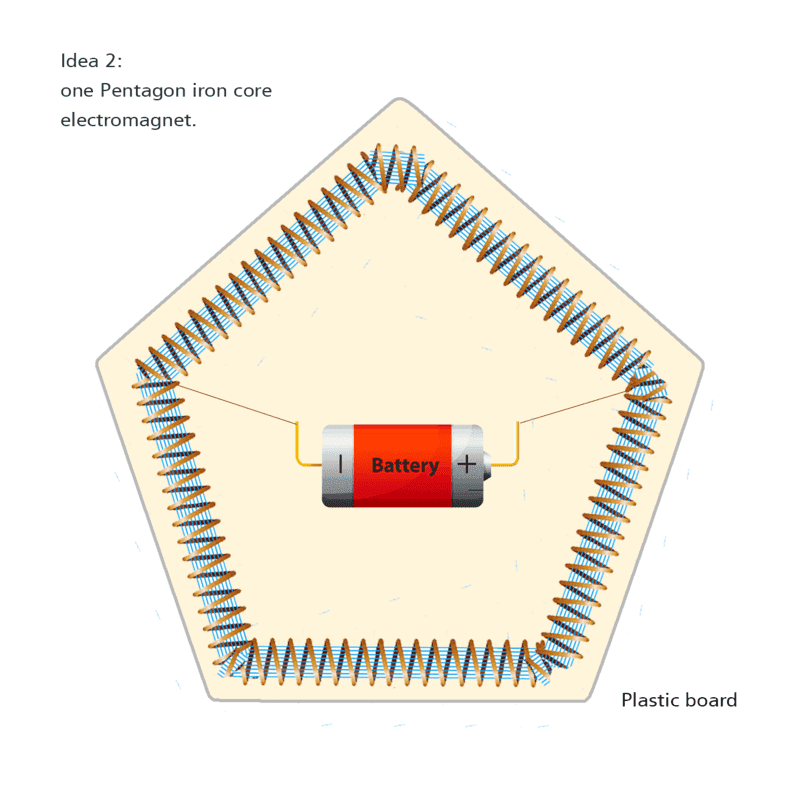
  • Another idea involves a large electromagnet shaped like a pentagon, though concerns are raised about the magnetization of the iron core affecting alignment.
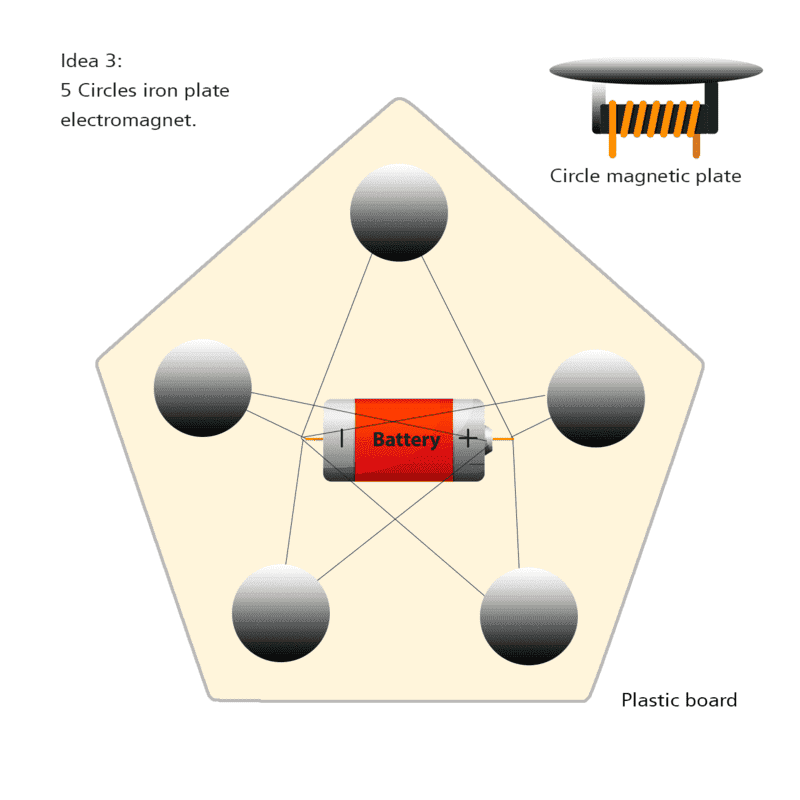
  • A suggestion is made to create an electromagnetic plate, with questions about the power requirements and the need to control magnetic polarity.
  • Some participants express skepticism about the necessity of electromagnets, suggesting that permanent magnets might suffice.
  • There is a proposal to create a dodecahedron from pentagonal plates, with discussions on how magnetic polarity would need to function at the intersections of the plates.
  • Concerns are raised about the geometric compatibility of the pentagons, as they do not tessellate, leading to potential misalignments when multiple pieces are joined.
  • One participant emphasizes the importance of having two poles on each edge to ensure uniformity in magnetic attraction.

Areas of Agreement / Disagreement

Participants express differing opinions on the effectiveness of electromagnets versus permanent magnets, and there is no consensus on the best design approach. The discussion remains unresolved regarding the optimal method to achieve the desired magnetic connection.

Contextual Notes

Participants note limitations in the current designs, including the need for clearer specifications on the number of plates and the exact requirements for the magnetic connection. There are also unresolved questions about the calculations and assumptions underlying the proposed designs.

Bernardtai
Messages
8
Reaction score
0
TL;DR
Study to design a pair of electromagnets place on a pentagon plastic board, target both will connect perfectly to each others. even I twist it and it will still align with angle.
Mission: create a pair of electromagnets which always connects (angel) perfectly together.

Initially, I design with the following 3 ideas, could any design possible to achieve?
solution1.png

1) First idea is to separate 5 iron core, all close to the edge and connect to the battery source. this attempt is to align the iron core near all border.

I tried it with real magnet, but it is not always perfectly connect together.
solution2.png


2) Idea 2 is a big electromagnet with iron core in the shape of pentagon. but I think since ironcore has been magnetized, this has least chance to have perfect angel align.
solution3.png


idea 3 is to make an electromagnetic plate, which comes with the idea from real magnet, but real magnet needs to deal with the N/S connection, and if I use this solution, should I consider power too ?
Sorry I am very junior in this field. please kindly help to give me some idea.
 
Engineering news on Phys.org
Welcome to PF.
You have given examples of what does not work.
You have not yet described clearly what is required.
How many plastic pentagonal plates will you have?
 
Your first idea looks best. Each side will join to any other side.
Pentagons do not tessellate, so when three are joined, there will be other stable alignments for a fourth (and more) where sides do not match.

I can't see why you would use electromagnets, rather than permanent magnets.
 
Baluncore said:
Welcome to PF.
You have given examples of what does not work.
You have not yet described clearly what is required.
How many plastic pentagonal plates will you have?

hi, I have 2, and ultimately I want to make all 12 faces to make it 3d, but first I want to see if it works.
 
Bernardtai said:
..., but first I want to see if it works.
So what do you want it to do?
 
Merlin3189 said:
Your first idea looks best. Each side will join to any other side.
Pentagons do not tessellate, so when three are joined, there will be other stable alignments for a fourth (and more) where sides do not match.

I can't see why you would use electromagnets, rather than permanent magnets.

Thanks for your suggestion, but first idea was tried with permanent magnets, but it is not a perfect fit.

I didnt put anything in calculation first since this is just a project for fun and want to make a magnet only connect in certain way. that's why I choose a pentagon.
 
Merlin3189 said:
So what do you want it to do?

I want to have 2 electromagnet fit perfectly together even I twist the pentagon in any direction, it will always come back in perfect position.

actually I want to control the N/S pole thru electric so that pair of magnets can only align perfect.
 
Merlin3189 said:
So what do you want it to do?
Maybe make a regular dodecahedron out of pentagons, that is held together by magnets ?
Maybe magnetic polarity must work if individual pentagonal plates are rotated, and where any 3 pentagons meet.
 
Baluncore said:
Maybe make a regular dodecahedron out of pentagons, that is held together by magnets ?
Maybe magnetic polarity must work if individual pentagonal plates are rotated, and where any 3 pentagons meet.

there are no rotation and nor make it magic move. just stay home and want to play this with my kids in my 3D printer. this is actually an idea by my son.

ultimately, i can make it as a dodehagon connect by magnets.
 
  • #10
I want to explore any design will do .. asking for suggestion.
 
  • #12
Well it sounds as if it could work.
I still can't see any advantage of electromagnets (but some disadvantages). You want the poles in the right place, near the corners as you've shown in the first plan, but whether the iron is energised by a permanent magnet or a coil. seems irrelevant.
I think shaped iron pole pieces would help, A rather than B.
If you used small Neodymium magnets, small pole pieces in the corners, like C, would be smaller.
PentagonMagnet.png
Picture edited
 
Last edited:
  • Like
Likes   Reactions: Baluncore
  • #14
Merlin3189 said:
Well it sounds as if it could work.
I still can't see any advantage of electromagnets (but some disadvantages). You want the poles in the right place, near the corners as you've shown in the first plan, but whether the iron is energised by a permanent magnet or a coil. seems irrelevant.
I think shaped iron pole pieces would help, A rather than B.
If you used small Neodymium magnets, small pole pieces in the corners, like C, would be smaller.
https://www.physicsforums.com/attachments/259441

THIS IS Interesting !

actually the reason of using electromagnets because I fail to use a simple magnet to do it.. and since it has 5 edge only, the N/S is not even...

your suggestion is interesting, a magnet between an Iron. but if i make a pair of it, will it really connect perfectly when I twist it ?
 
  • #15
You do need two poles on each edge. Then all edges are the same, a N pole and a S pole.
The body of the electromagnet (or of a bar magnet) plays no part. It's the poles that matter.

I've added corner D with two magnets. I've put an iron filler between them, but that is optional.
 

Similar threads

  • · Replies 7 ·
Replies
7
Views
2K
  • · Replies 4 ·
Replies
4
Views
3K
  • · Replies 4 ·
Replies
4
Views
7K
  • · Replies 2 ·
Replies
2
Views
2K
  • · Replies 4 ·
Replies
4
Views
3K
Replies
5
Views
3K
  • · Replies 2 ·
Replies
2
Views
9K
Replies
7
Views
15K
  • · Replies 1 ·
Replies
1
Views
2K
Replies
8
Views
20K