Power for an Op amp from single source

Click For Summary

Discussion Overview

The discussion centers around the feasibility of powering an operational amplifier (op amp) using a single voltage source, specifically addressing the requirements for +18V and -18V. Participants explore the implications of biasing circuits, virtual ground concepts, and the role of resistors in the circuit design.

Discussion Character

  • Technical explanation
  • Conceptual clarification
  • Debate/contested

Main Points Raised

  • Some participants question whether it is valid to power the op amp with a single supply, expressing uncertainty about the circuit's functionality.
  • One participant suggests that voltage is relative and proposes grounding the negative end of a 36V supply, though notes that this would result in a non-bipolar output.
  • Another participant explains that resistors create a "virtual ground" necessary for biasing the op amp in a single-supply configuration, comparing it to biasing in BJT amplifiers.
  • Some participants assert that the resistors in the original schematic do not provide adequate biasing for the op amp, as they believe the supply terminals will simply reflect the battery voltages.
  • There is mention of a workable schematic that has been used successfully in practice, along with a reference to a Texas Instruments Application Report on single-supply op-amp circuits.
  • One participant shares their experience designing electronics for guitar pedals, indicating practical application of the discussed concepts.
  • Concerns are raised about the completeness of the original circuit and the necessity of additional components, such as capacitors, to ensure proper operation in the linear region of the op amp.

Areas of Agreement / Disagreement

Participants express differing views on the validity of the proposed circuit and the role of resistors in biasing. There is no consensus on whether the original circuit is sufficient or complete, and multiple competing perspectives on the necessity and function of biasing networks remain.

Contextual Notes

Some participants highlight limitations in the original schematic, noting that it may not account for load conditions or the need for additional components to achieve proper biasing.

FrankJ777
Messages
140
Reaction score
6
Is it possible to power the op amp in this diagram in this manner if it requires +18V and -18V?
This doesn't seem valid to me, but I'm not sure why it's not exactly.
Thanks
 

Attachments

  • opamp_36.jpg
    opamp_36.jpg
    26 KB · Views: 600
Engineering news on Phys.org
sure. voltage is relative anyway. you could choose to ground the negative end of the 36 V supply instead of what is halfway between the positive and negative ends. but then the output of the op-amp would not be bipolar.
 
FrankJ777 said:
Is it possible to power the op amp in this diagram in this manner if it requires +18V and -18V?
This doesn't seem valid to me, but I'm not sure why it's not exactly.
Thanks

I'm not seeing what the purpose of the resistors are, whether they are there or not the supply terminals on the opamp will see the positive and negative leads of the battery.
 
Well these resistor create a circuit that is called "virtual ground".
Every real life "active device" to work properly as an amplifier supplied from a single source need proper bias circuit.
When you use BJT as a CE amplifier, you use a voltage divider to bias the active device somewhere in the "linear region".
In case of single supply op amp you have to do the same think. You need to bias the op amp somewhere in the middle of his "linear region". And this resistor provide proper DC bias for Op amp.
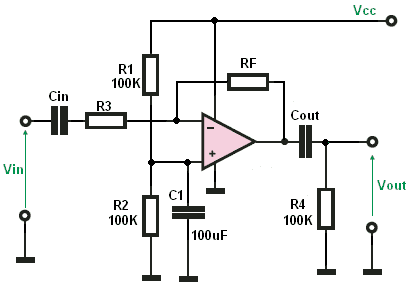
96_1320874827.png
 
The schematic in the first post does set a bias point so to speak but it is not useable if the load is between the output (naturally) and ground. The resistors are not able to carry any significant load current. The schematic in post #4 is definitely workable. I have used it or something similar many times.
 
Averagesupernova said:
The schematic in post #4 is definitely workable. I have used it or something similar many times.
Yep. Here a Texas Instruments Application Report with a collection of Single-Supply Op-Amp Circuits.

"www.eng.yale.edu/ee-labs/morse/compo/sloa058.pdf"
 
Last edited by a moderator:
That's what I have been doing in the last few months! I am designing electronics inside guitar and guitar effect pedals. They all use one 9V battery only. I just put the power across the op-amp like your picture and use a voltage divider to get half voltage for biasing the input of the op-amp like what Jony130's post.
 
yungman said:
That's what I have been doing in the last few months! I am designing electronics inside guitar and guitar effect pedals.

sounds like a good gig.

do you or have you worked on any digital effects devices?

can you tell us what some of these stomp boxes are?

L8r,

r b-j
 
Jony130 said:
Well these resistor create a circuit that is called "virtual ground".
Every real life "active device" to work properly as an amplifier supplied from a single source need proper bias circuit.
When you use BJT as a CE amplifier, you use a voltage divider to bias the active device somewhere in the "linear region".
In case of single supply op amp you have to do the same think. You need to bias the op amp somewhere in the middle of his "linear region". And this resistor provide proper DC bias for Op amp.

96_1320874827.png

I am familiar with the need for biasing networks when working with active amplifiers, I'm just not seeing how the resistors in the original post provide any type of biasing at all.

Regardless of the value of R1, the terminals labeled Vcc and Vee are going to sit at the voltages on positive and negative terminals of the battery. How is that providing any form of biasing at all?

The only thing I can see is that the resistors provide one with a point to ground the circuit.
 
  • #10
rbj said:
sounds like a good gig.

do you or have you worked on any digital effects devices?

can you tell us what some of these stomp boxes are?

L8r,

r b-j

One is a Distortion pedal that I put my own twist on the clipping circuit. The major one is inside the guitar that I cannot review at this point. In fact I am very close of completing the patent application to submit to the USPTO this week or latest next. I am too cheap to pay thousands of dollars to have a patent attorney to do it. I spent the last half a year not only working on the circuits, also learning how to write the patent. It'll still cost me like $1800 just for the whole process if I am lucky enough that they grant me the patent.

I am not comfortable enough in DSP to do anything in digital. That's where you're the man.:smile:
 
  • #11
jegues said:
I am familiar with the need for biasing networks when working with active amplifiers, I'm just not seeing how the resistors in the original post provide any type of biasing at all.

Regardless of the value of R1, the terminals labeled Vcc and Vee are going to sit at the voltages on positive and negative terminals of the battery. How is that providing any form of biasing at all?

The only thing I can see is that the resistors provide one with a point to ground the circuit.

The original circuit was not meant to be complete.

The one quoted in your post shows the original two resistors as R1 and R2.

Because the previously negative line is now grounded then the non-inverting "+" input to the opamp now needs to be held at half the supply voltage.

Another consequence of this is that there has to be a capacitor in series with the input because the linear region of the opamp is now near the half voltage point of the opamp supply (half of 36 volts) and the input may not be at +18 volts or so.
 
  • #12
jegues said:
I am familiar with the need for biasing networks when working with active amplifiers, I'm just not seeing how the resistors in the original post provide any type of biasing at all.

Regardless of the value of R1, the terminals labeled Vcc and Vee are going to sit at the voltages on positive and negative terminals of the battery. How is that providing any form of biasing at all?

The only thing I can see is that the resistors provide one with a point to ground the circuit.

it defines that ground is midway between the positive and negative terminals of the battery. that's all it does.
 
  • #13
vk6kro said:
The original circuit was not meant to be complete.

That's all I needed to know.
 

Similar threads

  • · Replies 6 ·
Replies
6
Views
6K
Replies
6
Views
4K
  • · Replies 3 ·
Replies
3
Views
2K
  • · Replies 6 ·
Replies
6
Views
3K
  • · Replies 5 ·
Replies
5
Views
3K
  • · Replies 7 ·
Replies
7
Views
2K
  • · Replies 5 ·
Replies
5
Views
3K
  • · Replies 6 ·
Replies
6
Views
2K
  • · Replies 11 ·
Replies
11
Views
3K
  • · Replies 12 ·
Replies
12
Views
4K