Poynting vector and single electron in free space

Join the discussion
Ask a follow-up here, or get your own question answered by working scientists, mathematicians and engineers — people, not an autocomplete.
Real named experts · corrections over time · the nuance an AI answer skips
8 replies · 2K views
Orthoceras
Messages
133
Reaction score
55
I am trying to draw the Poynting vector field for a single electron in free space between two capacitor plates. The electron is moving (and accelerating) to the positive plate at the right. I expected the Poynting vector field lines to converge to the electron, because that is where the work has to be done. However, very close to the electron the E-field is dominated by the electron, assuming it is a point particle. As a result the Poynting vector field does not converge to the electron. What is my mistake?
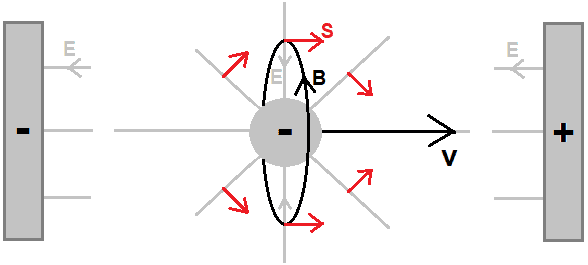
poynting4.png
 
Physics news on Phys.org
Your mistake is neglecting the external field near the electron.

Any time that you make a simplifying assumption and wind up with nonsense, the first thing is to check what happens if you don’t make the simplifying assumption.
 
  • Like
Likes   Reactions: vanhees71
I don't understand that. Close to the electron the radial E-field becomes infinitely strong, assuming it is a point particle. Why is the finite external field not negligable?
 
Orthoceras said:
I don't understand that. Close to the electron the radial E-field becomes infinitely strong, assuming it is a point particle. Why is the finite external field not negligable?
Physically, do you expect the electron to somehow gain energy without the finite external field?

But again. In general, any time you make a simplifying assumption and get nonsense, then you should redo your calculation without the simplifying assumption. Even if you don’t immediately see why. The nonsense is telling you that something is wrong.
 
I think we agree that work is done by the electric field on the electron. However, I thought the Poynting vector field should converge exactly to the location of the electron to deliver that energy. Your point seems to be that is a mistake?
 
Orthoceras said:
I thought the Poynting vector field should converge exactly to the location of the electron to deliver that energy. Your point seems to be that is a mistake?
I agree that is a mistake, although I cannot claim that was my point. Your results correctly show that point quite convincingly.
 
Of course classical point particles are a nuissance, and the related questions are not fully resolved. The quantum version is a bit better off, because you can at least define it in the perturbative sense and systematically renormalize the divergences analogous to the classical ones in a systematic manner order by order of perturbation theory.
 
I guess my mistake was forgetting that the Poynting vector has to migrate the energy of the Coulomb field of the electron from left to right, in addition to delivering the increase of the kinetic energy of the electron. That explains why the Poynting vector converges to a diffuse area at the right of the electron.

In more familiar cases where the Poynting vector is used, such as current in a wire, there is no migration of an electrostatic field because the wire is neutral.
 
  • Like
Likes   Reactions: Dale
Orthoceras said:
the Poynting vector has to migrate the energy of the Coulomb field of the electron from left to right, in addition to delivering the increase of the kinetic energy of the electron.
Excellent physical insight!