Predicting Initial Length of String Needed Before Stretch

Click For Summary

Discussion Overview

The discussion revolves around determining the initial length of string required for a guitar setup, considering various physical parameters such as static friction, frequency, tension, and geometrical aspects of the guitar. Participants explore the relationships between these variables and their implications for string length in the context of music performance.

Discussion Character

  • Exploratory
  • Technical explanation
  • Conceptual clarification
  • Debate/contested
  • Mathematical reasoning

Main Points Raised

  • One participant presents an equation involving multiple variables related to guitar string setup, seeking assistance in verifying their work.
  • Another participant elaborates on additional variables related to string geometry, including the effects of windings around the string post and the breakover angle.
  • A request for references or definitions of the parameters used in the discussion is made, indicating a need for clarity on terminology.
  • Discussion includes material properties of guitar strings, with one participant providing specific values for density, elastic modulus, and Poisson's ratio, while noting the challenge of finding accurate values for these parameters.
  • Participants discuss typical values for certain angles and dimensions in guitar design, suggesting assumptions based on common practices in guitar construction.
  • A request for visual aids, such as pictures or technical drawings of the described guitar construction, is made to enhance understanding.

Areas of Agreement / Disagreement

Participants express varying levels of understanding and assumptions regarding the parameters involved, with no consensus reached on the specific values or methods to calculate the initial string length. The discussion remains open-ended with multiple viewpoints presented.

Contextual Notes

Some assumptions regarding angles and material properties are noted as potentially limiting, and there are unresolved aspects related to the mathematical formulation of the problem. The discussion reflects a range of experiences and knowledge levels among participants.

Who May Find This Useful

Individuals interested in guitar construction, physics of musical instruments, or those studying the application of physics in music performance may find this discussion relevant.

Chrono G. Xay
Messages
91
Reaction score
3
I have put together an equation whose purpose is:

With a desired 'magnitude of static friction' ( μ_s ), 'fundamental frequency' ( f ), and 'tension' ( T ),

initial conditions such as 'string breakover angle' ( Θ_0 ), 'nut-tuner distance' ( L_{h,0} ), and 'string diameter' ( d ),

and, finally, constants 'tuner diameter' ( D ), 'nut thickness' ( L_n ), 'nut-saddle distance' ( L_s ), 'saddle-bridge distance' ( L_b ), 'elastic modulus' ( E ), and 'Poisson's Ratio' ( ν ),

What 'initial length of string' ( L_0 ) is required?

I have already written my work out, and was hoping there'd be someone among the members of PF who wouldn't mind helping to check it with me.

Please keep in mind that I am an undergraduate pursuing a degree in Music Education, studying percussion, and have a great passion for Physics and Math, applying what I learn to further accelerate my comprehension and make the execution of a piece of music that much more fluid and efficient.
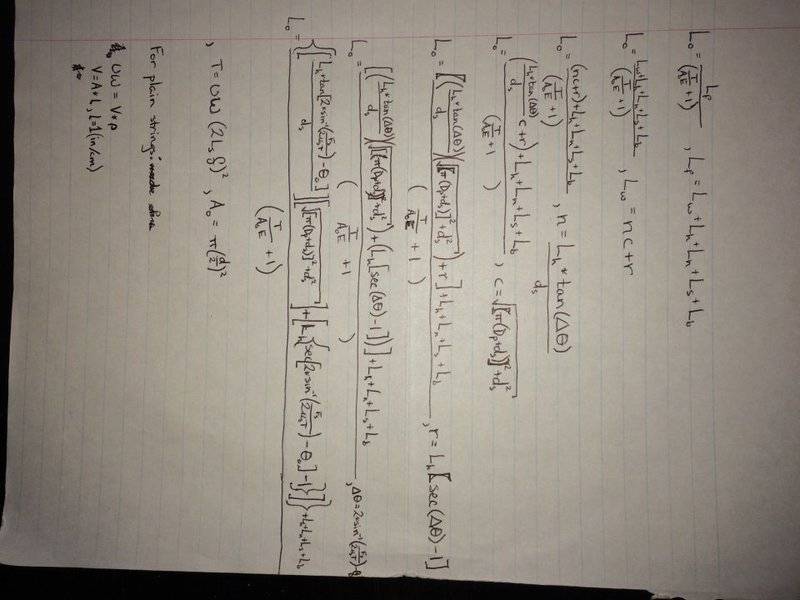
image.jpg


(My apologies about the picture- I tried a few times to get it to display right side up, but it wouldn't work for me...)
 
Last edited:
Physics news on Phys.org
As for the variables I have not yet explained, they have to do with geometries of the guitar, such as L_w , which is the length of extra string as it relates to windings around the string post, either up or down, where 'n' is the number of windings, 'c' is the length of string needed to circumscribe the string post once such that multiple windings will result in a diagonal sort of stack (like in reality), 'r' is the length associated with how L_h changes as more string is wrapped around the string post, and 'ΔΘ' has to do with how the breakover angle of the string from the nut to the tuner changes as more string is wrapped around the string post.

Note: The only flaw with 'r' as it is currently written is that it assumes the initial incident angle between the string and the string post is a right angle, and while this may be true for some cases I would like to be able to account for the majority of cases where this is not true.
 
Is there a reference you can provide, preferably online, where the various parameters are defined?

Chet
 
I believe the material typically used for manufacturing of plain guitar strings (i.e. not wound) is Mn-50 Ni-41 Sn-9, where ρ = 7.797 \frac{g}{cm^3}, but I haven't been able to find the values for 'E' and 'ν', so I'm having to use those of 430 Steel (which supposedly D'Addario uses, and whose density ρ = 7.74 \frac{g}{cm^3}), where the ranges for E and ν can be found here: http://www.azom.com/properties.aspx?ArticleID=996.

With guitars where the headstock is angled using a scarf joint, the typical value of 'Θ_0', so I've read, is \frac{π}{12}. For the sake of argument, let's say the scale length 'L_s' is 25.5 in., the initial string diameter 'd' is 0.009 in., the string post is a solid cylinder (no concave milling) with a diameter 'D' of 0.25 in., sticks up out of the headstock by 0.5 in. and the hole for the string is halfway (0.25 in.) up, the initial nut-tuner distance 'L_h' is 6 in. (The high-e string of a guitar with a reversed headstock), and the saddle-bridge distance 'L_b' is 1.5 in. (no spring-loaded "tremolo" unit). Also, let's suppose that the nut is made of Teflon (ex. GraphTech TUSQ nut) so the coefficient of static friction 'μ_s' is about 0.04 .
 
Could you put up pictures of an actual guitar with the construction you describe or better still a technical drawing ?
 
  • Like
Likes   Reactions: Chestermiller
Here we go:

image.jpg


image.jpg
 
Last edited:

Similar threads

  • · Replies 5 ·
Replies
5
Views
3K
  • · Replies 75 ·
3
Replies
75
Views
7K