Predicting the vertical/horizontal/mediolateral force of a lungfish limb

  • Context: Graduate 
  • Thread starter Thread starter mgranatosky
  • Start date Start date
  • Tags Tags
    Force
Click For Summary

Discussion Overview

The discussion revolves around predicting the vertical, horizontal, and mediolateral forces exerted by the limbs of a lungfish during locomotion. Participants explore modeling approaches prior to data collection, considering factors such as buoyancy and limb joint mechanics. The conversation includes theoretical considerations and references to existing literature on similar locomotion studies.

Discussion Character

  • Exploratory
  • Technical explanation
  • Debate/contested
  • Mathematical reasoning

Main Points Raised

  • One participant seeks to model the forces acting on lungfish limbs based on static models and questions the relevance of angles relative to the center of mass versus the hip/shoulder joint.
  • Another participant challenges the assumption that forces from each leg act through the center of mass, suggesting that this may not apply in stable or unstable cases.
  • Buoyancy's role in calculating vertical ground reaction forces is discussed, with a suggestion that total vertical ground reaction should account for buoyancy.
  • Some participants draw parallels between lungfish locomotion and that of crabs or lobsters, noting the importance of overcoming viscous drag.
  • Concerns are raised about the presence of horizontal forces at the legs, with differing views on whether they are necessary or expected in static models.
  • Participants reference literature that may provide insights into forces and torques relevant to lungfish locomotion.
  • There is a suggestion to treat the lungfish as a table for modeling purposes, serving as a null hypothesis against which empirical data can be compared.

Areas of Agreement / Disagreement

Participants express differing views on the assumptions regarding force application through the center of mass and the necessity of horizontal forces. The discussion remains unresolved with multiple competing perspectives on the modeling approach and the role of buoyancy.

Contextual Notes

Participants note that the complexity of locomotion, particularly in a hydrodynamic context, introduces additional factors that may not be fully captured in static models. There are also unresolved questions regarding the appropriate modeling framework and the influence of limb joint mechanics.

mgranatosky
Messages
4
Reaction score
0
Hello

This may be an incredibly simple question, but I am looking for some help to clarify things for me.

I am a researcher interested in animal locomotion. Currently, I am working on a project collecting single limb force data (vertical, horizontal, and mediolateral substrate reaction force in a single limb) from a lungfish (a fish that walks along the bottom of rivers similar to a salamander).

I am hoping to do some modelling before we collect any data. I want to be able to predict approximately how much vertical, horizontal, and mediolateral force will be on each limb.

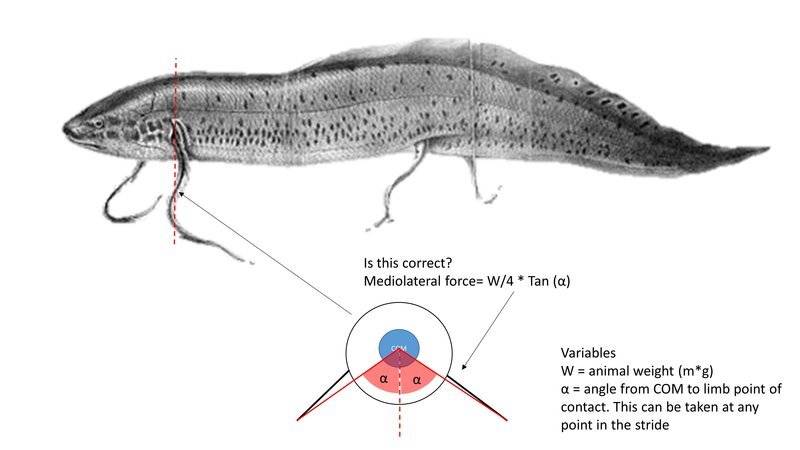
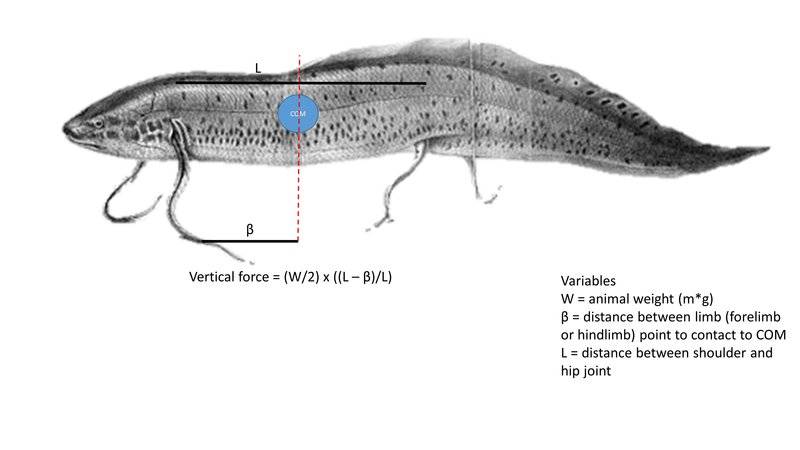
I believe that the static models I provided in the pictures attached should be some representation of the expected forces when the animal is walking on the ground. Essentially, use the static models to predict force across the stride. In the horizontal and mediolateral model you'll notice that there is an angle measurement involved. I believe that this angle should be relative to the center of mass, but is it actually at the hip/shoulder joint?

To make matters a little more complicated (maybe not) these animals only walk in the water. In our experiments we are planning to collect data while animals walking in a fish tank on a desk. This fish does not float (it sinks to the bottom), but does buoyancy play a factor in this scenario, and if so, how will this change calculations?

I appreciate your help so much, and welcome any edits or better suggestions.
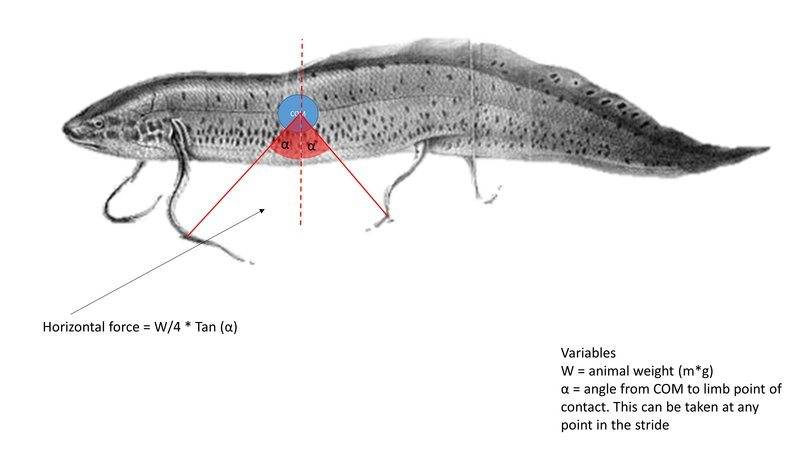
Predicted forces_horizontal.jpg
Predicted forces_mediolateral.jpg
Predicted forces_Vertical.jpg
 

Attachments

  • Predicted forces_horizontal.jpg
    Predicted forces_horizontal.jpg
    27.3 KB · Views: 1,130
  • Predicted forces_mediolateral.jpg
    Predicted forces_mediolateral.jpg
    29.7 KB · Views: 548
  • Predicted forces_horizontal.jpg
    Predicted forces_horizontal.jpg
    27.3 KB · Views: 745
  • Predicted forces_mediolateral.jpg
    Predicted forces_mediolateral.jpg
    29.7 KB · Views: 723
  • Predicted forces_Vertical.jpg
    Predicted forces_Vertical.jpg
    26.5 KB · Views: 718
Physics news on Phys.org
mgranatosky said:
I believe that the static models I provided in the pictures attached should be some representation of the expected forces when the animal is walking on the ground.
Why are you assuming that the force from each leg acts through the COM? Is each leg force of a table acting through the tables COM?

mgranatosky said:
I believe that this angle should be relative to the center of mass, but is it actually at the hip/shoulder joint?
Is see no reason to assume either one of these two. The latter would only be justified for a very unstable static case, with the joints completely passive, and limbs aligned to produce no external torque around the joints.

mgranatosky said:
This fish does not float (it sinks to the bottom), but does buoyancy play a factor in this scenario, and if so, how will this change calculations?
For the static case:
total vertical ground reaction = weight - buoyancy
 
Last edited:
mgranatosky said:
Hello

This may be an incredibly simple question, but I am looking for some help to clarify things for me.

This is assuredly not a simple question.

I was tempted to think of this as similar to a crab or lobster, in which case the only significant difference relates to overcoming viscous drag. Which isn't too hard.

However, the images you show made me think carefully about how the lungfish legs are jointed- how does the musculature of the lungfish act to generate forces on the riverbed? Being confused, I quickly checked the literature, and sure enough, there is data:

https://academic.oup.com/icb/article/53/2/283/806410/Propulsive-Forces-of-Mudskipper-Fins-and
https://www.nature.com/articles/srep33734
https://www.ncbi.nlm.nih.gov/pmc/articles/PMC4008594/
http://www.pnas.org/content/108/52/21146.full

I think that you can extract out forces and torques from those papers (and cited references).
 
Hello,

Thank you so much for the reply. I have answered your questions to the best of my ability below.

A.T. said:
Why are you assuming that the force from each leg acts through the COM? Is each leg force of a table acting through the tables COM?

That is the way I've always thought it about. It makes things easier to consider quadrupeds as tables. I am basing these models on previously published data (see below)

image 1.JPG


image 2.JPG


image 3.JPG


A.T. said:
Is see no reason to assume either one of these two. The latter would only be justified for a very unstable static case, with the joints completely passive, and limbs aligned to produce no external torque around the joints.

Is there a different model I should be using instead?

A.T. said:
For the static case:
total vertical ground reaction = weight - buoyancy

So in the models provided weight should be adjusted to W' = W - buoyancy?

Thank you so much for your help on this
 

Attachments

  • image 1.JPG
    image 1.JPG
    83.9 KB · Views: 547
  • image 2.JPG
    image 2.JPG
    61.9 KB · Views: 560
  • image 3.JPG
    image 3.JPG
    32.9 KB · Views: 489
Andy Resnick said:
This is assuredly not a simple question.

I was tempted to think of this as similar to a crab or lobster, in which case the only significant difference relates to overcoming viscous drag. Which isn't too hard.

However, the images you show made me think carefully about how the lungfish legs are jointed- how does the musculature of the lungfish act to generate forces on the riverbed? Being confused, I quickly checked the literature, and sure enough, there is data:

https://academic.oup.com/icb/article/53/2/283/806410/Propulsive-Forces-of-Mudskipper-Fins-and
https://www.nature.com/articles/srep33734
https://www.ncbi.nlm.nih.gov/pmc/articles/PMC4008594/
http://www.pnas.org/content/108/52/21146.full

I think that you can extract out forces and torques from those papers (and cited references).
Thank you so much for looking into this for me. I am familiar with these papers, and they have gotten me really excited about the origins of quadrupedal locomotion in non-tetrapod species.

From a modelling perspective, I would like to predict forces as if the animal was a table (see below). This will serve as a null hypothesis, and the empirical data can be used to see where differences occur.
Slide2.JPG


Predicted forces_Table vertical.jpg


Predicted forces_Table_mediolateral.jpg


Thank you so much
 

Attachments

  • Slide2.JPG
    Slide2.JPG
    14.4 KB · Views: 538
  • Predicted forces_Table vertical.jpg
    Predicted forces_Table vertical.jpg
    14.1 KB · Views: 560
  • Predicted forces_Table_mediolateral.jpg
    Predicted forces_Table_mediolateral.jpg
    16 KB · Views: 622
mgranatosky said:
predicted-forces_table_mediolateral-jpg.jpg
Why should there be any horizontal forces at the legs here?
 

Attachments

  • predicted-forces_table_mediolateral-jpg.jpg
    predicted-forces_table_mediolateral-jpg.jpg
    16 KB · Views: 505
Last edited:
A.T. said:
Why should there be any horizontal forces at the legs here?
Hello,

That view is meant to be a cross-section of the animal (see below). Anytime you have an animal with a sprawling limb posture (like the lungfish) mediolateral forces can be high. Sorry about the confusion

untitled.png
 

Attachments

  • untitled.png
    untitled.png
    8.4 KB · Views: 646
mgranatosky said:
Anytime you have an animal with a sprawling limb posture (like the lungfish) mediolateral forces can be high.
They can, but there is nothing in simple statics that says there must be any horizontal forces at all. It's all physiology and different optimization goals:

When standing on all legs, it makes sense to have the forces pass near the joints, so the muscles do not have to create much counter torque.

When the opposite leg is up, it makes sense to have the force pass near the COM to keep balance.

Locomotion is far more complex.

And the hydrodynamics of locomotion under water even more complex.
 

Similar threads

  • · Replies 66 ·
3
Replies
66
Views
6K
  • · Replies 8 ·
Replies
8
Views
3K
  • · Replies 1 ·
Replies
1
Views
1K
  • · Replies 2 ·
Replies
2
Views
2K
  • · Replies 9 ·
Replies
9
Views
4K
  • · Replies 22 ·
Replies
22
Views
7K
Replies
15
Views
26K
  • · Replies 7 ·
Replies
7
Views
3K
  • · Replies 16 ·
Replies
16
Views
3K
Replies
9
Views
13K