Pressure dependence of the equilibrium constant for an ideal gas

Click For Summary
SUMMARY

The equilibrium constant (K) for an ideal gas is not independent of pressure, contrary to some claims. The relationship between the Gibbs free energy change (ΔG) and the equilibrium constant is defined by the equation ΔG = -RT ln K, where R is the gas constant and T is temperature. The derivative of ln K with respect to pressure (p) is given by (∂ ln K/∂ p)_{T,n} = -ΔR V^0/(RT), indicating that K is influenced by changes in pressure when considering the reaction volume (ΔR V^0). This discussion clarifies that while K may appear constant under certain conditions, it is fundamentally dependent on the defined standard state pressure.

PREREQUISITES
  • Understanding of thermodynamics, specifically Gibbs free energy.
  • Familiarity with the concept of equilibrium constants in chemical reactions.
  • Knowledge of ideal gas laws and their implications on reaction volumes.
  • Basic calculus, particularly partial derivatives in thermodynamic contexts.
NEXT STEPS
  • Study the derivation of the Gibbs free energy equation and its implications for equilibrium constants.
  • Learn about the relationship between pressure changes and equilibrium shifts in chemical reactions.
  • Explore the concept of standard states in thermodynamics and how they affect K values.
  • Investigate the behavior of K under varying conditions using real gas equations versus ideal gas assumptions.
USEFUL FOR

Chemists, chemical engineers, and students studying thermodynamics or chemical equilibrium who seek to understand the nuances of pressure effects on equilibrium constants for ideal gases.

ussername
Messages
60
Reaction score
2
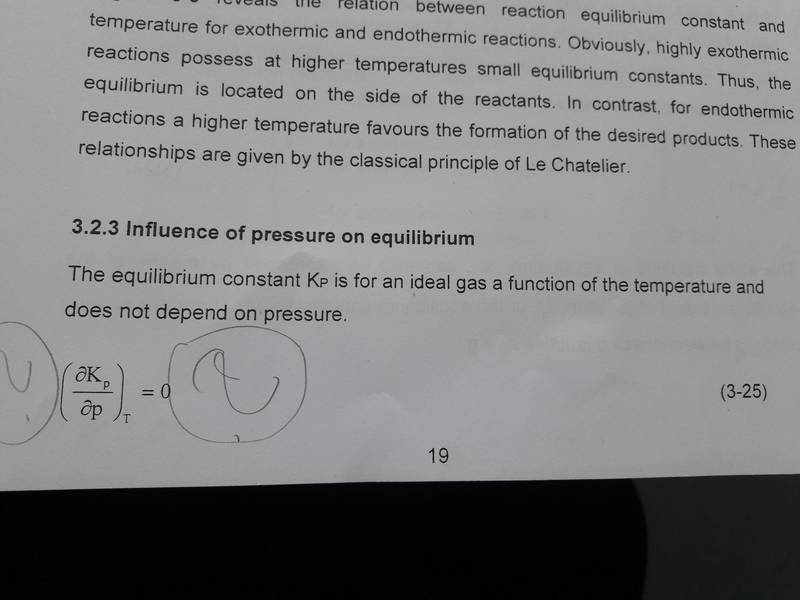
I read in some scripts that equilibrium constant for an ideal gas is not a function of pressure:
J6rgFkw.jpg

But that is not generally true!

Since:
$$\left (\frac{\partial \Delta_{R} G}{\partial p} \right )_{T,\vec{n}}=\Delta_{R} V$$
and
$$\Delta_{R} G^{0}=-RT\cdot \ln K$$
it should be:
$$\left (\frac{\partial \ln K}{\partial p} \right )_{T,\vec{n}}=-\frac{\Delta_{R} V^{0}}{RT}$$
If the standard state is ideal gas with the same temperature ##T## and pressure ##p##, it is:
$$V^{0}=\frac{RT}{p}(n_{1}+n_{2}+...+n_{N})$$
and the reaction volume is then:
$$\Delta _{R}V^{0}=\sum \upsilon _{i}\cdot \left (\frac{\partial V^{0}}{\partial n_{i}} \right )_{T,p,n_{j\neq i}}=\frac{RT}{p}\cdot \sum \upsilon _{i}$$
$$\left (\frac{\partial \ln K}{\partial p} \right )_{T,\vec{n}}=- \frac{\sum \upsilon _{i}}{p}$$

How can anybody claim that ##(\partial \ln K / \partial p)_{T,\vec{n}}=0## for any reaction in ideal gas?

Edit: Usually ##p=100000 \, Pa## thus the derivation is small enough but not principally zero. Maybe that's what the script is saying.
 
Chemistry news on Phys.org
Could you please tell us what exact text (like who wrote it, name of text, etc) you copied the image from, and where (looks like chapter 3 maybe 25th formula).
Context helps us old fogies figure out what is going on. Thanks.

Maybe that's what the script is saying.
If we knew what the script was, someone could probably agree with that statement. I do not know enough to comment reasonably.
 
ussername said:
How can anybody claim that (∂lnK/∂p)T,⃗n=0(∂ln⁡K/∂p)T,n→=0(\partial \ln K / \partial p)_{T,\vec{n}}=0 for any reaction in ideal gas?
Maybe because it's experimentally true?
Your fallacy seems to be in assuming
dlnK/dp = -1/RT*dΔG0/dp
But ΔG0 does not vary with the pressure of the system. It is a constant for a standard state of defined pressure and temperature, not necessarily equal to the actual pressure of the system. Of course if you change the definition of the standard state pressure, ΔG0 and K will change, but that is a different thing. For example, for the reaction
A ↔ 2B
K = (PB/P0)2/(PA/P0)
If pressures are measured in atm and the standard state is P0 = 1 atm, then numerically K = PB2/PA
If instead you use a standard state of P0 = 2 atm, then K' = PB2/2PA = K/2
But if you consistently use the same standard state , say P0 = 1 atm, then PB2/PA will always equal the same value of K (at the same temperature), irrespective of the actual pressure of the system.
 
  • Like
Likes   Reactions: DrDu
You are right, for standard state with ##p^0## it is ##G^0 = f(n_1,n_2,...,n_N) \neq f(p)## and
$$\left( \frac{\partial \Delta_{R}G^0}{\partial p} \right)_{T,\vec{n}}=0$$ $$\left( \frac{\partial \ln K}{\partial p} \right)_{T,\vec{n}}=0$$
Just for standard state with ##p## this derivation is not generally zero but it is almost zero as I showed above.
 
What do you mean by "standard state with p" (as distinct from p0)? ΔG0 is defined for a defined standard pressure, which I have called p0. Are you suggesting a "standard state" with standard pressure = the pressure of the system, whatever that happens to be? That's not a proper standard state; you can't define an equilibrium constant that way.
 
  • Like
Likes   Reactions: DrDu and Chestermiller
ussername said:
I read in some scripts that equilibrium constant for an ideal gas is not a function of pressure:
View attachment 207509
But that is not generally true!

Since:
$$\left (\frac{\partial \Delta_{R} G}{\partial p} \right )_{T,\vec{n}}=\Delta_{R} V$$
and
$$\Delta_{R} G^{0}=-RT\cdot \ln K$$
it should be:
$$\left (\frac{\partial \ln K}{\partial p} \right )_{T,\vec{n}}=-\frac{\Delta_{R} V^{0}}{RT}$$
If the standard state is ideal gas with the same temperature ##T## and pressure ##p##, it is:
$$V^{0}=\frac{RT}{p}(n_{1}+n_{2}+...+n_{N})$$
and the reaction volume is then:
$$\Delta _{R}V^{0}=\sum \upsilon _{i}\cdot \left (\frac{\partial V^{0}}{\partial n_{i}} \right )_{T,p,n_{j\neq i}}=\frac{RT}{p}\cdot \sum \upsilon _{i}$$
$$\left (\frac{\partial \ln K}{\partial p} \right )_{T,\vec{n}}=- \frac{\sum \upsilon _{i}}{p}$$

How can anybody claim that ##(\partial \ln K / \partial p)_{T,\vec{n}}=0## for any reaction in ideal gas?

Edit: Usually ##p=100000 \, Pa## thus the derivation is small enough but not principally zero. Maybe that's what the script is saying.
I was a bit puzzled at the beginning, but I am convinced now that you are right. mjc123 is right in that ##K_p## does not change with temperature when you hold both the standard P constant and the partial pressure of the components. But this is not the point, as we are deriving with respect to P not keeping the partial pressures constant, but the number of moles n, or, what amounts to the same, the concentrations. Now ##\ln K_p=\ln K_c+\ln (P/P_0) \sum_i \nu_i ##, from which your claim follows.
 
I don't understand you. We're talking about varying pressure, not temperature. Kp does not vary with P because ΔG0 does not vary with P, being defined for a particular standard pressure. Kp is constant, whatever the partial pressures of the components - that is the point of an equilibrium constant.
Can you clarify what is the P you are varying here? At constant temperature, you can't vary P and keep the concentrations constant. (Nor the number of moles, if the reaction involves a change in the number of moles; changing the pressure will shift the position of equilibrium - but not the equilibrium constant.)
 
mjc123 said:
I don't understand you. We're talking about varying pressure, not temperature. Kp does not vary with P because ΔG0 does not vary with P, being defined for a particular standard pressure. Kp is constant, whatever the partial pressures of the components - that is the point of an equilibrium constant.
Can you clarify what is the P you are varying here? At constant temperature, you can't vary P and keep the concentrations constant. (Nor the number of moles, if the reaction involves a change in the number of moles; changing the pressure will shift the position of equilibrium - but not the equilibrium constant.)
You are obviously right.
Already the original question is wrong:
"How can anybody claim that [...]"
as Kp is not a function of ##\vec{n}## at all, but only of P and T.
Maybe what I and the OP had in mind is the quotient ##Q= \prod_i (P_i/P_0)^{\nu_i}##, which is a function of P and ##\vec{n}##. In equilibrium ##Q=K_p##, but when P is changed with n fixed, Q will be out of equilibrium.
 
  • #10
I agree with mjc123. ##\Delta G^0(T)## is defined as the change in free energy between the following two thermodynamic equilibrium states:

1. Pure reactants in stoichiometric proportions in separate containers at temperature T and pressure 1 bar

2. Pure products in corresponding stoichiometric proportions in separate containers at temperature T and 1 bar

So ##\Delta G^0(T)## is a function only of T (and not pressure). Since ##RTln{K_p}=-\Delta G^0(T)##, ##K_p(T)## is a function only of temperature.
 
  • Like
Likes   Reactions: jim mcnamara and Lord Jestocost

Similar threads

Replies
24
Views
3K
Replies
3
Views
2K
  • · Replies 8 ·
Replies
8
Views
3K
  • · Replies 5 ·
Replies
5
Views
940
Replies
14
Views
3K
  • · Replies 23 ·
Replies
23
Views
3K
  • · Replies 1 ·
Replies
1
Views
2K
  • · Replies 6 ·
Replies
6
Views
2K
Replies
19
Views
2K
  • · Replies 7 ·
Replies
7
Views
2K