Pressure Difference in Test Tube w/ Air Flow Rate

Click For Summary

Discussion Overview

The discussion revolves around the pressure dynamics in a test tube containing water when air is introduced at a specific flow rate. Participants explore the relationship between air flow rate, pressure inside the test tube, and the effects of water resistance, with a focus on theoretical and mathematical aspects of fluid dynamics.

Discussion Character

  • Exploratory
  • Technical explanation
  • Debate/contested
  • Mathematical reasoning

Main Points Raised

  • One participant describes a scenario with a test tube sealed with rubber, containing water, and questions how to mathematically relate air flow rate to pressure inside the tube.
  • Another participant suggests that if air does not flow out at the same rate as it enters, the pressure inside will increase, potentially due to bubbling in the water.
  • A different viewpoint posits that the water primarily resists flow, and if the outlet is atmospheric, the pressure inside must exceed atmospheric pressure to maintain flow.
  • One participant mentions simplifying the scenario by using a long pipe connected to a pump, indicating that pressure at the pump end would be higher than at the exit end.
  • There is a discussion about the applicability of the Darcy-Weisbach equation, with one participant questioning its relevance to air flow and seeking clarification on the friction factor for rubber/vinyl tubing.
  • Another participant acknowledges uncertainty about the applicability of the Darcy-Weisbach equation for air and suggests looking for head loss information for air in tubing.

Areas of Agreement / Disagreement

Participants express differing views on the factors influencing pressure inside the test tube and the applicability of certain equations, indicating that multiple competing views remain without consensus on the best approach to analyze the situation.

Contextual Notes

There are limitations regarding the assumptions made about flow rates, the behavior of water in the test tube, and the conditions under which the Darcy-Weisbach equation may or may not apply. The discussion does not resolve these uncertainties.
iki08
Messages
4
Reaction score
0
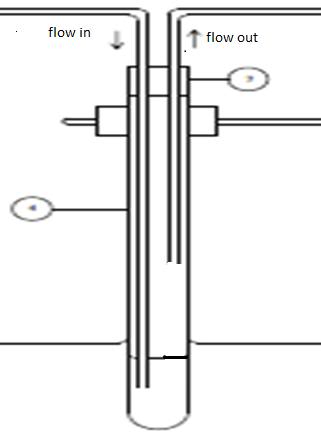
lets say if i have a test tube (diameter 3cm and height 30cm) seal with a rubber. in the test tube there 100ml of water = around 10 cm height. if air was flow into the test tube with flow rate around 20L/min, and after a few sec, the rubber was push out. in general i understand that the pressure inside the test tube is higher than atmospheric pressure. but i can't find any mathematical solution that relate flow rate and pressure to proof that the pressure inside the test tube is higher than outside. can anyone explain it to me.
Untitled1.jpg
 
Last edited:
Physics news on Phys.org
What's that flow out doing there in the diagram?
If air doesn't flow out at the same rate, it's obvious that the pressure inside increases.

If it IS flowing out at the same rate, it may be that the bubbling in the water causes some of the water molecules to come out of the liquid, and increase the pressure over the surface in the test tube
 
I'm not sure the water does much other than resist the flow on the inlet tube. If the tube were to remain sealed, and assuming the outlet tube exits into the atmoshpere, then the outlet tube's resistance to flow is the primary reason pressure inside the tube would be greater than the ambient pressure out side. The pressure on the inlet tube would have to be greater still in order to overcome the resistance in the water so that the air exits the water at the same pressure as the pressure inside the tube.

You could simplify this quite a bit by simply having a long length of pipe with one end connected to a pump and the other end exiting to the atmoshpere. The pressure at the pump end would be higher than the pressure at the exit end.

http://en.wikipedia.org/wiki/Darcy–Weisbach_equation

http://en.wikipedia.org/wiki/Head_loss#Head_loss
 
sorry for the late reply

asdofindia - air was flow to the tube to mix the reactant in the tube then the 'flow out' is for air to flow out to atm and the outside flow rate is around 38 L/min. i just don't know which equation i should use to solve this problem.rcgldr- are you sure the darcy weisbach equation can be applied to this problem? i thought that equation only can be used for liquid. and usually what is the darcy friction factor value of rubber/vinyl tubing?
 
iki08 said:
rcgldr- are you sure the darcy weisbach equation can be applied to this problem?
No, but it may be possible to find "head loss" information for air and certain common types of tubing or pipes. I don't know how much pressure a glass test tube can handle, so if you wanted to measure the pressure on a sealed test tube, I'd recommend getting a stronger tube.
 

Similar threads

  • · Replies 10 ·
Replies
10
Views
2K
  • · Replies 48 ·
2
Replies
48
Views
6K
  • · Replies 9 ·
Replies
9
Views
4K
  • · Replies 160 ·
6
Replies
160
Views
11K
  • · Replies 8 ·
Replies
8
Views
2K
  • · Replies 17 ·
Replies
17
Views
10K
  • · Replies 2 ·
Replies
2
Views
1K
  • · Replies 46 ·
2
Replies
46
Views
5K
  • · Replies 13 ·
Replies
13
Views
21K
  • · Replies 29 ·
Replies
29
Views
5K