Pressure generated by a column of air

Click For Summary
SUMMARY

This discussion centers on the selection of a fan for extracting air from bathrooms and discharging it onto a roof, specifically addressing the impact of a 50-meter vertical air column. Participants conclude that while the fan must overcome gravity, the atmospheric pressure gradient effectively cancels the energy required to push the exhaust air upward. The consensus is that the height of the air column is of secondary importance, and factors such as viscosity and fan specifications should be prioritized in the selection process.

PREREQUISITES
  • Understanding of Bernoulli's principle and its application in fluid dynamics.
  • Familiarity with atmospheric pressure gradients and their effects on airflow.
  • Knowledge of viscosity and its impact on airflow in pipes.
  • Experience with selecting fans based on specifications like diameter and conduit length.
NEXT STEPS
  • Research the application of Bernoulli's equation in real-world scenarios, particularly in HVAC systems.
  • Study the effects of viscosity on airflow, especially in long duct systems.
  • Explore fan selection criteria, including airflow capacity and noise levels for bathroom ventilation.
  • Investigate the principles of buoyancy and how they relate to air movement in ventilation systems.
USEFUL FOR

HVAC engineers, building contractors, and anyone involved in designing effective ventilation systems for residential or commercial spaces.

Emanuel Silva
Messages
5
Reaction score
0
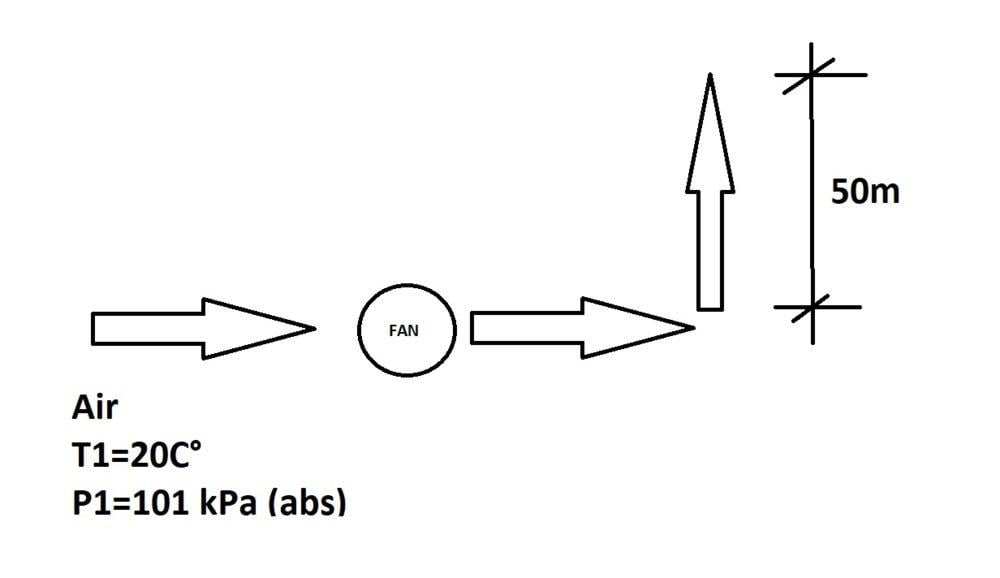
Applying Bernoulli, Does the term ρ*g*h matters ? I am trying to select a fan
FAN.jpg
 
Physics news on Phys.org
I don't really understand what you're trying to do here - could you provide some more details? What do you need the fan to do, and what does the 50m mean in your diagram?
 
Are you trying to push the air 50 meters high or to the left?

You could also reference the Gas Laws.
 
  • Like
Likes   Reactions: Emanuel Silva
cjl said:
I don't really understand what you're trying to do here - could you provide some more details? What do you need the fan to do, and what does the 50m mean in your diagram?

I am trying to extract air from some bathrooms and discharge it on the roof,

I need to select a fan (working point implies a pressure resistance and a flow), I know the flow, but should I consider the column of air in this selection?
 
osilmag said:
Are you trying to push the air 50 meters high or to the left?

You could also reference the Gas Laws.

High, the horizontal trajectory is minimum, It is negligible in this case.

I am trying to extract air from some bathrooms and discharge it on the roof,

I need to select a fan (working point implies a pressure resistance and a flow), I know the flow, but should I consider the column of air in this selection?
 
Emanuel Silva said:
High, the horizontal trajectory is minimum, It is negligible in this case.

I am trying to extract air from some bathrooms and discharge it on the roof,

I need to select a fan (working point implies a pressure resistance and a flow), I know the flow, but should I consider the column of air in this selection?
Short answer is "no". Yes, you have to push the air upward against gravity. But there is also a pressure gradient in the ambient atmosphere, lower pressure up high, higher pressure down low. The pre-existing pressure gradient exactly cancels the energy it would take to force your exhaust air up through the pipe against gravity.

Assuming your exhaust air is the same density as the ambient atmosphere.
 
  • Like
Likes   Reactions: Emanuel Silva, cjl, gmax137 and 1 other person
As jbriggs said, the pressure gradient in your column is matched by the atmosphere, so no you will not need to consider it. However, in a 50m pipe, it's likely that viscosity is not negligible, so you won't just be able to directly use bernoulli here if you need an accurate estimate of the flow that the fan will provide.
 
  • Like
Likes   Reactions: Emanuel Silva and jbriggs444
jbriggs444 said:
Short answer is "no". Yes, you have to push the air upward against gravity. But there is also a pressure gradient in the ambient atmosphere, lower pressure up high, higher pressure down low. The pre-existing pressure gradient exactly cancels the energy it would take to force your exhaust air up through the pipe against gravity.

Assuming your exhaust air is the same density as the ambient atmosphere.
I have searched many books for a mathematical explanation for this, but I have not found it and I always get people who tell me that the air column should be considered. Where could I find a mathematical explanation for this? any particular book? t

Thank you very much, my big question is resolved :)
 
Emanuel Silva said:
Where could I find a mathematical explanation for this? any particular book? t
It goes back to Archimedes and buoyancy. Air is neutrally buoyant in air.

Same as water is neutrally buoyant in water. It takes arbitrarily little pressure to circulate water as long as you are willing to circulate it arbitrarily slowly. The underlying explanation for buoyancy is the variation of pressure with depth. Pascal's principle.

Edit: As @cjl has noted, viscosity will resist flow based on the pipe length even though gravity may not. For laminar flow, for instance, see this link.
 
Last edited:
  • Like
Likes   Reactions: Emanuel Silva
  • #10
Emanuel Silva said:
I always get people who tell me that the air column should be considered.
It's easy to find 'people' who have no idea about Physics yet who have all sorts of funny notions. If you read what's in this thread, you'll see plenty of reasons why the height of the column is of secondary importance. You can take that as good information because they're Physicists and Engineers etc.
However, thinking along the lines of a chimney flue, which works by convection ( warm air floating up and out of the top). The motive power for this is very low and it is not uncommon for a cold flue to refuse to 'draw' when you try to get a fire going. A lot of cold air in the upper parts of the flue can actually sit on the warm air at the bottom and resist convection. So a vertical column can affect things in some circumstances. BUT you are planning to use a fan, which will fill the column with 'bathroom air'. That air will have high humidity and humid air is less dense than dry air (something contrary to what 'people' tend to think). So the vertical column may even help you by encouraging convection.
If you want to decide on what fan to use, all the good ones tell you the diameter and recommend a maximum suitable length of conduit, number of bends etc..
Do not try to do this job with a small noisy fan. Good hotels and suchlike manage to have silent fans in bathrooms which keep the room dry and quiet.
 
  • Like
Likes   Reactions: Emanuel Silva, vanhees71 and gmax137
  • #11
If you are going to use Bernoulli, even with a viscous term included, you need to include the gravitational (potential energy) term. However, it may not be too important.
 
  • #12
Chestermiller said:
If you are going to use Bernoulli, even with a viscous term included, you need to include the gravitational (potential energy) term.
I don't "disbelieve you" but doesn't the Potential Energy of the falling air outside cancel that out? You are normally pretty good on fluids so I hesitated to ask.
 
  • #13
sophiecentaur said:
I don't "disbelieve you" but doesn't the Potential Energy of the falling air outside cancel that out? You are normally pretty good on fluids so I hesitated to ask.
I don't understand your term "falling air outside." My understanding is that the air outside the pipe is static. So there is a gravitation induced gradient of pressure in the outside air. This will turn out to just cancel the gravitation potential energy term in the Bernoulli equation for the air inside the pipe. But, in applying the Bernoulli equation to the air inside the pipe, the gravitational potential energy term should be included, and then be canceled with the outside air term later. It is true that, if the gravitation contribution to the pressure is neglected in both the air inside the pipe and the air outside, the final answer will come out correct.
 
Last edited:
  • Like
Likes   Reactions: gmax137
  • #14
Chestermiller said:
I don't understand your term "falling air outside."
Edit: "What goes up must come down", as they say.
PE gained inside equals PE lost on the outside - is all. And your post agrees with that.
 
Last edited:
  • Like
Likes   Reactions: Emanuel Silva
  • #15
Chestermiller said:
If you are going to use Bernoulli, even with a viscous term included, you need to include the gravitational (potential energy) term. However, it may not be too important.
No, they can neglect it in this case.
 
  • #16
50m?
Is this a 17-storey building??
 
  • #17
cjl said:
No, they can neglect it in this case.
See my post #13
 

Similar threads

  • · Replies 14 ·
Replies
14
Views
6K
  • · Replies 3 ·
Replies
3
Views
2K
  • · Replies 10 ·
Replies
10
Views
2K
  • · Replies 8 ·
Replies
8
Views
876
  • · Replies 8 ·
Replies
8
Views
3K
  • · Replies 9 ·
Replies
9
Views
4K
  • · Replies 14 ·
Replies
14
Views
2K
  • · Replies 7 ·
Replies
7
Views
2K
  • · Replies 10 ·
Replies
10
Views
4K
Replies
1
Views
2K