Pressure loss to double wall pipe (ventilation)

Click For Summary

Discussion Overview

The discussion revolves around calculating the pressure drop in a double wall pipe system used for air ventilation. Participants seek to understand the factors contributing to pressure loss, including the effects of straight sections, elbows, and supports within the pipe system.

Discussion Character

  • Technical explanation
  • Mathematical reasoning
  • Debate/contested

Main Points Raised

  • One participant outlines the parameters of the double wall pipe system, including dimensions, airflow capacity, and the number of elbows and supports.
  • Another participant asks for clarification on whether the pressure drop pertains to air or water.
  • Several participants express uncertainty about the calculation methods and seek specific mathematical formulas for pressure drop calculations.
  • A participant shares a calculation draft but expresses doubt about its accuracy, prompting feedback from others.
  • Discrepancies in Reynolds number calculations between a participant's results and an online calculator are highlighted, with one participant noting a potential error in viscosity used by the calculator.
  • Another participant suggests that the pressure drop across the support rings may be negligible compared to the total pressure drop.
  • A simple CFD analysis is mentioned, indicating a low pressure drop per support plate.

Areas of Agreement / Disagreement

Participants express varying levels of confidence in their calculations and methods, with some seeking clarification and others providing feedback. There is no consensus on the best approach to calculate the pressure drop, and discrepancies in results remain unresolved.

Contextual Notes

Participants mention specific assumptions regarding fluid properties and flow conditions, but these assumptions are not universally agreed upon. The discussion includes references to external resources and tools, which may have varying applicability based on the context of the problem.

longz
Messages
11
Reaction score
0
Hi every body,

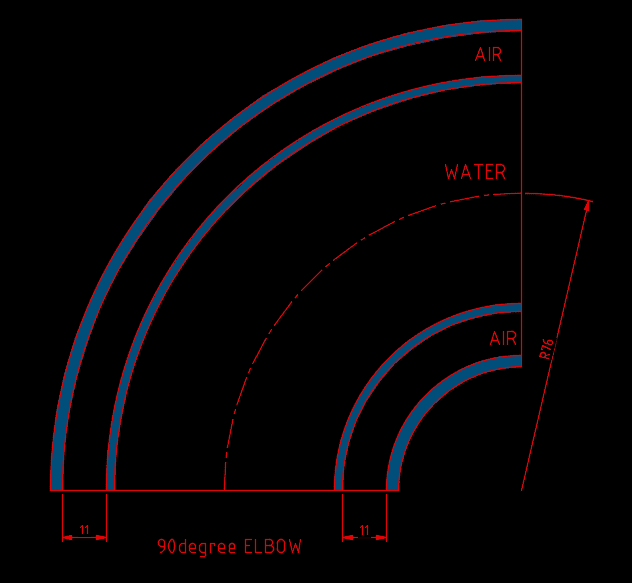
I need help to calculate the pressure drop to double wall pipe with information as below, i understand need calculate pressure loss to the straight pipe, elbows and supports but I don't know exactly how.

- Fluid : air
- Double wall pipe (stainless steel) with outer pipe OD89mm, wall thickness 3mm, inner pipe OD61mm, wall thickness 2mm. the air will blow into the void between inner and outer pipe
- Pipe distance : 7m.
- Number of 90 degree elbow : 7 pcs
- Number of plastic support to inner pipe : 9 pcs
- Air flow capacity 28 m3/h equivalent 7.8 L/s.

Some drawing for clear view:
1. Double wall pipe section
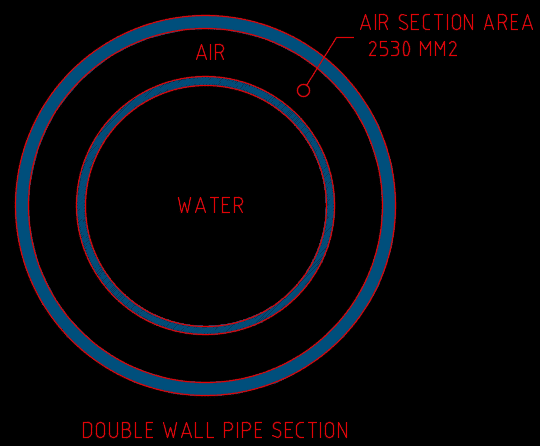
upload_2017-10-20_8-23-29.png


2. Double wall pipe section with support, the support is obstruction to the air flow similar to orifice.
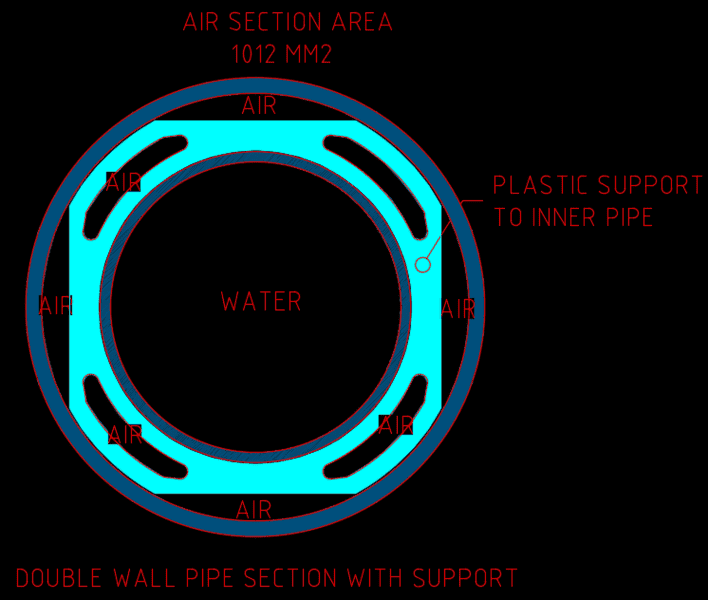
upload_2017-10-20_8-40-37.png


3. Elbow
upload_2017-10-20_8-55-24.png


Thank every body.
 

Attachments

  • upload_2017-10-20_7-51-58.png
    upload_2017-10-20_7-51-58.png
    7.4 KB · Views: 720
  • upload_2017-10-20_8-23-29.png
    upload_2017-10-20_8-23-29.png
    11.4 KB · Views: 932
  • upload_2017-10-20_8-36-59.png
    upload_2017-10-20_8-36-59.png
    22 KB · Views: 765
  • upload_2017-10-20_8-40-37.png
    upload_2017-10-20_8-40-37.png
    24.3 KB · Views: 1,134
  • upload_2017-10-20_8-55-24.png
    upload_2017-10-20_8-55-24.png
    10.5 KB · Views: 1,098
Engineering news on Phys.org
Which are you trying to determine, the pressure of the water or the pressure of the air?
 
Hi Chestermiller,

I need to determine the pressure drop to the air.

Thank
 
longz said:
Hi Chestermiller,

I need to determine the pressure drop to the air.

Thank
If the air were flowing through a circular pipe, would you know how to get its pressure drop? If so, please describe.
 
I have no idea, can you provide some instructions ?

thank
 
longz said:
I have no idea, can you provide some instructions ?

thank
See chapter 7 of Transport Phenomena by Bird, Stewart, and Lightfoot.
 
I really sorry as I can't get this book, can you advise the specific mathematic formula ?
 
Hi Chestermiller,

I made a study and draft a calculation to pressure drop but I not sure it is correct 100% or not, can you please have a check and correct me if i was wrong something.

thank
 

Attachments

longz said:
Hi Chestermiller,

I made a study and draft a calculation to pressure drop but I not sure it is correct 100% or not, can you please have a check and correct me if i was wrong something.

thank
I didn't check your arithmetic, but I can tell you that you have done this exactly the way I would have done it. Very nice work. Kudos!

Chet
 
  • #10
Hi Chestermiller,

I found a online calculator exactly same to this matter but the result is quite different in Reynold number (509853 versus with 4988 as mine calc.) caused me confusing, can you please have a look and advise the reason? below is the link of software and information input/output.

http://www.pressure-drop.com/Online-Calculator/index.html

Input calculation

upload_2017-10-29_12-4-51.png


Output calculation

upload_2017-10-29_12-5-25.png
 

Attachments

  • upload_2017-10-29_12-3-28.png
    upload_2017-10-29_12-3-28.png
    20.4 KB · Views: 740
  • upload_2017-10-29_12-4-51.png
    upload_2017-10-29_12-4-51.png
    19.7 KB · Views: 1,136
  • upload_2017-10-29_12-5-25.png
    upload_2017-10-29_12-5-25.png
    11 KB · Views: 1,177
  • #11
longz said:
Hi Chestermiller,

I found a online calculator exactly same to this matter but the result is quite different in Reynold number (509853 versus with 4988 as mine calc.) caused me confusing, can you please have a look and advise the reason? below is the link of software and information input/output.

http://www.pressure-drop.com/Online-Calculator/index.html

Input calculation

View attachment 213951

Output calculation

View attachment 213952
In their calculation output, the viscosity used looks too low by a factor of 100.
 
  • #12
Hi Chestermiller,

Thank for advices, you are correct. I changed the value of the viscosity and the software output similar to mine calc.

To pressure drop of inner pipe support ring, could you please advise some instructions ? I considering this is multi-hole orifices plate but the point is the holes is not same and have multi plates on the pipe route. I don't know how to start the calculation.
 
  • #13
longz said:
Hi Chestermiller,

Thank for advices, you are correct. I changed the value of the viscosity and the software output similar to mine calc.

To pressure drop of inner pipe support ring, could you please advise some instructions ? I considering this is multi-hole orifices plate but the point is the holes is not same and have multi plates on the pipe route. I don't know how to start the calculation.
In a case like this, you have to use your best judgment as to whether the multi-hole is adequate. Compared to the total pressure drop, how much does the pressure drop across the plate matter?
 
  • #14
Laminar iso 1.png


Simple CFD analysis using the default laminar flow model in OpenFoam .

5 m/sec uniform air velocity at inlet . Zero pressure (gauge) at outlet . Air flows from left to right .

So roughly 110 Pa pressure drop per support plate . Almost nothing really and certainly negligible .
laminar-ortho.png

pipe an support v4.png
 

Attachments

  • Laminar iso 1.png
    Laminar iso 1.png
    29.6 KB · Views: 692
  • laminar-ortho.png
    laminar-ortho.png
    22.3 KB · Views: 658
  • pipe an support v4.png
    pipe an support v4.png
    7.3 KB · Views: 621
  • Like
Likes   Reactions: Chestermiller

Similar threads

  • · Replies 15 ·
Replies
15
Views
4K
Replies
8
Views
2K
  • · Replies 8 ·
Replies
8
Views
3K
Replies
13
Views
4K
  • · Replies 20 ·
Replies
20
Views
11K
  • · Replies 10 ·
Replies
10
Views
5K
Replies
6
Views
4K
  • · Replies 5 ·
Replies
5
Views
4K
  • · Replies 1 ·
Replies
1
Views
6K
  • · Replies 3 ·
Replies
3
Views
17K