Problem in integrating to find Rutherford's formula

Click For Summary
SUMMARY

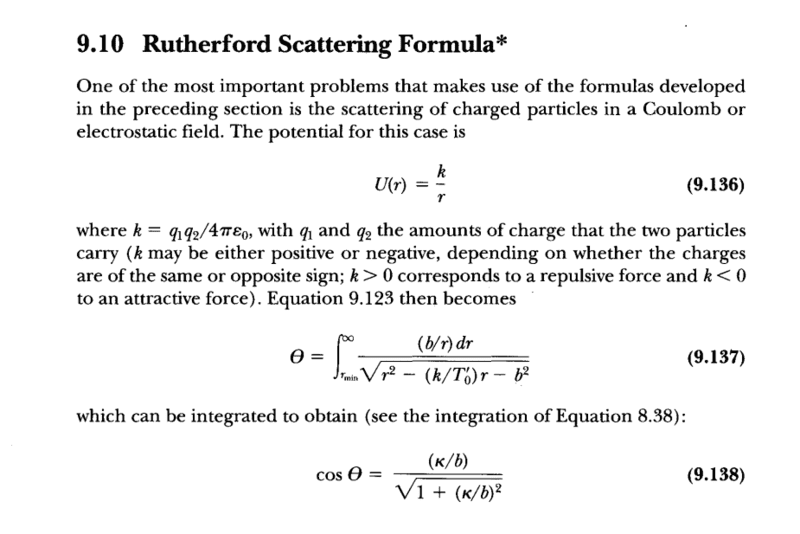
The discussion focuses on the change of variable used to derive equation 9.138 from equation 9.137 in the book "Classical Dynamics of Particles and Systems" (5th Edition) by Stephen T. Thornton and Jerry B. Marion. The participants highlight the use of the substitution \( u = 1/r \) and its derivative \( du = -dr/r^2 \) as a method to simplify the equations. The challenge arises from the presence of \( 1/r \) in the numerator, complicating the integration process. The conversation concludes with a participant expressing gratitude for the insight and a commitment to retry the problem.

PREREQUISITES
  • Understanding of classical mechanics concepts, particularly dynamics.
  • Familiarity with calculus, specifically integration techniques.
  • Knowledge of variable substitution methods in mathematical equations.
  • Access to "Classical Dynamics of Particles and Systems" 5th Edition for reference.
NEXT STEPS
  • Review the derivation of equations in "Classical Dynamics of Particles and Systems" to understand variable substitutions.
  • Practice integration techniques involving variable changes, focusing on substitutions like \( u = 1/r \).
  • Examine equation 8.38 in the same textbook for insights on similar variable transformations.
  • Explore additional resources on classical dynamics to reinforce understanding of the subject matter.
USEFUL FOR

This discussion is beneficial for students and educators in physics, particularly those studying classical mechanics and seeking clarity on integration techniques and variable substitutions in dynamic systems.

MatinSAR
Messages
673
Reaction score
204
Homework Statement
Figure below.
Relevant Equations
Figure below.
Could someone guide me on what change of variable was used to obtain equation 9.138 from equation 9.137?
1714250757096.png

Book : Classical Dynamics of Particles and Systems 5th Edition by Stephen T. Thornton (Author), Jerry B. Marion (Author)

They told us to check equation 8.38 and in that page they had ##1/r^2## in the numerator so they used ##u=1/r## then they get ##du=-dr/r^2##.
But I cannot use that here because I have ##1/r## in the numerator ...
 
Physics news on Phys.org
If you take ##r## out from the square root in the denominator you get ##1/r^2## in the numerator.
 
  • Like
Likes   Reactions: MatinSAR
Hill said:
If you take ##r## out from the square root in the denominator you get ##1/r^2## in the numerator.
I was oblivious. Thanks for your clever idea! I will retry to solve.
 

Similar threads

  • · Replies 3 ·
Replies
3
Views
2K
Replies
5
Views
2K
Replies
3
Views
2K
Replies
1
Views
2K
Replies
2
Views
1K
  • · Replies 3 ·
Replies
3
Views
2K
  • · Replies 6 ·
Replies
6
Views
2K
Replies
5
Views
2K
  • · Replies 2 ·
Replies
2
Views
2K
Replies
9
Views
2K