Problem with a double integral

Click For Summary
The discussion centers on evaluating a double integral using polar coordinates, specifically for the region defined by the equation (x − 1)^2 + y^2 ≤ 1 and 0 ≤ y ≤ x. The user initially divided the region into two parts but questioned if a single region could suffice, given the polar representation r=2cos(θ) with θ ranging from 0 to π/4. Responses confirm that using one region is valid, and the user successfully verifies their approach by calculating the integral. A miscalculation in the final result is acknowledged, leading to a corrected answer of (3π/4) + 1.
Amaelle
Messages
309
Reaction score
54
Homework Statement
Compute the integral (3x dx dy), where the region of equation is : (x − 1)^2 + y^2 ≤ 1, 0 ≤ y ≤ x
Relevant Equations
0<=r<=2cos(θ),
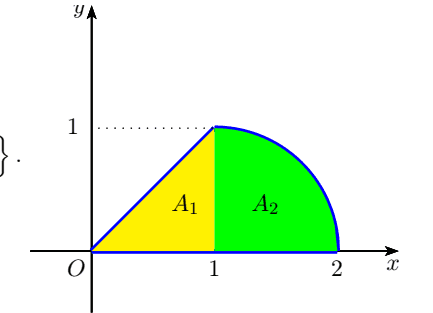
I already have the solution in which the region of integration has been divided into two regions
1597153537239.png

but I was wondering if I can only use one region considering the polar coordinate system) the disk equation for me is r=2cos(θ) and the theta goes from 0 to (pi/4)

0<r<2cos(θ) and the 0 <θ<pi/4
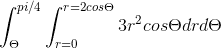
the total integral becomes
D3%20r%5E%7B2%7B%7D%7Dcos%5CTheta%20dr%20d%5CTheta.gif


is my approach is correct?

Thanks a lot in advance!
 
Physics news on Phys.org
Amaelle said:
Homework Statement:: Compute the integral (3x dx dy), where the region of equation is : (x − 1)^2 + y^2 ≤ 1, 0 ≤ y ≤ x
Relevant Equations:: 0<=r<=2cos(θ),

I already have the solution in which the region of integration has been divided into two regions View attachment 267622
but I was wondering if I can only use one region considering the polar coordinate system) the disk equation for me is r=2cos(θ) and the theta goes from 0 to (pi/4)

0<r<2cos(θ) and the 0 <θ<pi/4
the total integral becomes
View attachment 267623

is my approach is correct?

Thanks a lot in advance!
I don't see why it wouldn't work. See if you get the same answer with both approaches. If you do, that would confirm that your approach is correct, and would also be good practice for converting integrals from Cartesian (rectangular) form to polar form.
 
  • Like
Likes Amaelle
Thanks a lot for your prompt answer, the problem is that I couldn't find the same
Mark44 said:
I don't see why it wouldn't work. See if you get the same answer with both approaches. If you do, that would confirm that your approach is correct, and would also be good practice for converting integrals from Cartesian (rectangular) form to polar form.
Thanks a lot , i did it and it works!
 
etotheipi said:
You can do it even without a double integral. You just need to evaluate ##\frac{1}{2}\int (2\cos{\theta})^2 d\theta##$$A = \frac{1}{2} \int_0^{\frac{\pi}{4}} 4\cos^2{\theta} \, d\theta = 2\int_0^{\frac{\pi}{4}} \frac{1}{2} + \frac{1}{2}\cos{2\theta} \, d\theta = \left[ \theta +\frac{1}{2}\sin{2\theta} \right]_0^{\frac{\pi}{4}} = \frac{\pi}{4} + \frac{1}{2}$$
thanks a lot but i think you did a miscalculation the final answer is (3pi/4)+1
 
  • Like
Likes etotheipi
Amaelle said:
thanks a lot but i think you did a miscalculation the final answer is (3pi/4)+1

Whoops... you're right! I thought you just wanted the area :doh:
 
Question: A clock's minute hand has length 4 and its hour hand has length 3. What is the distance between the tips at the moment when it is increasing most rapidly?(Putnam Exam Question) Answer: Making assumption that both the hands moves at constant angular velocities, the answer is ## \sqrt{7} .## But don't you think this assumption is somewhat doubtful and wrong?

Similar threads

  • · Replies 19 ·
Replies
19
Views
2K
Replies
3
Views
2K
Replies
4
Views
1K
  • · Replies 2 ·
Replies
2
Views
1K
  • · Replies 9 ·
Replies
9
Views
1K
  • · Replies 11 ·
Replies
11
Views
4K
  • · Replies 7 ·
Replies
7
Views
2K
Replies
25
Views
2K
  • · Replies 2 ·
Replies
2
Views
2K
  • · Replies 17 ·
Replies
17
Views
4K