Problem with series convergence — Taylor expansion of exponential

Click For Summary
SUMMARY

The discussion focuses on the convergence of series in the context of the Taylor expansion of the exponential function. It clarifies that as \( n \) approaches infinity, \( n^7 \) is little o of \( 2^{n/2} \) due to the dominance of exponential functions over polynomial functions. The proof provided demonstrates that the logarithm of the ratio \( \frac{n^k}{b^n} \) approaches negative infinity, confirming that \( n^k \) becomes negligible compared to \( b^n \) as \( n \) increases. This establishes that exponential growth outpaces polynomial growth in limits.

PREREQUISITES
  • Understanding of Taylor series and expansions
  • Familiarity with asymptotic notation, specifically little o notation
  • Basic knowledge of logarithmic functions and their properties
  • Concept of limits in calculus
NEXT STEPS
  • Study the properties of Taylor series, particularly for exponential functions
  • Learn about asymptotic analysis and its applications in algorithm complexity
  • Explore the relationship between polynomial and exponential functions in calculus
  • Investigate the concept of limits and their proofs in mathematical analysis
USEFUL FOR

Mathematicians, students studying calculus or analysis, and anyone interested in understanding the behavior of functions as they approach infinity.

Amaelle
Messages
309
Reaction score
54
Homework Statement
problem with serie convergence (look at the image)
Relevant Equations
taylor serie expnasion, absolute convergence, racine test
Good day
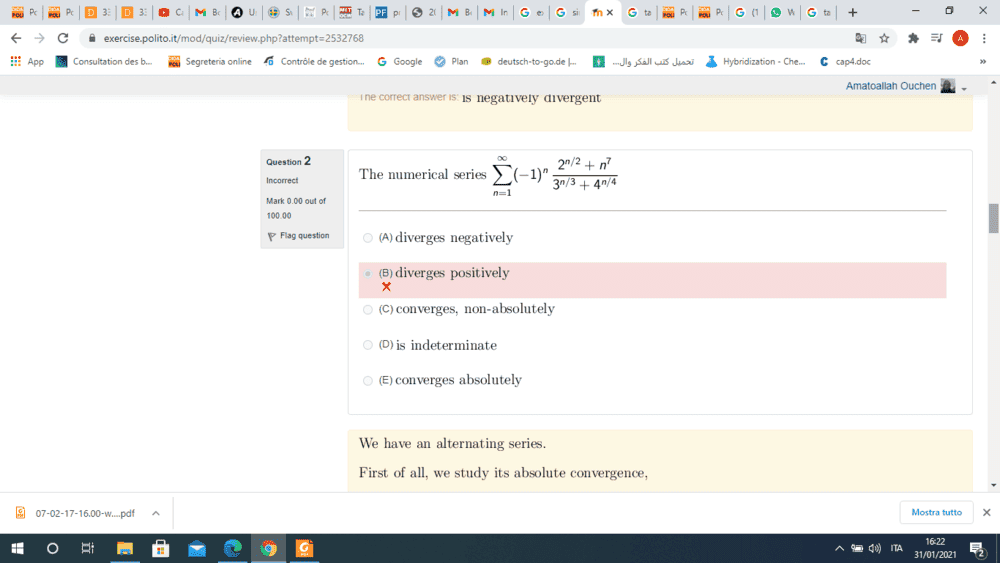
1612106724444.png


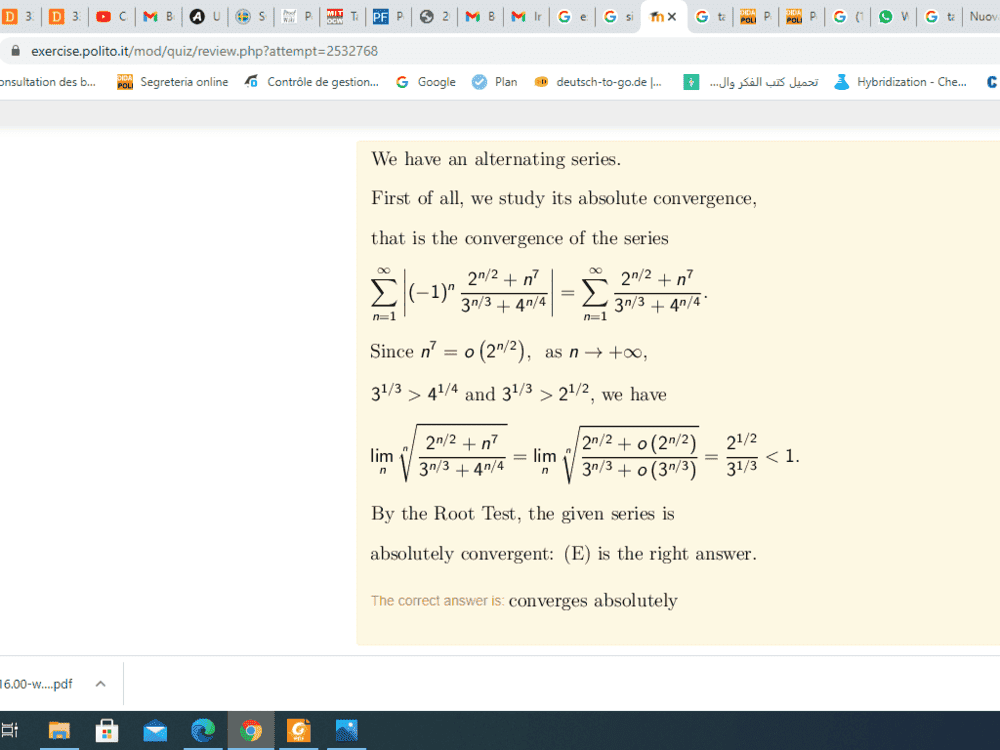
and here is the solution, I have questions about
1612107099220.png


I don't understand why when in the taylor expansion of exponential when x goes to infinity x^7 is little o of x ? I could undesrtand if -1<x<1 but not if x tends to infinity?
many thanks in advance!
 

Attachments

  • 1612106657426.png
    1612106657426.png
    29.7 KB · Views: 193
Last edited by a moderator:
Physics news on Phys.org
##n^7\neq o(n)##. I assume you meant the part where it says ##n^7=o(2^{n/2})##. Since ##\sqrt{2}>1##, ##2^{n/2}## dominates any power function as ##n\rightarrow\infty##.
 
Exactely, I would be extremely grateful if you could elaborate more about this point!
 
Sure. I assume you don’t understand why exponentials dominate power functions? Here is a simple proof: $$\log\frac{n^k}{b^n}=k\log(n)-n\log(b)$$ which tends to ##-\infty## as ##n\rightarrow\infty##, provided that ##\log(b)>0##. Thus, taking the exponential of both sides shows that $$\lim_{n\rightarrow\infty}\frac{n^k}{b^n}=\lim_{n\rightarrow\infty}e^{k\log(n)-n\log(b)}=0.$$
 
thanks a million! you nail it!
 
Question: A clock's minute hand has length 4 and its hour hand has length 3. What is the distance between the tips at the moment when it is increasing most rapidly?(Putnam Exam Question) Answer: Making assumption that both the hands moves at constant angular velocities, the answer is ## \sqrt{7} .## But don't you think this assumption is somewhat doubtful and wrong?

Similar threads

  • · Replies 2 ·
Replies
2
Views
2K
  • · Replies 6 ·
Replies
6
Views
2K
  • · Replies 1 ·
Replies
1
Views
2K
  • · Replies 10 ·
Replies
10
Views
4K
  • · Replies 5 ·
Replies
5
Views
3K
  • · Replies 10 ·
Replies
10
Views
2K
  • · Replies 1 ·
Replies
1
Views
2K
Replies
2
Views
3K
  • · Replies 4 ·
Replies
4
Views
1K
  • · Replies 5 ·
Replies
5
Views
2K