Projectile Motion: Deriving an Expression for g

Click For Summary

Homework Help Overview

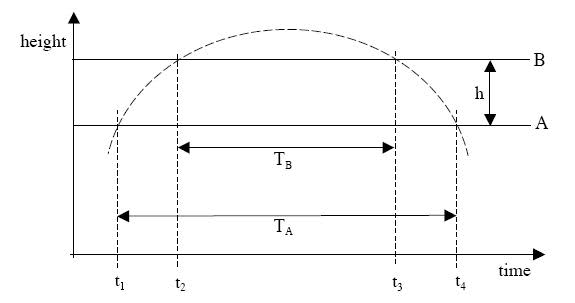
The discussion revolves around deriving an expression for the acceleration due to gravity (g) using projectile motion. The original poster describes a scenario where a projectile is fired upward, and the time taken to pass two horizontal lines (A and B) is measured in both directions. The goal is to express g in terms of height (h) and the times (TA and TB).

Discussion Character

  • Exploratory, Conceptual clarification, Mathematical reasoning

Approaches and Questions Raised

  • Participants discuss the need for standard kinematics equations related to constant acceleration and how to apply them to the problem. Some express uncertainty about how to relate the times and velocities involved in the motion. Others question the definitions of variables used in the equations.

Discussion Status

There is an ongoing exploration of different approaches to the problem, with participants sharing their attempts and seeking clarification on the relationships between variables. Some guidance has been offered regarding the use of kinematic equations, but no consensus has been reached on a specific method or solution.

Contextual Notes

Participants note the importance of understanding the graph and the implications of the projectile's motion, as well as the need to make assumptions about the initial conditions and the nature of the acceleration.

GSV
Messages
2
Reaction score
0
Projectile Motion! Please Help!

Homework Statement


The acceleration due to gravity can be measured by firing a projectile upward and
measuring the time it takes to pass two given points in both directions. The figure below
is a plot of height versus time and shows that the time the projectile takes to pass a
horizontal line A in both directions is TA, and the time it takes to pass a horizontal line B
in both directions is TB. Derive an expression for g, the acceleration due to gravity. Your
expression should involve only h, TA, and TB. State any assumptions you make.
4sb31k.jpg


The Attempt at a Solution


Dont even know where or how to start! Please Help! thanks
 
Physics news on Phys.org
this is a constant acceleration problem.
need standard kinematics equations for constant accelerations
relate relevant variables based on the plot (ie. what you know) and then solve those resultant simultaneous equations
 
mjsd said:
this is a constant acceleration problem.
need standard kinematics equations for constant accelerations
relate relevant variables based on the plot (ie. what you know) and then solve those resultant simultaneous equations

Could you guide me through them!
I tried but i couldn't make it to work.
 
first, learn the equations (if not the derivation of them as well)

http://www.ac.wwu.edu/~vawter/PhysicsNet/Topics/Kinematics/ConstantAccEqMotion.html

and understand how to interpret graphs

http://www.ac.wwu.edu/~vawter/PhysicsNet/Topics/Kinematics/SpaceTime.html
 
Last edited by a moderator:


I'm working this problem right now. Where do you start? I mean do you go from when it passes A the first time to when it passes A the second time, similiarly with B? Do you go from ground to A, to A to B, to B to B again on the way down, to B to the ground?

If you measure from A to A and B to B I get:

0=(V1)*(Ta)-.5*g*(Ta)^2
and
0=(V2)*(Tb)-.5*g*(Tb)^2

But how are you supposed to related them? And How do you get rid of the V's?

If I do it the second Way I get times that arn't right like (t1-t2). :confused:


What are you defining V1 and V2 as?


I'm Defining V1 as the velocity of the object as it passes the A line, and V2 as the velocity as the object passes the B line. Is this correct?


Ok, can someone at least tell me how they would start this freaking problem?


If u is the velocity of projection, at t1 the velocity will be
vA = u - g*t1. ...(1)
At t4 the velocity will be
v2 = -vA = u - g*t4...(2). From equ. 1 and 2 we get
2vA = g*(t2 - t1 ) or vA = g/2*(t4 - t1) ...(3)
Similarly vB = g/2*( t3 - t2)...(4)
Now use the vB^2 - vA^2 = 2g*h find g.
 

Similar threads

  • · Replies 3 ·
Replies
3
Views
4K
  • · Replies 15 ·
Replies
15
Views
27K
  • · Replies 1 ·
Replies
1
Views
3K
Replies
30
Views
2K
  • · Replies 1 ·
Replies
1
Views
2K
  • · Replies 18 ·
Replies
18
Views
5K
Replies
8
Views
3K
  • · Replies 4 ·
Replies
4
Views
3K
  • · Replies 3 ·
Replies
3
Views
3K
  • · Replies 35 ·
2
Replies
35
Views
5K