Proof of a formula with two geometric random variables

Click For Summary
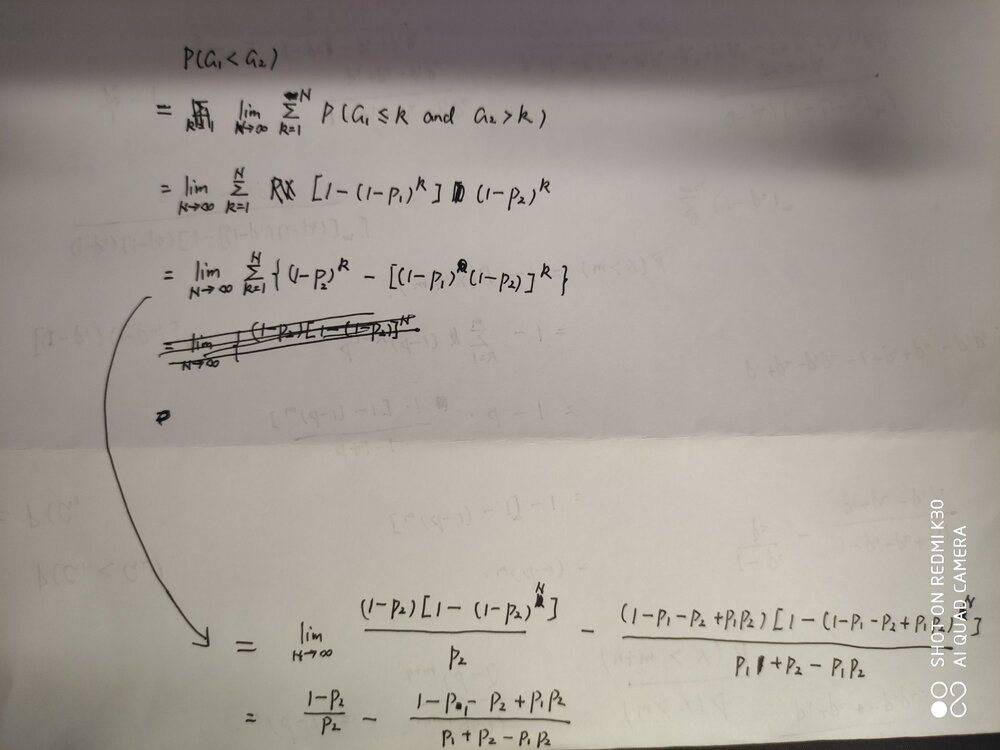
The discussion focuses on proving a formula involving two geometric random variables. The initial attempt at the solution is criticized for multiple-counting cases. The correct approach is to sum the cases where G_1 equals k, rather than where G_1 is less than or equal to k. This clarification is essential for accurately solving the problem. The emphasis is on correcting the method to avoid errors in counting.
Armine
Messages
2
Reaction score
0
Homework Statement
If G_1 and G_2 are independent geometric random variables with parameters p_1 and p_2 respectively, show that
Relevant Equations
P(G_1<G_2)=p_1(1-p_2)/(p_1+p_2-p_1p_2)
The image above is the problem and the image below is the solution I have tried but failed.

MVIMG_20210209_102231_recompress.jpg
1612521305080_recompress.jpg
 
Physics news on Phys.org
You first equation is multiple-counting many cases. You should sum the cases where ##G_1 = k##, not ##G_1 \le k##
 
FactChecker said:
You first equation is multiple-counting many cases. You should sum the cases where ##G_1 = k##, not ##G_1 \le k##
Get it, thank you very much!
 
Question: A clock's minute hand has length 4 and its hour hand has length 3. What is the distance between the tips at the moment when it is increasing most rapidly?(Putnam Exam Question) Answer: Making assumption that both the hands moves at constant angular velocities, the answer is ## \sqrt{7} .## But don't you think this assumption is somewhat doubtful and wrong?

Similar threads

  • · Replies 2 ·
Replies
2
Views
1K
  • · Replies 1 ·
Replies
1
Views
1K
  • · Replies 4 ·
Replies
4
Views
3K
Replies
5
Views
1K
Replies
2
Views
2K
Replies
7
Views
2K
Replies
2
Views
1K
  • · Replies 2 ·
Replies
2
Views
2K
  • · Replies 2 ·
Replies
2
Views
2K
  • · Replies 1 ·
Replies
1
Views
2K